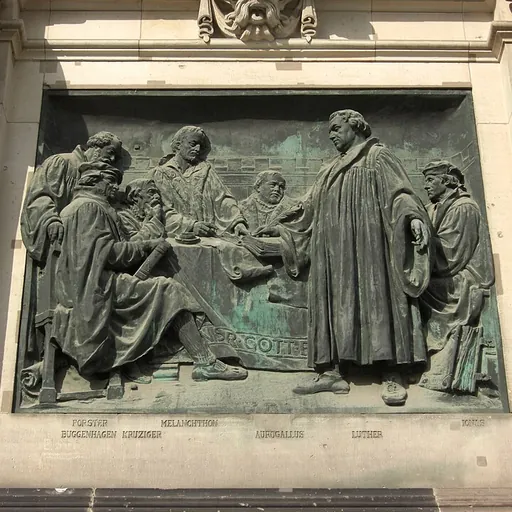
Matthäus Aurogallus
German hebraist and historian (ca 1490-1543)
About Matthäus Aurogallus
Lived 1490 – 1543 (aged 52–53). Matthäus Aurogallus was a grammarian, historian of religion, historian, university teacher, theologian and classical philologist.
Matthäus Aurogallus (1490 – 10 November 1543), born as Matthäus Goldhahn (he latinized his name Aurogallus in the fashion of renaissance humanists), was a Bohemian linguist. Aurogallus served as professor of Hebrew at the University of Wittenberg and was a colleague of Philip Melanchthon and Martin Luther. He assisted Luther in the revision of the reformer's translation of the Old Testament and made valuable contributions to the academic study of Hebrew.
Early life and education Matthäus Aurogallus was born in Chomutov in northeastern Bohemia, where also began his education at nearby humanist school founded by Czech nobleman and writer Bohuslav Hasištejnský z Lobkovic in his family home, Hasištejn Castle. before returning to Komotau to teach Latin at his former school.
Wittenberg and Luther In 1519 Aurogallus left his position and moved to Wittenberg, where he began a friendly relationship with Philip Melanchthon. Two years later, at the recommendation of Melanchthon and Luther, Aurogallus also joined Wittenberg’s faculty as professor of Hebrew, replacing Matthäus Adrian, who – although he had been recommended for the position by Luther several years earlier – was removed from the post after his vocal opposition to Luther’s religious reforms.
At the time, Wittenburg – under Luther's leadership – was the epicentre of the Protestant Reformation, and Aurogallus was drawn into the movement at least peripherally as a scholar of Hebrew. Aurogallus acted as an adviser to Martin Luther on Hebrew translation while the latter was composing his translation of the Old Testament.
On 1 May 1542 Aurogallus attained the prestigious position of rector of the University of Wittenberg.
Works Compendium Hebreae Chaldeaequae grammatices (Compendium of Hebrew and Chaldaic Grammar) (1523–25, 1531 Wittenberg) De Hebraeis, urbium, regionum, populorum, fluminum, montium, & aliorulocorum, nominibus (1526 Wittenberg, 1539 & 1543 Basel) Chronik der Herzöge uund Könige von Böhmen (Chronicle of the Dukes and Kings of Bohemia (lost) Hebräisch historisch-geographisches Reallexicon (Hebrew historical-geographic lexicon) (1526–1539)
Don’t just read it —
keep it.
Full-length biographies made to live with: read them, listen on the way to work, watch them tonight.
- E-book
- Audio
- Video
Instant download · yours to keep · every purchase keeps this site free
Important facts
People in Matthäus Aurogallus's life
Named in this biography and alive at the same time
Related people
Same field, nearest in time




Contemporaries
People whose lives overlapped Matthäus Aurogallus's





Frequently asked questions
Who was Matthäus Aurogallus?
German hebraist and historian (ca 1490-1543)
When was Matthäus Aurogallus born?
Matthäus Aurogallus was born in 1490 in Michanice, Chomutov.
When did Matthäus Aurogallus die?
Matthäus Aurogallus died on 10 November 1543 in Lutherstadt Wittenberg.
What was Matthäus Aurogallus's occupation?
Matthäus Aurogallus was a grammarian, historian of religion, historian, university teacher, theologian and classical philologist.
What nationality was Matthäus Aurogallus?
Matthäus Aurogallus's recorded nationality: Duchy of Saxe-Weimar, German Bohemian.
Sources & further reading
· Wikipedia: Matthäus Aurogallus
· DBpedia: Matthäus Aurogallus
Cite this page
APA: Biography.guide. (2026). Matthäus Aurogallus. https://biography.guide/matthaus-aurogallus/
MLA: "Matthäus Aurogallus." Biography.guide, https://biography.guide/matthaus-aurogallus/.
Chicago: "Matthäus Aurogallus." Biography.guide. https://biography.guide/matthaus-aurogallus/.
Data last updated: 2026-09-21 · Spot an error? Report a correction.
Portrait: Wikimedia Commons · author & licence
Page generated 2026-09-27 04:59 UTC