Matrakçı Nasuh
Bosnian Ottoman polymath (1480 – c. 1564)
About Matrakçı Nasuh
Lived 1480 – 1564 (aged 83–84). Matrakçı Nasuh was a Turkish mathematician, geographer, architect, farmer, writer and painter.
Nasuh bin Karagöz bin Abdullah el-Visokavi el-Bosnavî, commonly known as Matrakçı Nasuh (; ) for his competence in the combat sport of Matrak which was invented by himself, (also known as Nasuh el-Silâhî, Nasuh the Swordsman, because of his talent with weapons; 1480 – 1564) was a 16th-century Ottoman Bosnian statesman of the Ottoman Empire, polymath, mathematician, philosopher, teacher, historian, geographer, cartographer, swordmaster, navigator, inventor, painter, farmer, and miniaturist.
He was brought to Constantinople after being recruited by Ottoman scouts in Rumelia. He was then educated, served several Ottoman sultans, and became a teacher at Enderun School.
Life Siege of Nice (1543) by Matrakçı NasuhMatrakçı Nasuh, born in the Bosnian town of Visoko, was a Janissary who went through both the infantry and the devşirme system. He was a swordsman and sharpshooter who spoke five languages and was recruited into the Ottoman Navy.
Although born to Bosnian Muslim parentage, Nasuh was drafted into the devşirme system, usually reserved for the Christian populace of the empire. Exceptionally, however, in Bosnia, the devşirme was also extended to local Muslim families.
After a long period of studying mathematics and geometry, he wrote his works Cemâlü'l-Küttâb and Kemalü'l- Hisâb and submitted them to the Ottoman sultan Selim I. He wrote also the two books named Mecmaü't-Tevârih and Süleymannâme, on history from 1520 to 1543. He also wrote a historical piece on the Persian campaign of Suleiman I titled Fetihname-i Karabuğdan. A recent study of his book Umdet-ul Hisab found that Matrakçı had invented some multiplication methods and that the lattice method had been widely used in the Enderun School nearly 50 years before John Napier reintroduced it to Europe. thumb
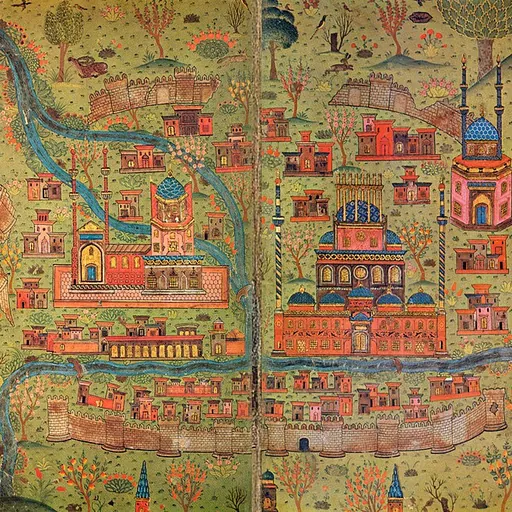
Besides his works on mathematics and history, he painted miniatures which focus on panoramic views of landscapes and cities painted with the greatest detail (his Constantinople landscape picture, shows almost every street and building of the city). In Ottoman miniature art, this was later known as the "Matrakçı style". One of his four volumes of miniatures deals with Suleiman I's Safavid war, upon which he had written his historical work Fetihname-i Karabuğdan. Besides illustrating the march of the Ottoman Army from Constantinople to Baghdad and then Tabriz and its return via Aleppo and Eskişehir, Nasuh also includes all the cities met by the army along the way. The Library of Istanbul University hosts the only copy of this work.
Nasuh was also a soldier and a master bladesmith. He worked as a weapons teacher at Enderun School. He and his students demonstrated their skills in a show which was part of the circumcision celebrations of Suleiman I's sons including future sultan Selim II. Because of his success in this demonstration, Nasuh received the honorary title of Ustad ("master") and Reis ("chief") from the sultan. He also wrote a book about usage of various weapons and techniques of cavalry and infantry fight, called Tuhfet-ül Guzât. A street near the Hometown Heritage Museum Visoko (Zavičajni Muzej Visoko) is named after him: Matrakčijina (English: Matrakci's Street).
A documentary film about Matrakçı was produced by Turkish Radio-television in 1978. City of Diyarbakir – illumination
Don’t just read it —
keep it.
Full-length biographies made to live with: read them, listen on the way to work, watch them tonight.
- E-book
- Audio
- Video
Instant download · yours to keep · every purchase keeps this site free
Important facts
People in Matrakçı Nasuh's life
Named in this biography and alive at the same time
Related people
Same field, nearest in time


Contemporaries
People whose lives overlapped Matrakçı Nasuh's

Frequently asked questions
Who was Matrakçı Nasuh?
Bosnian Ottoman polymath (1480 – c. 1564)
When was Matrakçı Nasuh born?
Matrakçı Nasuh was born in 1480 in Visoko.
When did Matrakçı Nasuh die?
Matrakçı Nasuh died in 1564.
What was Matrakçı Nasuh's occupation?
Matrakçı Nasuh was a mathematician, geographer, architect, farmer, writer and painter.
What nationality was Matrakçı Nasuh?
Matrakçı Nasuh was Turkish.
Sources & further reading
Cite this page
APA: Biography.guide. (2026). Matrakçı Nasuh. https://biography.guide/matrakci-nasuh/
MLA: "Matrakçı Nasuh." Biography.guide, https://biography.guide/matrakci-nasuh/.
Chicago: "Matrakçı Nasuh." Biography.guide. https://biography.guide/matrakci-nasuh/.
Data last updated: 2026-09-23 · Spot an error? Report a correction.
Portrait: Wikimedia Commons · author & licence
Page generated 2026-09-27 05:06 UTC