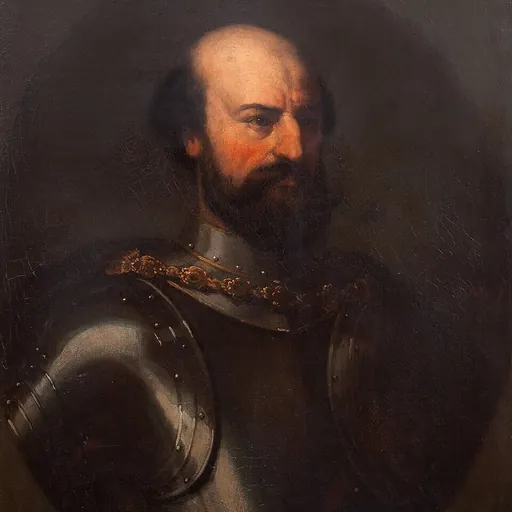
About Máté Csák III
Lived 1260 – 1321 (aged 60–61). Máté Csák III was a Hungarian aristocrat and military commander.
Máté Csák or Matthew III Csák (between 1260 and 1265 – 18 March 1321; , ), also Máté Csák of Trencsén oligarch who ruled de facto independently the north-western counties of Kingdom of Hungary (today roughly the western half of present-day Slovakia and parts of Northern Hungary). He held several of the highest royal offices in the kingdom, serving as Master of the Horse (főlovászmester) (1293–1296), Palatine (nádor) (1296–1297, 1302–1309), and Master of the Treasury (tárnokmester) (1309–1311). During the Hungarian succession crisis that followed the extinction of the House of Árpád in the male line, he was able to maintain his rule over his territories even after his defeat at the Battle of Rozgony against King Charles I of Hungary. In the 19th century, he was often described as a symbol of the struggle for independence in both the Hungarian and Slovak literatures. inherited their father's possessions, Komárom (Slovak: Komárno) and Szenic (Slovak: Senica). Regardless of his relatively short rule his (ex-)domain was called the Matthew's Land (terra Matthei) already in the 14th century. This concept had been preserved until the 15th century, when individuals still used to claim their origin from the Matthew's Land (de Terra Matthei) instead of the official administrative divisions or settlements of the Kingdom of Hungary. Thereafter, the topic was covered by numerous Slovak poets and writers like Ľudovít Štúr, Ján Kalinčiak, Jozef Miloslav Hurban, Mikuláš Dohány, Viliam Paulíny-Tóth, Samuel Ornis, Jonáš Záborský, Jozef Škultéty and others.
This view was primarily held by a relatively narrow group of Slovak intellectuals. By the second half of the 19th century and the early 20th century there was a growing trend to question Matthew Csák as a Slovak national hero from individuals like Jonáš Záborský and Július Botto. By 1923, Slovak historiography definitively rejected this viewpoint through Slovak historian Jozef Škultéty. Similar views are also rejected by modern Slovak historiography. In Slovak historical memory Matthew Csák is perceived simply as a feudal magnate, a notable regional figure and the "Lord of Váh and Tatras".
Don’t just read it —
keep it.
Full-length biographies made to live with: read them, listen on the way to work, watch them tonight.
- E-book
- Audio
- Video
Instant download · yours to keep · every purchase keeps this site free
Important facts
Family & relationships
Related people
Same field, nearest in time



Contemporaries
People whose lives overlapped Máté Csák III's



Frequently asked questions
Who was Máté Csák III?
Hungarian nobleman (1260–1321)
When was Máté Csák III born?
Máté Csák III was born in 1260 in Trenčín.
When did Máté Csák III die?
Máté Csák III died on 18 March 1321 in Trenčín.
What was Máté Csák III's occupation?
Máté Csák III was an aristocrat and military commander.
What nationality was Máté Csák III?
Máté Csák III was Hungarian.
Sources & further reading
Cite this page
APA: Biography.guide. (2026). Máté Csák III. https://biography.guide/mate-csak-iii/
MLA: "Máté Csák III." Biography.guide, https://biography.guide/mate-csak-iii/.
Chicago: "Máté Csák III." Biography.guide. https://biography.guide/mate-csak-iii/.
Data last updated: 2026-09-22 · Spot an error? Report a correction.
Portrait: Wikimedia Commons · author & licence
Page generated 2026-09-27 05:04 UTC