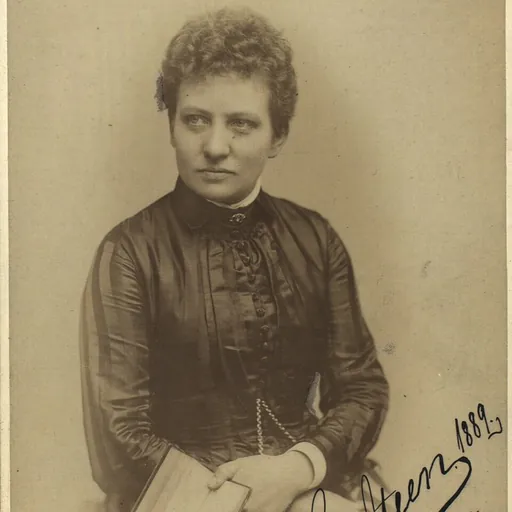
Mary Steen
Danish photographer and women's rights activist
About Mary Steen
Lived 1856 – 1939 (aged 82). Mary Steen was a Danish photographer and women's rights activist.
Mary Dorothea Frederica Steen (28 October 1853 – 7 April 1939) was a Danish photographer and feminist. At the age of 31, she opened a studio in Copenhagen where she specialized in indoor photography. She later became Denmark's first female court photographer, working not only with the Danish royal family but, at the invitation of Princess Alexandra, with the British royal family too. She also played an important part in improving conditions for female workers and encouraging women to take up the profession of photography.
Early life
Born in a village between Aarhus and Randers in Jutland, Steen was the daughter of Niels Jensen Steen, a schoolteacher, and Caroline Kirstine Petersen. In her late teens, she moved to Copenhagen where she graduated at the Women's Business School but she soon found out that she was not made for office work. She decided to take up photography and received training first in Sweden and then with a photographer in Copenhagen.
Professional career
In 1884, at the age of 31, she opened her own photographic studio on Amagertorv in the centre of Copenhagen.
In 1888, she became the first female court photographer for Princess Alexandra who was to marry Great Britain's Edward VII. Around 1895, Princess Alexandra invited her to London where she photographed members of the royal family, including Queen Victoria at Windsor Castle.
As a result of growing deafness, she closed her studio in 1918.
Promoting feminism
In 1891, she was the first woman on the board of the Danish Photographers Association. She was also active in the Danish Women's Society (Dansk Kvindesamfund) where she sat on the board from 1889 to 1892. Together with Julie Laurberg, she photographed the leading figures in the Danish women's movement. In 1891, she received a grant from the Reiersenske Fond, a trade association, which allowed her to travel to Germany and Vienna.
She campaigned for better working conditions for women including eight days holiday and a half day off on Sundays. She treated her own staff well, paying good wages.
Overall assessment
Steen considered her work to be art. Photography was becoming an attractive profession for women. Agnes Henningsen who became a trainee with Mary Steen in 1895 provides a lively description of Steen in her memoirs Byen erobret, published in 1945: "Everything about Mary Steen was powerful and energetic. She shook her head decisively, refusing to have a trainee. She would discourage anyone who wanted to open a studio in Copenhagen. (...) I concluded: 'So I won't be able to take those children, Miss Steen. The only thing I want is to be a photographer.' She stood up, gesturing meaningfully: 'Start tomorrow.'"
Don’t just read it —
keep it.
Full-length biographies made to live with: read them, listen on the way to work, watch them tonight.
- E-book
- Audio
- Video
Instant download · yours to keep · every purchase keeps this site free
Important facts
People in Mary Steen's life
Named in this biography and alive at the same time


Related people
Same field, nearest in time


Contemporaries
People whose lives overlapped Mary Steen's




Frequently asked questions
Who was Mary Steen?
Danish photographer and women's rights activist (1853–1939)
When was Mary Steen born?
Mary Steen was born on 28 October 1856 in Hvilsager Parish.
When did Mary Steen die?
Mary Steen died on 7 April 1939 in Copenhagen.
What was Mary Steen's occupation?
Mary Steen was a photographer and women's rights activist.
What nationality was Mary Steen?
Mary Steen was Danish.
Sources & further reading
Cite this page
APA: Biography.guide. (2026). Mary Steen. https://biography.guide/mary-steen/
MLA: "Mary Steen." Biography.guide, https://biography.guide/mary-steen/.
Chicago: "Mary Steen." Biography.guide. https://biography.guide/mary-steen/.
Data last updated: 2026-09-22 · Spot an error? Report a correction.
Portrait: Wikimedia Commons · author & licence
Page generated 2026-09-27 04:57 UTC