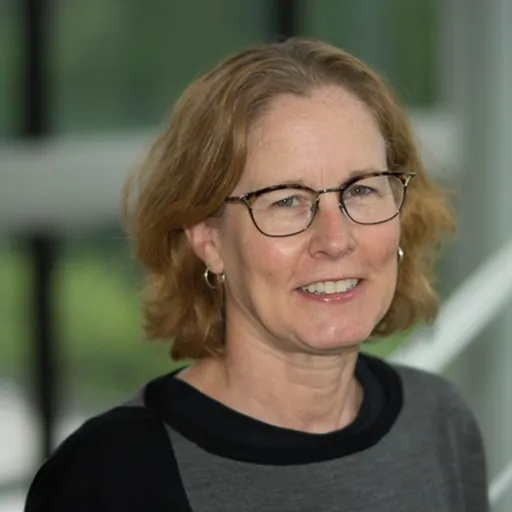
About Mary Dasso
Mary Dasso was a researcher, known for Ran GTPase.
Mary C. Dasso is an American biochemist known for research on chromosome segregation and the discovery of Ran GTPase. She is the acting scientific director of the division of intramural research and a senior investigator in the section on cell cycle regulation at the Eunice Kennedy Shriver National Institute of Child Health and Human Development.
Early life and education Dasso was raised in Eugene, Oregon, along with her three siblings. Her father was a professor at the Charles H. Lundquist College of Business, and her mother was a homemaker. Her family spent a lot of time outdoors and on camping trips which later influenced her interest in biology starting in high school. At her parents' suggestion, she attended University of Oregon with intentions on following in her brother's footsteps to apply to law school. Her sophomore year, Dasso held a summer position in Pete H. von Hippel's laboratory where she studied the function of T4 DNA polymerase, which is now commonly used by researchers to mutate genes of interest and conduct DNA-related studies. She continued in his lab through the rest of her time in Oregon, and those studies became the basis of her thesis at the Robert D. Clark Honors College. In 1984, Dasso graduated summa cum laude with a major in chemistry and a minor in mathematics.
She was a Marshall Scholar at the University of Cambridge, where she obtained her Ph.D. in biochemistry. At Cambridge, she chose to work with in the laboratories of Richard Jackson and Tim Hunt. She studied the initiation of eukaryotic mRNA translation, examining how the cells of complex organisms, such as plants and animals, turned DNA instructions into new proteins. Her scholarship was initially set for 2 years, but Dasso successfully applied for an additional third year so that she could earn her doctoral degree. In 2015, she became the associate scientific director for budget and administration. Dasso became acting scientific director of the division of intramural research in February 2020.
Dasso published key findings on the small ubiquitin-related modifier (SUMO) pathway that then contributed to the discovery of SUMOylation, a process in which proteins are tagged by SUMO proteins, thereby modifying the tagged protein's function. In 2010, her team showed that the SUMO protein SENP6 was essential for assembling the kinetochore, another key structure that forms during mitosis.
Awards and honors Dasso was elected to the American Association for the Advancement of Science in 2018 and the American Society for Cell Biology in 2019.
Don’t just read it —
keep it.
Full-length biographies made to live with: read them, listen on the way to work, watch them tonight.
- E-book
- Audio
- Video
Instant download · yours to keep · every purchase keeps this site free
Important facts
Related people
Same field, nearest in time






Frequently asked questions
Who was Mary Dasso?
American biochemist
When was Mary Dasso born?
Mary Dasso was born in United States.
What was Mary Dasso's occupation?
Mary Dasso was a researcher.
What was Mary Dasso known for?
Mary Dasso was known for Ran GTPase.
Sources & further reading
Cite this page
APA: Biography.guide. (2026). Mary Dasso. https://biography.guide/mary-dasso/
MLA: "Mary Dasso." Biography.guide, https://biography.guide/mary-dasso/.
Chicago: "Mary Dasso." Biography.guide. https://biography.guide/mary-dasso/.
Data last updated: 2026-09-23 · Spot an error? Report a correction.
Portrait: Wikimedia Commons · author & licence
Page generated 2026-09-27 05:06 UTC