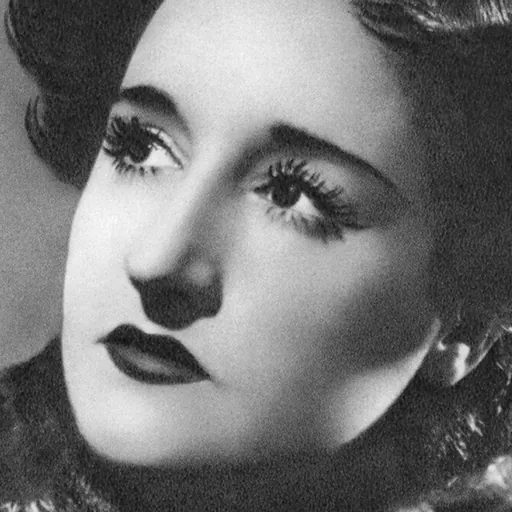
About Maruja Mallo
Lived 1902 – 1995 (aged 93). Maruja Mallo was a Spanish theatre designer, teacher, painter, graphic artist, artist and draftsperson.
Maruja Mallo (born Ana María Gómez González; 5 January 1902 – 6 February 1995) was a Spanish surrealist painter. She is considered an artist of the Generation of 1927 within the Spanish avant-garde movement.
Biography Mallo was the fourth daughter of fourteen children born to Justo Gómez Mallo (Customs Corps Official and native of Madrid) and María del Pilar González Lorenzo, born in Viveiro, Spain, on 5 January 1902. She is the older sister of sculptor Cristino Mallo (born in Tui in 1905).
Early years When she was a young girl, Mallo would alternate between living with parents and her aunt (Juliana Lastres Carrer) and uncle (Ramiro Gonzalez Lorenzo). While living with her aunt and uncle at a young age, she felt inspired to create and express herself through artwork. After the birth of one of her brothers, the family moved to Avilés, where they remained from 1913 to 1922.
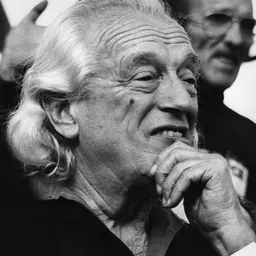
In 1922 at age 20, Mallo's family moved to Madrid. There, she began to study at the San Fernando Royal Academy of Fine Arts, where she stayed until 1926. In Madrid she met artists, writers, and scientists from the Spanish Generation ’27 like Salvador Dalí, Concha Méndez, Ernesto Giménez Caballero, Gregorio Prieto, Federico García Lorca, Margarita Manso, Luis Buñuel, María Zambrano, and Rafael Alberti, with whom she maintained a relationship until he met María Teresa León. She went on to form a group of women from the Generation of ’27 known as “Las Sinsombrero” (English: those without hats). In particular, she was friends with Concha Méndez and Josefina Canarias.
During the 1920s, Mallo also worked on numerous literary publications and produced several books. Author Ortega y Gasset recognized her paintings in 1928 and organized her first exhibit in Revista de Occidente, which was very successful, praised for its originality and freshness. It displayed ten oil paintings representing towns full of sun, bullfighters and women from Madrid, as well as colored prints of machinery, sports, and cinema from the beginning of the century. The exhibit was a starting point from which Mallo was judged for her work and not her gender. During this time, Mallo's paintings followed the theme of new objectivity or magic realism, theorized by Franz Roh in his book Magic Realism in 1925.
The 1930s and the Second Spanish Republic Mallo's work became more surrealistic in the early 1930s, including geometric visual language and themes that ranged from fruits to agricultural structures as well as creating ceramic disks with themes of fish and bulls. Mallo collaborated intensely with Rafael Alberti starting in 1931. In those years she painted the series Cloacas (Sewers) y Campanarios (Belfries).
In that same year, Mallo, committed to the Second Spanish Republic, started teaching as a drawing professor at the Institute of Arévalo, in the School Institute of Madrid, and at the Ceramics School of Madrid, for which she designed a series of dishes that no longer exist, and where she learned mathematic and geometric concepts to use in ceramics.
In 1942 the book Maruja Mallo was published with a prologue by Ramón Gómez de la Serna. The Award for Plastic Arts in Madrid, 1982 In 1990 she received the gold medal for Community in Madrid and in 1991 the Galician Medal In 1992, at 90 years old, one of her exhibits was celebrated in the Guillermo de Osma de Madrid gallery, which showed, for the first time, the series of paintings from her exile in America In 1993 a retrospective exhibit was held in Santiago de Compostela that inaugurated the new Gallego Center for Contemporary Art. Later, the exhibit was moved to the Buenos Aires Fine Arts Museum. For the first time since 1948, Mallo's work was exhibited in New York as Maruja Mallo: Paintings 1926- 1952 in 2018 from 26 September – 1 December at Ortuzar Projects project space in Tribeca, New York. Mallo's artwork can be found at the Museo Nacional Centro De Arte Reina Sofia which is Spain's national museum of 20th-century art.
Legacy In Viveiro, Mallo's hometown, a permanent museum concentrated on the studies of her work was established. Also, an avenue was named after her in the Madrid district of Hortaleza. Streets with Mallo's name can also be found in cities like Almería, Estepona, Mérida, Boadilla del Monte, Guadalajara, and the Castle of San Juan.
In 2017, the Gallegas Day of the Arts was dedicated to Mallo, granted by the Royal Gallegan Academy of Fine Arts.
Works La verbena (The Fair) (1927) La kermesse (The Fair) ( (1928) Canto de las espigas (Song of the ears) (1929) La huella (The footprint) (1929) Antro de Fosiles (Fossil Club) (1930) Tierra y excrementos (Earth and feces) (1932) Sorpresa en el trigo (Wheat surprise) (1936) Figuras (Figures) (1937) Cabeza de mujer (Woman's head) (1941) Máscaras (Masks) (1942) Serie Las naturalezas vivas (Natural life series) (1942) El racimo de uvas (The cluster of grapes) (1944) Oro (Gold) (1951) Agol (1969) Geonauta (Geonaut) (1975) Selvatro (Jungle) (1979) Concorde (Concord) (1979) Máscara tres-veinte (Mask three-twenty) (1979) Airagu (1979) Acróbatas macro y microcosmos (Macro and microcosm acrobats) (1981) Acróbatas (Acrobats) (1981) Protozaorios (Protozoa) (1981) Panteo (Pantheon) (1982) Acróbata (Acrobat) (1982) Protoesquema (Protoschema) (1982) Razas (Races) (1982) Viajeros del éter (Aether Travelers) (1982)
Don’t just read it —
keep it.
Full-length biographies made to live with: read them, listen on the way to work, watch them tonight.
- E-book
- Audio
- Video
Instant download · yours to keep · every purchase keeps this site free
Important facts
People in Maruja Mallo's life
Named in this biography and alive at the same time



Related people
Same field, nearest in time





Contemporaries
People whose lives overlapped Maruja Mallo's


Frequently asked questions
Who was Maruja Mallo?
Galician artist; surrealist painter (1902-1995)
When was Maruja Mallo born?
Maruja Mallo was born on 5 January 1902 in Viveiro.
When did Maruja Mallo die?
Maruja Mallo died on 6 February 1995 in Madrid.
What was Maruja Mallo's occupation?
Maruja Mallo was a theatre designer, teacher, painter, graphic artist, artist and draftsperson.
What nationality was Maruja Mallo?
Maruja Mallo was Spanish.
Sources & further reading
Cite this page
APA: Biography.guide. (2026). Maruja Mallo. https://biography.guide/maruja-mallo/
MLA: "Maruja Mallo." Biography.guide, https://biography.guide/maruja-mallo/.
Chicago: "Maruja Mallo." Biography.guide. https://biography.guide/maruja-mallo/.
Data last updated: 2026-09-20 · Spot an error? Report a correction.
Portrait: Wikimedia Commons · author & licence
Page generated 2026-09-27 04:58 UTC