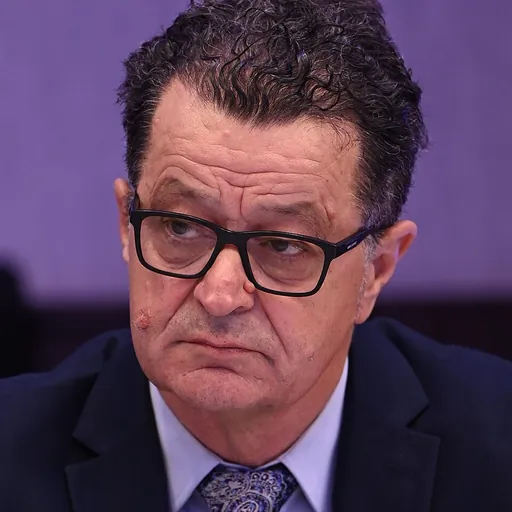
Martin Raguž
Chairman of the Council of Ministers of Bosnia and Herzegovina from 2000 to 2001
About Martin Raguž
Born 1958. Martin Raguž is a Bosnian politician.
Martin Raguž (born 2 March 1958) is a Bosnian Croat politician who served as Chairman of the Council of Ministers of Bosnia and Herzegovina from 2000 to 2001. He was a member of the national House of Peoples from 2011 to 2019, while previously he served in the House of Representatives from 2002 to 2010.
Raguž also served as the first minister of human rights and refugees from 2000 until 2001, and as the federal minister without portfolio from 1995 to 1996. He was also the minister of labour and social politicy from 1992 to 1993, during the Bosnian War. A member of the Croatian Democratic Union since 1993, Raguž left it to join its splinter party, the Croatian Democratic Union 1990. He later served as the party's president between 2013 and 2015.
Early political career Raguž became politically active at the time of 1990 general election, the first in the Socialist Republic of Bosnia and Herzegovina, then a part of Yugoslavia. He was one of the founders of the liberal-oriented BiH Union of Socialist Youth. He ran for the Croat member of the Presidency of the Socialist Republic of Bosnia and Herzegovina as a candidate of the SSO-H party. Of the seven Croatian candidates, Raguž finished last with a haul of 130,428 (6.13%) votes.
At the beginning of the Bosnian War in 1992, Raguž was appointed Minister of Labour and Social Policy for the Republic of Bosnia and Herzegovina, working in besieged Sarajevo. At the beginning of Croat–Bosniak War, he joined the Croatian Democratic Union (HDZ BiH) and accepted an invitation by the Croatian Republic of Herzeg-Bosnia to help mitigate the humanitarian crisis.
Raguž worked as the deputy head of the Office for Displaced Persons, Refugees and Displaced Persons until 1993, when he was appointed head of that office, replacing Darinka Tadić. He served until 1994, when it became the Ministry for Refugees and Social Affairs,
Post-war political career After the war, Raguž was appointed federal minister without portfolio, where he remained until 1996, and was in charge of coordinating activities for the implementation of the Dayton Agreement. From 2000 until 2001, he served as minister of Human Rights and Refugees. Raguž was then appointed Chairman of the Coordination Council.
After the High Representative Wolfgang Petritsch removed Ante Jelavić as the Croat member of the presidency, talks began about possible successors to Jelavić as president of the HDZ BiH. The international community, as a condition of returning to political home-rule, required the removal of all politicians who participated in the creation of the self-government. Although Raguž was also part of its establishment, the international community considered him to be acceptable as the new leader of the HDZ BiH. In March 2014, he called for the federalization of Bosnia and Herzegovina. His call was welcomed by former High Representative Christian Schwarz-Schilling. In a meeting with the director of the Department of South and Central Europe of the U.S. State Department, Raguž advocated for greater impact of the United States on Bosnia and Hercegovinu.
2014 presidential campaign
On 5 July 2014, Raguž accepted the nomination of the HDZ 1990 for the Croat member of the Presidency of Bosnia and Herzegovina in the October general election. His nomination marked a deepening of the conflict within the Croatian National Assembly. The cornerstone of Raguž's policy was cooperation with the European Union. Raguž's campaign received support from the First Bosnian party, whose president Šeherzada Delić announced official support for Raguž in the election.
Raguž failed to get elected, obtaining 38.60% of the vote, while HDZ BiH leader Dragan Čović won with 52.20%.
Resignation In December 2015, the West Herzegovina Canton HDZ 1990 board requested that Raguž resign because of "the general inactivity and inaction of the party and the party's deteriorating situation on the ground." He consequently resigned on 23 December, citing health problems, including spinal issues.
Don’t just read it —
keep it.
Full-length biographies made to live with: read them, listen on the way to work, watch them tonight.
- E-book
- Audio
- Video
Instant download · yours to keep · every purchase keeps this site free
Important facts
People in Martin Raguž's life
Named in this biography and alive at the same time



Related people
Same field, nearest in time



Contemporaries
People whose lives overlapped Martin Raguž's


Frequently asked questions
Who is Martin Raguž?
Chairman of the Council of Ministers of Bosnia and Herzegovina from 2000 to 2001
When was Martin Raguž born?
Martin Raguž was born on 2 March 1958 in Stolac.
What is Martin Raguž's occupation?
Martin Raguž is a politician.
What nationality is Martin Raguž?
Martin Raguž is Bosnian.
Sources & further reading
Cite this page
APA: Biography.guide. (2026). Martin Raguž. https://biography.guide/martin-raguz/
MLA: "Martin Raguž." Biography.guide, https://biography.guide/martin-raguz/.
Chicago: "Martin Raguž." Biography.guide. https://biography.guide/martin-raguz/.
Data last updated: 2026-09-21 · Spot an error? Report a correction.
Portrait: Wikimedia Commons · author & licence
Page generated 2026-09-27 04:58 UTC