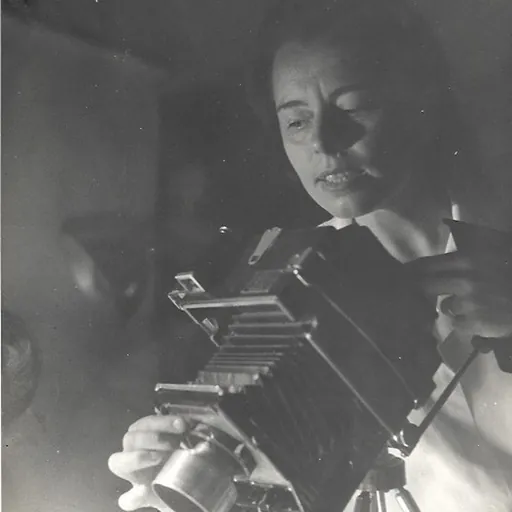
Martha Mood
American artist (1908 to 1972)
About Martha Mood
Lived 1908 – 1972 (aged 63–64). Martha Mood was an American needleworker and tapestry maker.
Martha Mood (June 21, 1908 – July 15, 1972) was an American artist who is known for her stitchery and textile works and for being one of the first artists to raise the craft to the status of fine art in the United States. She is also known for her work in ceramics and as a photographer.
Biography Mood was born in Oakland, California, to German immigrant parents who owned a bakery. She spent her childhood and early adult years in the Bay Area. When she was seven years old, her family moved to San Rafael, CA, where she attended St. Rafael's Roman Catholic parochial school and Dominican College High School.
Martha was married to Beaumont Mood, her second husband, from 1947 to 1966. The Moods lived in Dallas, Texas, for five years. While on a photographic tour of Texas, Martha and Beaumont were in a serious car accident. Martha almost lost her life and she required numerous surgeries over the next two years to repair extensive facial injury. In 1952, the Moods moved to the San Antonio, Texas. Martha Mood taught art in San Antonio public schools and at the San Antonio Art Institute. Following a ceramics class, she produced sculptures and architectural fixtures. Mood began experimentation with stitchery, also known as appliqué tapestry, in the early 1950s. By 1959, at the age of 51, stitchery had developed into Mood's primary artistic medium.
Artistic works
In stitchery and textiles Stitchery developed out of the practices of the utilitarian and decorative crafts of quilt making, applique, and embroidery. In the 1960s stitchery became recognized as an art form. Mood produced works in many different styles including abstract, primitive, semi-realistic, and Cubist. Her choice of material and yarn was based on design, color, and texture. She used textured material, including heavy upholstery, primitive sacking materials, delicate linens, silks, recycled fabric, and clothing. Mood used a variety of yarns, threads, and twines for the embroidery to compliment the fabric appliques. Henderson and Shirley Koploy wrote two books about Mood's life and work: The Sublime Heritage of Martha Mood, vol. 1 (The Story of Martha Mood, Her Stitchery and the Tapestries Woven from Her Stitchery Design) and vol. 2 (A Seeing Eye).
In ceramics
Martha Mood created ceramic sculptures, panels and murals. The subject matter of her ceramic work was typically animals or human figures. To produce the ceramic fixtures, Martha and Beaumont Mood formed the Martha and Beaumont Mood Lighting company. Martha developed the designs for the fixtures while Beau made the molds, mixed the clay, and cast the pieces. The fixtures were perforated with hundreds of tiny holes from which the light shined through and small lined designs formed patterns.
Martha and Beaumont Mood Fixtures can be found at Trinity University, Saint Mary’s Hall Prep School, the Denton, Texas municipal buildings, Texas Instruments Semiconductor Building in Dallas, Johnson City Post Office, the Bill Miller BBQ restaurant,
In photography Martha Mood worked as a photographer from 1931 to 1946. She took photographs for several books, including:
Parents and Children Go to School by Dorothy Baruch, 1939 Looking at Honolulu Through the Camera by Martha Homsy, 1942 This is Hawaii: A Collection of Fine Photographs by Hawaii's Leading Cameramen, 1944 (Editor) The Hula: The Dance and Its Meaning, 1944 The Hula: Dance Lessons with 72 Photos, 1954 Fishermen and Workers in the Fields. Traveling exhibition of 38 Mood stitcheries, including the Leigh Yawkey Woodson Art Museum, Wausau, Wisconsin; and the Marion Koogler McNay Art Museum, San Antonio. 1975 A League of Women: Women Artists for the SAALM Permanent Collection 1950–Present. San Antonio Art League, 2024 Stitchery Exhibition at the Wichita Art Institute, Kansas
Collections Mood's artwork has been found in private collections, public installations, and museums. Private collectors include: Lyndon B. Johnson, John Connally, Winthrop Rockefeller, Clint Murchison, O'Neil Ford, and Charles Urschel. Museums housing Mood's works include the Museum of Fine Arts Houston, McNay Art Museum, and the San Antonio Art League and Museum.
Don’t just read it —
keep it.
Full-length biographies made to live with: read them, listen on the way to work, watch them tonight.
- E-book
- Audio
- Video
Instant download · yours to keep · every purchase keeps this site free
Important facts
People in Martha Mood's life
Named in this biography and alive at the same time






Related people
Same field, nearest in time

Contemporaries
People whose lives overlapped Martha Mood's


Frequently asked questions
Who was Martha Mood?
American artist (1908 to 1972)
When was Martha Mood born?
Martha Mood was born in 1908.
When did Martha Mood die?
Martha Mood died in 1972.
What was Martha Mood's occupation?
Martha Mood was a needleworker and tapestry maker.
What nationality was Martha Mood?
Martha Mood was American.
Sources & further reading
Cite this page
APA: Biography.guide. (2026). Martha Mood. https://biography.guide/martha-mood/
MLA: "Martha Mood." Biography.guide, https://biography.guide/martha-mood/.
Chicago: "Martha Mood." Biography.guide. https://biography.guide/martha-mood/.
Data last updated: 2026-09-20 · Spot an error? Report a correction.
Portrait: Wikimedia Commons · author & licence
Page generated 2026-09-27 04:57 UTC