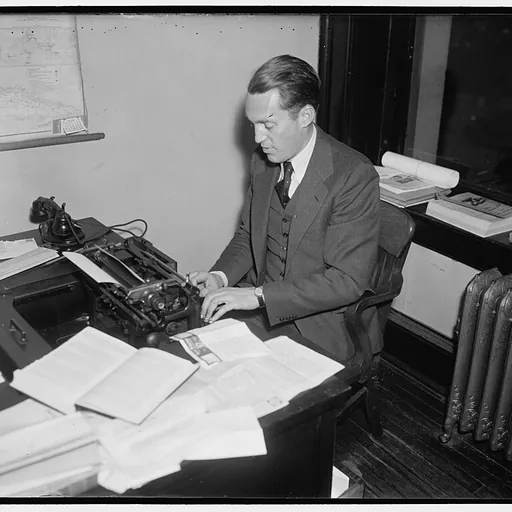
About Marquis Childs
Lived 1903 – 1990 (aged 87). Marquis Childs was an American journalist and writer.
Marquis William Childs (March 17, 1903 – June 30, 1990) was a 20th-century American journalist, syndicated columnist, and author.
Early life and education
Childs was born on March 17, 1903, in Clinton, Iowa. He graduated from Lyons High School in Clinton in 1918, and received a B.A. in 1923 and Litt.D. in 1966 from the University of Wisconsin–Madison. After working for United Press in several Midwestern cities (including Chicago) since 1923, he attended the University of Iowa and completed his M.A. in 1925. In 1969, he obtained a second Litt.D. from the University of Iowa. mostly serving as a feature writer for its American Mercury magazine section. President Roosevelt was inspired to send a special commission abroad to study European cooperative systems.
Childs's first novel, Washington Calling! (1937), was called "unquestionably the most intelligent novel of Washington since Harvey Ferguson's Capitol Hill." That same year Childs traveled to Spain and wrote a series of articles on the Spanish Civil War for the Post-Dispatch. He expressed anti-Franco and pro-Loyalist sentiments.
The next country subjected to Childs's appraisal was Mexico. His series on oil expropriation was so controversial that a United States Senate investigation followed. He was chastised on and off the Senate floor by oilman and Senator Joseph F. Guffey of Pennsylvania. Childs sued Guffey for slander, won a full apology on the floor of the Senate, then withdrew the suit.
Wartime and post-war author
In the early 1940s, Childs published several books that won renewed critical acclaim: Toward a Dynamic America with William T. Stone; This Is Your War ("succinct and stimulating," said The New York Times); and I Write from Washington. During the spring of 1943, as guest of the Swedish Foreign Office, Childs again visited Sweden and became interested in the role of neutrals in World War II; this led him to investigate conditions in Switzerland, upon which he reported in a Saturday Evening Post article.
Relaxation for Childs during the war years came with horseback riding and figure skating—"When you're trying to keep your balance on a backward eight, you can't think about either your own or the world's troubles." He began writing his column Washington Calling in February 1944 and published The Cabin (an autobiographical novel) that year:
" 'Some day,' he said, 'I'll ride on trains whenever I want to ... I'll be important and at small towns people will look in at the window. They'll say, 'I've seen his picture in the newspapers.' Why he should have this fame was never clear in the fantasies he created within the still, closed pool of his mind."
During another stint with the Post-Dispatch (1954–1962), Childs wrote essays for American Heritage and Holiday and published: Ethics in a Business Society, which was translated into Japanese and Portuguese; The Peacemakers, which appeared in foreign language editions in Denmark, Sweden, The Netherlands, and France; The Ragged Edge: The Erosion of Individual Liberties; and best-sellers Eisenhower: Captive Hero and Walter Lippmann and His Times, co-edited with James Reston. Surprisingly, there are two three-act plays, Maud and Madame Minister, among the Childs materials collected by the University of Iowa.
Newspaperman again
In 1944, Childs rejoined his old news agency, the United Press. His work also landed him on the master list of Nixon political opponents.
Personal life
Childs pronounced his first name "MARK-us." from cardiovascular disease. He was buried in Oakland Cemetery, Clinton, Iowa.
Awards
In 1945, Childs received the Sigma Delta Chi Award for "sustained insight in national affairs, first hand reporting, and effective writing." In 1951 he garnered the University of Missouri "distinguished service in journalism" award. That year he delivered the graduation address to a combined Clinton, Iowa, High School-Clinton Community College assembly and, on the same day, to Lyons High School graduates. He spoke on the value of individuality, a recurrent theme in his writing, speeches, and reminiscences.
In 1961, Childs received an order of chivalry from King Gustaf VI Adolf of Sweden, the Nordstjärneorden.
Childs was awarded the Golden Plate Award from the American Academy of Achievement in 1969.
Works
In his epilogue to Witness to Power (1975), Childs wrote,
"My judgments have been tempered over the years by a growing awareness of the hazard of power. It may not be literally true that all power corrupts but the more it is exercised the more likely it is for the individual to deceive himself into believing that he is infallible. And when it comes to absolute power we have seen in this grisly century all too many examples of what that can mean."
Sweden Sweden: Where Capitalism is Controlled (1934), John Day: New York. Sweden: the Middle Way (1936), Yale University Press: New Haven. This is Democracy: Collective Bargaining in Scandinavia (1938), Yale University Press: New Haven.
United States They Hate Roosevelt! (1936), Harper & Brothers: New York & London. Washington Calling! (1937), W. Morrow: New York (a novel). Toward a Dynamic America: The Challenge of a Changing World (1941, with William T. Stone), Foreign Policy Association: New York. This Is Your War (1942), Little Brown: Boston. I Write from Washington (1942), Harper & Brothers: New York & London. Cabin (1944), Harper & Brothers: New York (a novel).
Post-war publications Which Way for America? (1947), Minneapolis. The Farmer Takes a Hand: The Electric Power Revolution in Rural America (1952), Doubleday & Co: New York.
Eisenhower: Captive Hero (date). Walter Lippmann and His Times (date), co-edited with James Reston. Witness to Power (1975), McGraw-Hill: New York.
Don’t just read it —
keep it.
Full-length biographies made to live with: read them, listen on the way to work, watch them tonight.
- E-book
- Audio
- Video
Instant download · yours to keep · every purchase keeps this site free
Important facts
People in Marquis Childs's life
Named in this biography and alive at the same time





Related people
Same field, nearest in time



Contemporaries
People whose lives overlapped Marquis Childs's

Frequently asked questions
Who was Marquis Childs?
American writer and journalist (1903–1990)
When was Marquis Childs born?
Marquis Childs was born on 17 March 1903 in Clinton.
When did Marquis Childs die?
Marquis Childs died on 30 June 1990 in San Francisco.
What was Marquis Childs's occupation?
Marquis Childs was a journalist and writer.
What nationality was Marquis Childs?
Marquis Childs was American.
Sources & further reading
Cite this page
APA: Biography.guide. (2026). Marquis Childs. https://biography.guide/marquis-childs/
MLA: "Marquis Childs." Biography.guide, https://biography.guide/marquis-childs/.
Chicago: "Marquis Childs." Biography.guide. https://biography.guide/marquis-childs/.
Data last updated: 2026-09-22 · Spot an error? Report a correction.
Portrait: Wikimedia Commons · author & licence
Page generated 2026-09-27 05:01 UTC