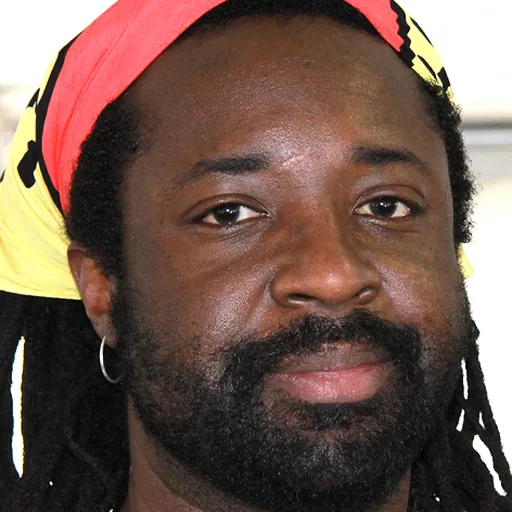
About Marlon James
Born 1970. Marlon James is a Jamaican novelist, writer and literary scholar.
Marlon James (born 24 November 1970 ) is a Jamaican writer. He is the author of six novels: John Crow's Devil, The Book of Night Women (2009), A Brief History of Seven Killings (2014), which won him the 2015 Man Booker Prize, Black Leopard, Red Wolf (2019), Moon Witch, Spider King (2022), and The Disappearers (2026). He also wrote the limited television series Get Millie Black.
Now living in Minneapolis, Minnesota, United States, James teaches literature at Macalester College in Saint Paul, Minnesota. He is also a faculty lecturer at St. Francis College's Low Residency MFA in Creative Writing.
Early life and education
James was born in Kingston, Jamaica, to parents who were both in the Jamaican police: his mother (who gave him his first prose book, a collection of stories by O. Henry) became a detective and his father (from whom James took a love of Shakespeare and Coleridge) was a lawyer. James attended Kingston's prestigious Wolmer's Trust High School for Boys. He is a 1991 graduate of the University of the West Indies, where he read language and literature. He left Jamaica to escape anti-gay violence and economic conditions that he felt would mean career stagnation, later explaining: "Whether it was in a plane or a coffin, I knew I had to get out of Jamaica."
Career James's first novel, John Crow's Devil (2005) – which was rejected 70 times before being accepted for publication – tells the story of a biblical struggle in a remote Jamaican village in 1957. His second novel, The Book of Night Women (2009), is about a slave woman's revolt in a Jamaican plantation in the early 19th century. His 2014 novel, A Brief History of Seven Killings, explores several decades of Jamaican history and political instability through the perspectives of many narrators. It won the fiction category of the 2015 OCM Bocas Prize for Caribbean Literature and the 2015 Man Booker Prize for Fiction, after being the first ever book by a Jamaican author to be shortlisted. He is the second Caribbean winner of the prize, following Trinidad-born V. S. Naipaul who won in 1971. James's 2022 work, Moon Witch, Spider King, is the second in a planned fantasy series that began with Black Leopard, Red Wolf (2019).
James has taught English and creative writing at Macalester College in Saint Paul, Minnesota, since 2007. He is also a faculty lecturer at St. Francis College's Low Residency MFA in Creative Writing.
In February 2019, James gave the seventh annual Tolkien Lecture at Pembroke College, Oxford.
In 2020, James began co-hosting with his editor Jake Morrissey a literary podcast called "Marlon and Jake Read Dead People" that explores, in a casual setting, the work of deceased authors.
In 2021, he was a James Merrill House Fellow in Stonington, Connecticut, and James began writing his first television series for HBO and Channel 4 titled Get Millie Black. Get Millie Black released in 2024 on HBO and 2025 on Channel 4, receiving critical acclaim.
James is a recipient of the 2026 Guggenheim Fellowship in Fiction.
In July 2026, James's novel The Disappearers was longlisted for the Booker Prize.
Themes Themes in James's work span religion and the supernatural, sexuality, violence, and colonialism. Often, his novels display the struggle to find an identity, whether it be as a slave or a postcolonial inhabitant of Jamaica.
John Crow's Devil (2005) In John Crow's Devil, his first novel, James explores postcolonial Jamaica through a religiously charged, archetypal battle of good and evil. His characters in this novel represent, through their archetypal portrayals, many facets of humanity including hope. Despite the particular setting, the novel "conveys archetypal situations that reside in the collective unconsciousness." Additionally, this piece of Caribbean gothic reveals the power of guilt and hypocrisy both in a person and in a community, and generally reveals truths of human nature. The ghosts of colonialism are more subtle, but the instability and struggle for identity are clear to the reader.
The Book of Night Women (2009) In The Book of Night Women, James challenges the traditional slave narrative by presenting a protagonist (Lilith) who approaches her enslavement with complex duality, despite the constant description of antagonism between slaves and masters on a plantation in Jamaica. Lilith hates the masters, but much of the novel deals with how she "aspires to obtain a privileged stature within plantation society by submitting to the sexual subjugation of a white overseer, Robert Quinn". This is additionally challenged by Lilith and Robert's "love", leading the reader to question the limits of love and relationships. James intends to have readers root for Robert and Lilith, but then catch themselves, as Robert Quinn has a reputation as a brutal, violent overseer—even ordering Lilith to be severely whipped. The situation for the reader is further complicated because Quinn is Irish, another population that was looked down upon during the time period. While this at times brings him sympathy, his whiteness overshadows his Irishness.
Additionally, the novel explores the complexity of what it is to be a woman, with some characters having deep connections to Obeah and Myal spiritualism. The female slaves are portrayed as strong-willed and intelligent, while the male slaves are often portrayed as weak, thoughtless, and even traitorous. "Rape, torture, murder and other dehumanizing acts propel the narrative, never failing to shock in both their depravity and their humanness. It is this complex intertwining that makes James’s book so disturbing and so eloquent". The novel "defies hegemonic notions of empire by pointing out the explosive and antagonistic relationship between colonizers and colonized." The novel has twelve narrators, contributing to the "excess" that Sheri-Marie Harrison explores in her article "Excess in A Brief History of Seven Killings". She explains: "James's rejection of a purely nationalist tradition, like that of other authors in his cohort, concretizes his critique of the ways nationalism distracts us from the increased deregulation of global capital and its production of material inequality around the globe. This disruption of privileged tropes in the interest of turning attention onto the transnational forces that structure inequality helps to explain James's use of "a poetics of excess". His experimentation with form functions to rework now familiar paradigms and themes that have been central to the literary imagination of postcolonial realities for a little over half a century." — is the first instalment of a planned trilogy. It has been described by NPR journalist Ari Shapiro as "an epic fantasy quest — full of monsters, sex, and violence, set in a mythic version of ancient Africa." According to TIME magazine, the novel "joins the ranks of those by authors like Tomi Adeyemi and N. K. Jemisin, whose works push back against stereotypes about the types of figures who 'should' appear in fantasy fiction".
Moon Witch, Spider King (2022) The sequel to Black Leopard, Red Wolf, titled Moon Witch, Spider King, was published by Riverhead Books in 2022. The Guardian called it a "gruelling, invigorating reading experience rife with contradictions" and said it "widened the horizons of swords-and-sorcery narratives while presenting a lurid vision of Africa to rival anything in the imperialist make-believe of H. Rider Haggard".
Influences James's influences include authors as well as musicians. In his acceptance speech for the Man Booker Prize in 2015, he explained: "The reggae singers Bob Marley and Peter Tosh were the first to recognize that the voice coming out our mouths was a legitimate voice for fiction and for poetry." In other words, these singers empowered other artists such as James to create. In his 2015 essay "From Jamaica to Minnesota to Myself", published in the New York Times Magazine, James describes reading Salman Rushdie's novel Shame (1983): "Its prose was so audacious, its reality so unhinged, that you didn't see at first how pointedly political and just plain furious it was. It made me realize that the present was something I could write my way out of."
Tone and style James's work carries a unique style, often referred to as disturbing, brutal, and violent, leading him to be compared in one review to Quentin Tarantino, who is known for his excessive use of violence in his films. James does not hold back in his graphic descriptions of sexual and violent acts, which contributes to the raw nature of his writing. "James does not set out to entertain, he does not want readers to be entertained by shocking events: he believes they should be rightly horrified…"
Dayton Literary Peace Prize Fiction
American Book Awards — Andrew Carnegie Medals for Excellence Fiction Anisfield-Wolf Book Award Fiction Green Carnation Prize Fiction Man Booker Prize — Minnesota Book Awards Novel & Short Story OCM Bocas Prize for Caribbean Literature — St. Francis College Literary Prize — 2016 International Dublin Literary Award —
Lambda Literary Awards Speculative Fiction Man Booker Prize — National Book Award Fiction Ray Bradbury Prize 2022 Moon Witch, Spider King NAACP Image Award Fiction 2026 The Disappearers The Booker Prize — Honours 2013: Silver Musgrave Medal from the Institute of Jamaica. 2019: Time 100 Most Influential People. 2024: Royal Society of Literature International Writer.
End of year lists In 2019, The Guardian, Kirkus Reviews, and Shelf Awareness named Black Leopard, Red Wolf one of the best books of the year. In 2022, Kirkus Reviews, NPR, and Publishers Weekly named Moon Witch, Spider King one of the best books of the year.
Works
Stand-alone literature
The Dark Star trilogy
Television Get Millie Black (2024)
Don’t just read it —
keep it.
Full-length biographies made to live with: read them, listen on the way to work, watch them tonight.
- E-book
- Audio
- Video
Instant download · yours to keep · every purchase keeps this site free
Important facts
People in Marlon James's life
Named in this biography and alive at the same time





Related people
Same field, nearest in time





Contemporaries
People whose lives overlapped Marlon James's






Frequently asked questions
Who is Marlon James?
Jamaican novelist
When was Marlon James born?
Marlon James was born on 24 November 1970 in Kingston.
What is Marlon James's occupation?
Marlon James is a novelist, writer and literary scholar.
What nationality is Marlon James?
Marlon James is Jamaican.
Sources & further reading
· DBpedia: Marlon James (novelist)
Cite this page
APA: Biography.guide. (2026). Marlon James. https://biography.guide/marlon-james-novelist/
MLA: "Marlon James." Biography.guide, https://biography.guide/marlon-james-novelist/.
Chicago: "Marlon James." Biography.guide. https://biography.guide/marlon-james-novelist/.
Data last updated: 2026-09-23 · Spot an error? Report a correction.
Portrait: Wikimedia Commons · author & licence
Page generated 2026-09-27 05:06 UTC