
About Marlies Göhr
Born 1958. Marlies Göhr is a German athletics competitor.
The 1980s In early 1980 Göhr confirmed herself as a favourite for the Olympic 100 m title. During a two-week span in May she ran 10.98 s at Potsdam, followed by an 11.00 s at Jena and at Dresden she ran a fast 10.93 sec, second only to her own world record time of 10.88 s. At the Moscow Olympic Games Göhr's main opposition was Lyudmila Kondratyeva (Soviet Union) who had beaten Göhr in the 200 m at the 1978 European Championships. Göhr got a bad start in the final and was edged out by Kondratyeva, who made a final lunge near the finish to win the gold medal, again by one hundredth of a second. Six days later, Göhr lined up for the 4 × 100 m relay final and anchored the team home to win the gold medal in a world record of 41.60 s.
Göhr made a good start to the 1981 season winning her third consecutive European Cup 100 m title at Zagreb in 11.17 s. Yet, on the world stage at the World Cup in Rome, Göhr had to settle for less than gold, again beaten by Evelyn Ashford, as well as by Kathy Smallwood (Great Britain). The following year at the 1982 European Championships in Athens, Göhr won in 11.01 s, becoming the first woman to defend the title.
The Göhr/Ashford rivalry blossomed in 1983, when both broke the world record. Firstly, Göhr broke it at the Olympic Day meet in East Berlin, winning in a time of 10.81 s. This record lasted less than a month, however, since Ashford broke it with a 10.79 s. Both athletes were in top form leading up to the inaugural World Championships, held in Helsinki. Both Göhr and Ashford won their respective semi-finals. Unfortunately, the final was anticlimactic since Ashford tore her hamstring during the race. Göhr won the gold medal from compatriot Marita Koch in 10.97 s and lifted a second gold medal in the 4 × 100 m relay.
Göhr and Ashford continued their dominance of the 100 m in 1984, recording the season's fastest 10 times between them. Unfortunately, Göhr was unable to compete at that year's Olympic Games in Los Angeles, because of the boycott by the Eastern Bloc countries, and Ashford won the gold medal. Ashford's time of 10.97 secs was the first time a woman had run a legal sub-11 second clocking in the Olympic Games. They had a showdown in Zurich, in which Ashford won setting a new world record of 10.76 to Gohr's 10.84.
In 1986, Göhr was focused on retaining her 100 m title at the European Championships in Stuttgart. She defended her title with a season's best time of 10.91 s and became the first woman to win three European 100 m titles. She then won a second gold medal in the 4 × 100 m relay. In October 1986, she was awarded a Star of People's Friendship in gold (second class) for her sporting success.
Göhr's last two appearances in major international championships were at the 1987 World Championships in Athletics in Rome and at the 1988 Olympic Games in Seoul. She was eliminated in the semi-finals of the 100 m in Rome but won a silver medal in the 4 × 100 m relay. At the Olympics, she was again eliminated in the 100 m semi-finals but won another silver in the relay.
Drug testing With the fall of the Berlin Wall in 1989, Stasi (secret police) files suggested widespread official doping under the East German regime.
Despite these reports, Göhr only tested positive for androgenic steroids in 1975 as a 17-year-old and has maintained that she never used them again. 1988 European Indoor Championships Budapest, Hungary
60 m
12th 100 m 11.13 6th in semi-final 1
4 × 100 m 42.09
World records
Don’t just read it —
keep it.
Full-length biographies made to live with: read them, listen on the way to work, watch them tonight.
- E-book
- Audio
- Video
Instant download · yours to keep · every purchase keeps this site free
Important facts
People in Marlies Göhr's life
Named in this biography and alive at the same time
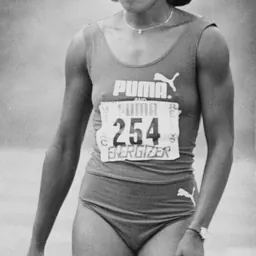
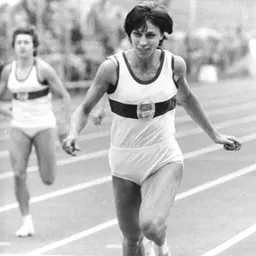

Related people
Same field, nearest in time






Contemporaries
People whose lives overlapped Marlies Göhr's

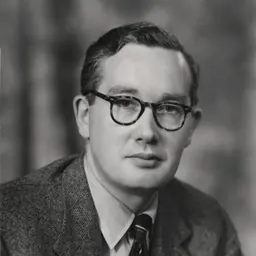


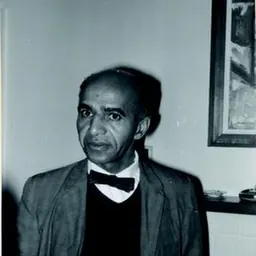
Frequently asked questions
Who is Marlies Göhr?
German athlete
When was Marlies Göhr born?
Marlies Göhr was born on 21 March 1958 in Gera.
What is Marlies Göhr's occupation?
Marlies Göhr is an athletics competitor.
What nationality is Marlies Göhr?
Marlies Göhr is German.
Sources & further reading
Cite this page
APA: Biography.guide. (2026). Marlies Göhr. https://biography.guide/marlies-gohr/
MLA: "Marlies Göhr." Biography.guide, https://biography.guide/marlies-gohr/.
Chicago: "Marlies Göhr." Biography.guide. https://biography.guide/marlies-gohr/.
Data last updated: 2026-09-25 · Spot an error? Report a correction.
Page generated 2026-09-27 05:11 UTC