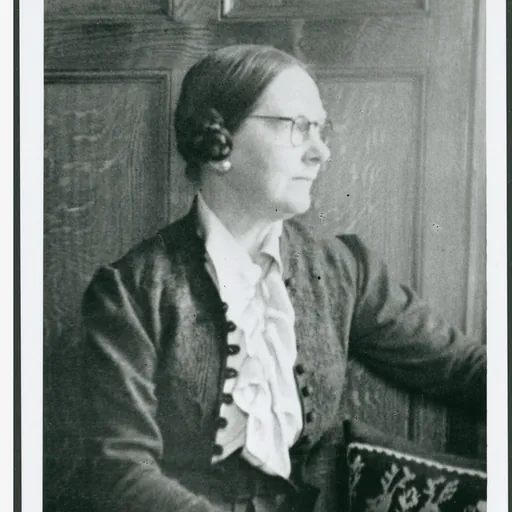
About Marjorie Campbell Gwynne
Lived 1886 – 1958 (aged 71). Marjorie Campbell Gwynne was a painter.
Marjorie Gwynne (born Marjorie Campbell Church: 7 April 1886 – 12 June 1958) was an Australian artist who lived in Adelaide. She worked both in oils and watercolours and was known for her strong use of tertiary colours especially in landscape and still life. In 1906, she began studying at the South Australian School of Design with Archibald Collins and continued studies with him until 1919. In 1918, she exhibited works at an exhibition organised by Collins for the war effort. Her work was described as having an intensity of colour and tone in watercolours and oils. That same year, Church married Edward Gywnne It was included in an exhibition in 1952 along with works by Nora Heyson, Jacqueline Hick and Elaine Haxton. The portrait of Bates now hangs in the Art Gallery of South Australia. A preliminary watercolour of the subject, completed in 1940, can be found in the collection at Carrick Hill.
In 1941, the National Gallery of Australia purchased its first painting by Gwynne and a report at the time commented that "she is one of those artists who is also a thinker. She paints flowers at times, and pays them the compliment of visiting them where they grow … instead of chopping their heads off, putting them in a pot, and painting them reflected in a shiny table."
In 1944, Gwynne became a member of "Group 9", a group of Adelaide artists brought together by Dorrit Black to support each other and hold exhibitions. Their first exhibition was in 1944, and a review of it describes Gwynne's work as "vivid, convincing, and colorful, [it] first attracts, then pleases and satisfies." An exhibition by the group in 1951 again praised both Black and Gwynne's work, but was less enthusiastic of the work submitted by Jeffrey Smart. In 1954, Gwynne's painting Still life with melons was selected for a special exhibition commemorating the visit to Australia by Queen Elizabeth II, along with works by Nora Heyson, Hans Heyson, Jeffrey Smart and others.
Gwynne's work is part of the permanent collections of the following museums: Art Gallery of South Australia, Adelaide Castlemaine Art Museum, Castlemaine, Victoria Carrick Hill, Adelaide National Gallery of Australia, Canberra Cruthers Collection of Women’s Art, University of Western Australia
Her work was also represented in two major exhibitions at the AGSA, South Australian Women Artists 1890s–1940s (1994) and Modern Australian Women: paintings and prints 1925–1945 (2000–2001).
Gwynne died in Adelaide on 12 June 1958.
Don’t just read it —
keep it.
Full-length biographies made to live with: read them, listen on the way to work, watch them tonight.
- E-book
- Audio
- Video
Instant download · yours to keep · every purchase keeps this site free
Important facts
People in Marjorie Campbell Gwynne's life
Named in this biography and alive at the same time




Related people
Same field, nearest in time



Contemporaries
People whose lives overlapped Marjorie Campbell Gwynne's


Frequently asked questions
Who was Marjorie Campbell Gwynne?
Australian painter (1886–1958)
When was Marjorie Campbell Gwynne born?
Marjorie Campbell Gwynne was born on 4 July 1886 in Adelaide.
When did Marjorie Campbell Gwynne die?
Marjorie Campbell Gwynne died on 12 June 1958 in Adelaide.
What was Marjorie Campbell Gwynne's occupation?
Marjorie Campbell Gwynne was a painter.
Sources & further reading
· Wikipedia: Marjorie Campbell Gwynne
Cite this page
APA: Biography.guide. (2026). Marjorie Campbell Gwynne. https://biography.guide/marjorie-campbell-gwynne/
MLA: "Marjorie Campbell Gwynne." Biography.guide, https://biography.guide/marjorie-campbell-gwynne/.
Chicago: "Marjorie Campbell Gwynne." Biography.guide. https://biography.guide/marjorie-campbell-gwynne/.
Data last updated: 2026-09-20 · Spot an error? Report a correction.
Page generated 2026-09-27 05:09 UTC