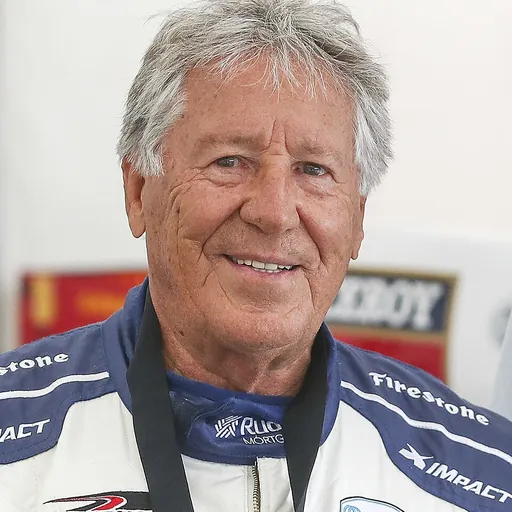
Mario Andretti
Italian-American racing driver (born 1940)
About Mario Andretti
Born 1940. Mario Andretti is an American and Italian formula One driver and racing automobile driver.
Early racing career Debut in dirt track racing leftThe first car Andretti regularly drove was his father's 1957 Chevrolet, which the twins did not race, but nonetheless upgraded with features like a glasspack muffler and fuel injection. In their first two weeks of racing, they won $300; they had previously been making $45 a week at the gas station. In 2016, he admitted that the story was fabricated. He recalled that it "psych[ed] [the opponents] out, big time." and scored 29 top-five finishes in 46 ARDC races. He finished third in the 1963 ARDC season standings. On Labor Day in 1963, Andretti won three feature races at two different tracks, an afternoon race at Flemington and a doubleheader at Hatfield, after which reporter Chris Economaki told him that "you just bought the ticket to the big time." To cover his expenses, he worked as a foreman at a golf cart factory. In 1971, USAC split off its dirt-track races into a separate National Dirt Car Championship. The pavement championship retained the name USAC Championship Car Series, while the dirt championship had fewer races and was later rebranded to the "Silver Crown Series." He started 16th and finished 11th. Dean Van Lines Racing Division (DVL), lost Chuck Hulse to injury. Andretti was pleased to join what he called one of the "few outfits worth driving for." He completed the final eight races of the season with DVL, finishing 11th in the season standings. He was named IndyCar Rookie of the Year. After the season, Brawner agreed to make Andretti his permanent driver in place of Hulse. Although he won only one race that year, he scored six second places and three third places, and scored points in 16 out of 18 races. His closest competitor, A. J. Foyt (who had won four of the last five USAC titles) won five races but failed to score seven times. At age 25, Andretti became the youngest IndyCar champion in history,
In 1966, Andretti won his second straight USAC title. In contrast to his maiden title win, Andretti won eight of fifteen starts and led 1,142 laps, nearly 1,000 laps more than his closest competitor. Andretti also took pole at the 1966 Indianapolis 500, but retired after 27 laps with a mechanical failure.
In 1967, Andretti lost the season USAC championship to A. J. Foyt. Although Andretti won eight races, Foyt won the 1967 Indianapolis 500; Andretti was on pole at Indianapolis but lost a wheel. Andretti fought through broken ribs to stay in the title race. Ordinarily, he would have won the championship anyway, as third place was worth 420 points and Foyt had crashed on lap 50. Andretti received his first Driver of the Year award but was deflated by how the season ended, saying, "I had the championship in my hands, and then it was gone." In 1968, Andretti once again lost the title at the final race of the season at Riverside, but this time in a reversal of the events of 1967. Andretti held a 304-point lead over Bobby Unser at the start and led Unser on track by 47 seconds at one point. However, his engine failed on lap 58. He borrowed Joe Leonard's car (whose brakes were dead Unser finished second, scoring 480 points. and concerned that Firestone was cutting back its sponsorship budget, Andretti won nine races in 1969, including the 1969 Indianapolis 500 and the Pikes Peak International Hill Climb. His 5,025 points were a USAC record, and he scored nearly twice as many points as runner-up Al Unser (2,630).
1970–1971: Team split and struggles The core of the team split up after the 1969 title season, when Goodyear persuaded STP mechanics Clint Brawner and Jim McGee to start their own team.
Various reasons were given for the split. Brawner said that he and McGee left because Granatelli and Firestone were underpaying them, and added that his old-school thinking clashed with Andretti and McGee's desire to innovate. but "certainly respected each other." and the STP Formula One team shut down after one season. In 1971, Andretti fell to ninth in USAC's paved track championship. Parnelli was IndyCar's dominant team at the time, with 1970 champion Al Unser and 1971 champion Joe Leonard. Andretti persuaded the team to hire Lotus designer Maurice Philippe, and Jim McGee also joined the team. He nearly won the 1973 title as well, but teammate Al Unser beat him even though Andretti won two out of three races. and raced in Formula 5000 in 1974 and 1975. In 1975, Andretti stopped competing full-time in IndyCar, instead driving full-time for the Parnelli Formula One team. After quitting Formula One in early 1976, Parnelli released Andretti from his USAC contract so that he could focus on Formula One.
Penske (1976–1978) While racing with Team Lotus, Andretti appeared sporadically in IndyCar with McGee's new team, Penske Racing.
In USAC, Andretti scored one win and eight top-five finishes in sixteen races from 1965 to 1968. won round 12 at Mosport, and finished seventh in the standings.
In the NASCAR Grand National Series, Andretti was less successful on average, with one win, one top-five finish, and three top tens in fourteen races from 1966 to 1969. He generally did not get the first pick of equipment and pit crews, and said that a lack of technical support forced him to ask a rookie, Donnie Allison, for help setting up his car. ) to an extent that was considered extreme at the time.
In the 1970s and 1980s, Andretti competed in six editions of the International Race of Champions (IROC), an invitational stock car series with a limited calendar. He won IROC VI and finished second in IROC III and IROC V. He won three races in twenty events. At the 1965 Indianapolis 500, Lotus star Jim Clark won and Andretti finished third as the top-placed rookie. On Clark's recommendation, Chapman invited Andretti to race in Formula One, saying, "When you're ready, call me."
Andretti joined Lotus for the 1968 Italian Grand Prix. He was delighted by the Lotus 49B, saying that its handling was a major improvement over IndyCar. Due to his disqualification at Monza (where he had qualified tenth), he became the first Formula One driver to start his first race from pole.
It's my neck. I put it under the guillotine every time I climb into a race car. So if somebody puts a price on it, I am going to study the sales tag—very carefully. — Mario Andretti — What's it Like Out There?
Ferrari (1971–1972) Andretti signed with Scuderia Ferrari in and entered seven out of 11 races, completing two. In his Ferrari debut, he achieved his maiden Grand Prix win at Kyalami after race leader Denny Hulme's engine failed with four laps to go. He also won the non-championship Questor Grand Prix in California. Following the Questor win, Enzo Ferrari offered to make Andretti his No. 1 driver for 1972, but Andretti declined, later remarking that "[Formula One] didn't pay much back then [...] but I always figured I'd get another opportunity." Andretti also raced five times in , but scored no podiums.
Parnelli (1974–1976) In the mid-1970s, Andretti encouraged Parnelli, his IndyCar team, to sponsor a Formula One car. To prepare for a Formula One challenge, the team secured funding from Firestone, He finished third at the non-championship 1975 BRDC International Trophy Race.
Parnelli skipped the first race of the 1976 season, or when his own car was unavailable.
The Lotus 77 was not competitive, and with five races to go, Andretti had scored just five points, leaving him mired in 13th place. He asked to switch to the next year's car in mid-season, but Chapman declined.
Ground effect revolution
Andretti's timing was fortuitous, as he rejoined Lotus at the eve of the ground effect revolution. Since mid-1975, Lotus had been trying to shape the car to generate downforce (making the car faster in the corners) without a large rear wing (whose drag would make the car slower on the straights). The Lotus design team added sidepods with vents to take in air, which was then channeled under the floor to facilitate the Venturi effect. The car was effectively sucked towards the ground, allowing it to take corners at unusually high speeds. Andretti, whose STP-March team had experimented with sidepods in 1970,
Andretti, who received praise on several occasions for his technical feedback,
Andretti also helped the team with his ability to set up a car; one commentator said that "aside from Andretti, only Lauda was known for great technical understanding [...] an increasingly vital quality for racecar drivers as racecars became increasingly sophisticated." Andretti said that "if people say I'm overly obsessed with setting up my car, that's up to them ... I make tiny adjustments to the car, and I can feel them." Engineer Nigel Bennett recalled that Andretti would request seemingly imperceptible adjustments before the race, such as "Lower the front springs by an eighth of a turn."
1977: Reliability issues Andretti won his first Italian Grand Prix in 1977, piloting the revolutionary Lotus 78. In , the Lotus 78 was one of the fastest cars on the grid, and Andretti won four races, more than any other driver. At Zolder, Andretti took pole by 1.54 seconds, infuriating Chapman, who wanted to hide the car's quality from his competitors. He scored a dominant win at the , but also held his own under close racing, winning the after a dramatic last-lap pass on John Watson. He also won his first after three attempts, an achievement in which he took great pride.
Other than the wins, Andretti endured a snakebit season. Lotus had commissioned special engines, which proved to be unreliable, in second at Silverstone, and battling for third at Zandvoort. Lotus' Peter Wright and Ralph Bellamy felt that if Chapman had settled for a regular Cosworth DFV engine, Lotus would have won the title. For his own part, Andretti rued Chapman's tendency to "pull the last litre or two of fuel out of the cars before the race," noting that he ran out of fuel at three races in 1977 (Kyalami, Anderstorp, and Mosport). Andretti also retired in third at Interlagos with an electrical failure, and crashed at Zolder while fighting for the lead, which he called "one of the biggest mistakes of [his] career." and Andretti finished third in the Drivers' Championship, with 47 points, 25 behind Ferrari's Niki Lauda, who skipped the last two races. Andretti won his first and only Formula One World Drivers' Championship in . Before the season, the team signed Ronnie Peterson and made him the highest-paid driver in Formula One. Enzo Ferrari offered to double Andretti's salary, but withdrew the offer after Chapman "raised hell with [Enzo]". After five races, he was tied for second place in the standings with 18 points, five adrift of Patrick Depailler.
Lotus unveiled the Lotus 79 at the . The new car included an improved diffuser to facilitate airflow at the back of the car. fixing what Andretti felt was the 78's biggest weakness. Lotus had four 1–2 finishes in 1978, and Andretti won them all, generating speculation that Chapman had ordered Peterson to let Andretti win. Two rounds before Andretti clinched the title, Peterson denied being ordered to let Andretti by at any point, which Andretti repeated after the season. In 2018, Andretti said that "I could never truly celebrate and I never will. It was an enormous jolt. You never really totally recover from [it]." Andretti scored a podium in the Lotus 80's debut at Jarama. Andretti finished 12th in the standings, with 14 points, 6 points behind Reutemann, who left for Williams after the season. In theory, one chassis would absorb the porpoising while the other chassis would carry the driver. The team used a transitional car, the Lotus 81, for , while Chapman developed the 88. Lotus replaced Reutemann with two talented teammates, Elio de Angelis and (briefly) Nigel Mansell, but the team was again unsuccessful. Andretti scored only one point all season. Over the course of the season, he lost faith in the developing Lotus 88, declaring that Chapman "got bored and started going crazy with other things that were outside of the rules." He left Lotus at the end of the season, shortly before Chapman was about to unveil the Lotus 88 for 1981. After his departure, the FIA banned the Lotus 88. Andretti picked the Italian team due to his friendship with one of their engineers Andretti finished fourth on his debut at the United States Grand Prix West, but the team was otherwise uncompetitive. He left the team after the season, explaining that the new generation of Formula One cars required "toggle switch driving with no need for any kind of delicacy [...] it made leaving Formula One a lot easier than it would have been."
Stand-in appearances (1982) During the season, Andretti briefly raced for both the Drivers' and Constructors' Championship-winning teams, Williams and Ferrari. Andretti joined Williams for the United States Grand Prix West after Reutemann abruptly quit. He damaged his suspension after contacting a wall and retired. IndyCar commitments prevented him from signing a full-time contract,
Andretti then replaced the injured Didier Pironi at Ferrari for the last two races of the season. He took pole and finished third at the . At the season-ending , Andretti's final Formula One race, he retired with a suspension failure, but Niki Lauda's engine failure clinched the Constructors' Championship for Ferrari. but declined to be considered for a reserve role in 1986, effectively ending his Formula One career.
CART IndyCar career
Penske (1979–1980) Andretti drove the Penske PC-9 during the 1980 CART season.In 1979, a new organization, Championship Auto Racing Teams (CART), set up the IndyCar World Series, which displaced the USAC championship.
Patrick (1981–1982) Andretti switched to Patrick Racing for the 1981 season. The move reunited him with STP Corporation, the team's sponsor, and Jim McGee, Andretti's mechanic from DVL and Parnelli. At the 1981 Indianapolis 500, Andretti was controversially stripped of the win four months after the race. After leaving Alfa Romeo, Andretti joined CART full-time for the 1982 season. He finished third in the season standings, As with 1981, all his other results were mechanical DNFs. The team used cars built by British company Lola, in contrast to the March cars in vogue at the time. At round six, he took the team's maiden win at Elkhart Lake, and scored another win in Las Vegas. He recorded eight top-five finishes in 13 starts. thumb Andretti at the 1984 Pocono 500 in Long Pond, PennsylvaniaIn 1984, the team commissioned a new chassis, which became the Lola T800. The car was designed by Lotus veteran Nigel Bennett and effectively utilized the ground effect technology that Formula One had just banned in 1982. (Various CART teams had been attempting to develop ground effect cars since 1980 at the latest. ) However, the team got off to a mediocre start. Andretti won the season opener at Long Beach, but his Indianapolis 500 race was compromised by electrical issues, and his wheel fell off at the Milwaukee Mile. After four races, he trailed Tom Sneva by 58 points. including the Michigan 500, where he beat Sneva by 0.14 seconds, the closest finish in IndyCar history at the time. After a tight, season-long battle, Andretti closed out the season with two conservative second-place drives, explaining that "I hated driving that way but that's what I had to do." Andretti got out to a fast start, winning three of the first four races and finishing second in the fourth, the 1985 Indianapolis 500. After four races, he had a 34-point lead in the standings. However, he recorded only one more top-five finish the rest of the way, and finished fifth in the standings. In addition, at age 46, he finally won his home race, the Pocono 500, after 14 attempts. He called it "one of the happiest weekends [he had] ever had." He led the championship with ten races to go,
In 1987, with an Adrian Newey-designed chassis and new engines designed by Ilmor, Andretti picked up eight poles but converted them into two wins.
In 1988, Andretti finished fifth in the season standings, one spot ahead of Michael.
Two-car era Michael Andretti joined Newman/Haas in 1989, which added a second car for the first time to accommodate him.
Ahead of the 1993 season, Michael Andretti left CART for Formula One. Mario wanted to return to the old one-car system, but the team replaced Michael with the reigning Formula One champion, Nigel Mansell, and gave Mansell number one driver status. Mansell and Andretti raced as teammates for two years, but did not get along, owing to their mutual competitiveness and personality differences. Andretti scored his last IndyCar win during the 1993 Phoenix race. Later that year, he qualified on pole at the Michigan 500 with a speed of , setting a new closed-course world record.
Andretti decided to race one final season, dubbed "The Arrivederci Tour." In 1994, the team as a whole took a step back, and Newman/Haas went winless for the first time. At his 407th, and final, IndyCar race, at Laguna Seca, Andretti's race was initially derailed by a flat tire, but he weaved his way back up to seventh. His engine failed with four laps to go. His 7,595 laps led remain the all-time record, nearly 1,000 laps higher than second-placed Michael Andretti's 6,692.
Indianapolis 500
Andretti won once at the Indianapolis 500 in 29 attempts, despite three pole positions and seven top-three grid placements.
Andretti occasionally did well at Indianapolis. He won the 1969 race, but benefited from good luck: he completed the race in the team's backup car, a now-outdated Brawner Hawk, and on just one set of tires. His race engineer said that the Hawk's gearbox was failing and would not have lasted another five laps. In 1987, he led 170 of the first 177 laps but slowed down to preserve his engine, which ironically caused the engine to fail. In 1992, he broke six toes, his son Jeff broke both legs, and his son Michael lost a 28-second lead with 12 laps to go due to a mechanical failure. Finally, in his last serious chance at a win in 1993, he led the most laps, but his race was derailed after the team incorrectly changed the tire stagger on his car during a late pit stop. Andretti won three 12 Hours of Sebring endurance races (1967, 1970, 1972), In early sportscar races he competed for Holman-Moody, but later often drove for Ferrari. He also competed in 25 North American Can-Am races in the late 1960s and early 1970s, with a best finish of third place at Riverside in 1969. In 1967, during a 3:30 am pit stop, a mechanic accidentally installed a front brake pad backwards, causing Andretti's brakes to lock up at the Dunlop Bridge. He crashed, broke several ribs, and was left exposed to oncoming traffic, but Roger McCluskey pulled him to safety.
Andretti's 1988 Porsche 962, co-driven with son Michael.Andretti did not return to Le Mans until ending his full-time Formula One career. In , he partnered with son Michael in a Mirage M12 Ford. They qualified in ninth place, but although their car passed initial inspection several days earlier, it was disqualified shortly before the race started due to an improper oil cooler. Andretti later said that the team "lost [the 1995] race five times over" through poor organization, including a botched pit stop, an ill-considered switch to wet-weather tires, and a two-minute pit stop to wash the car to clean up the sponsor decals.
Awards and honors Legacy Andretti has regularly driven the two seater IndyCar before races since his retirement.
Over the course of his long career, Andretti won over 100 races on major circuits, although the exact numbers vary depending on the definition of a major circuit. The International Motorsports Hall of Fame puts the total at either 109 or 111, while Andretti and the Automotive Hall of Fame put the total at 111.
Andretti's name has become synonymous with speed in American popular culture. An extremely versatile driver, Andretti stands alone, or close to it, in several lists of drivers to win in multiple categories:
Only driver to win the Indianapolis 500 (1969), Daytona 500 (1967), and the Formula One World Drivers' Championship (1978) (as of 2025). One of only two drivers (including Dan Gurney) to have won races in Formula One, IndyCar, the World Sportscar Championship, and NASCAR (as of 2019). One of only three drivers to have won major races on road courses, paved ovals, and dirt tracks in one season, a feat that he accomplished four times (as of 2007). As of 2024, Andretti's victory at the 1978 Dutch Grand Prix is the most recent Formula One win by an American driver.
Awards
+Mario Andretti career wins In 1992, he was voted the U.S. Driver of the Quarter Century by a panel of journalists and former U.S. Drivers of the Year. He was named the U.S. Driver of the Year in 1967, 1978, and 1984, and is the only driver to be Driver of the Year in three decades. Other halls of fame include the Indianapolis Motor Speedway Hall of Fame (1986), the U.S. National Sprint Car Hall of Fame (1996), the USAC Hall of Fame (2012), the FIA Hall of Fame (2017), and the U.S. National Midget Auto Racing Hall of Fame (2019). the "Andretti Hairpin" (turn 2 at Laguna Seca), and the "Andretti Road" (the grandstand driveway at Pocono). Indianapolis renamed a portion of a street "Mario Andretti Drive" in 2019 to celebrate the 50th anniversary of his 1969 Indianapolis 500 win. Nazareth, Pennsylvania renamed Andretti's home street of Market Street to "Victory Lane" after he won the Indianapolis 500.
In 2003, the Champ Car World Series race at Road America was renamed the "Mario Andretti Grand Prix" after Andretti helped broker a deal to keep it on the CCWS calendar. Andretti has also been honored by the Vince Lombardi Cancer Foundation (2007) and the Simeone Foundation (2008).
On October 23, 2006, the Italian government made Andretti a Commendatore of the Order of Merit of the Italian Republic (OMRI), the most senior Italian order of merit, in honor of Andretti's racing career and commitment to his Italian heritage. In 2008, Andretti was also named the honorary mayor of an association of Italian exiles from Andretti's birthplace of Montona. Andretti has also received the Carnegie Corporation's Great Immigrants Award (2006, the inaugural class); the Italy–USA Foundation's America Award (2015); and honorary citizenship of Lucca, Italy (2016).
Personal life
Andretti lives in Bushkill Township, Pennsylvania, a suburb of Nazareth, on an estate that he named "Villa Montona" in honor of his birthplace. was a native of Nazareth. They met when Dee Ann was teaching Andretti English in 1961. They were married on November 25, 1961, and had three children (Michael, Jeff, and Barbara) and seven grandchildren.
Andretti racing family
Both of Mario Andretti's sons, Michael and Jeff, were auto racers. Michael joined CART in 1983 and won the 1991 title; he also finished second on five occasions. He was U.S. Driver of the Year in 1991, and was third on the all-time IndyCar career wins list when he retired. Jeff Andretti competed in CART from 1990 to 1994. Mario's nephew John Andretti competed in CART and NASCAR, winning one CART race in 1991 and two NASCAR races in 1997 and 1999. In addition, in 2006, Mario's grandson Marco won the Indy Racing League Rookie of the Year award and the Indianapolis 500 Rookie of the Year Award, as Mario, Michael, and Jeff had done before him.
During the 1991 CART season, the Andrettis became the first family to have four relatives compete in the same series.
Business
Following his retirement, Andretti has remained active in the racing community. He serves on the board of the Cadillac Formula One team, which joined Formula One in . Since 2012, Andretti has been the official ambassador for the Circuit of the Americas (COTA) and the United States Grand Prix. In the media, Andretti test drives cars for Road & Track and Car and Driver magazines He also participated in the 2006 Bullrun Rally from New York to Los Angeles. Andretti was interviewed about his winemaking activities for the documentary A State of Vine (2007). In 1997, he founded Andretti Petroleum, which owns a chain of gasoline stations and car washes in Northern California. He also owns a chain of go-kart tracks. He was the title character of several video games, including Mario Andretti's Racing Challenge (1991), Mario Andretti Racing (1994), and Andretti Racing (1996/1997), the latter in association with his sons.
Film and television appearances Andretti has contributed to several racing films. He features in and partially narrates The Speed Merchants (1972), a documentary about the 1972 World Sportscar Championship, in which Andretti's Ferrari won the constructors' championship. In November 2015, he appeared on the first season of TV series Jay Leno's Garage, driving Leno in multiple fast cars and talking about his racing career.
Andretti has also made cameo or guest appearances in other media, generally associated with racing. Like many other IndyCar drivers, he guested on the television show Home Improvement. He cameoed in Bobby Deerfield (1977); Pixar's Cars (2006) (an animated film where he was represented by a sentient version of the Ford Fairlane in which he won the 1967 Daytona 500); and DreamWorks' Turbo (2013) (where he voiced the traffic director at Indianapolis Motor Speedway).
Racing record Racing career summary
American open-wheel racing (key) (Races in bold indicate pole position)
USAC Championship Car
Indianapolis 500 Year Chassis Engine Start Finish Team 1965 Hawk Ford 4 3 Dean Van Lines Racing Division 1966 Hawk Ford 1 18 Dean Van Lines Racing Division 1967 Hawk Ford 1 30 Dean Van Lines Racing Division 1968 Hawk Ford 4 33 Andretti Racing Enterprises 1969 Hawk Ford 2 1 STP Corporation 1970 McNamara Ford 8 6 STP Corporation 1971 McNamara Ford 9 30 STP Corporation 1972 Parnelli Offenhauser 5 8 Vel's Parnelli Jones Racing 1973 Parnelli Offenhauser 6 30 Vel's Parnelli Jones Racing 1974 Eagle Offenhauser 5 31 Vel's Parnelli Jones Racing 1975 Eagle Offenhauser 27 28 Vel's Parnelli Jones Racing 1976 McLaren Offenhauser 19 8 Penske Racing 1977 McLaren Cosworth 6 26 Penske Racing 1978 Penske Cosworth 33 12 Penske Racing 1980 Penske Cosworth 2 20 Penske Racing 1981 Wildcat Cosworth 32 2 Patrick Racing 1982 Wildcat Cosworth 4 31 Patrick Racing 1983 Lola Cosworth 11 23 Newman/Haas Racing 1984 Lola Cosworth 6 17 Newman/Haas Racing 1985 Lola Cosworth 4 2 Newman/Haas Racing 1986 Lola Cosworth 30 32 Newman/Haas Racing 1987 Lola Chevrolet 1 9 Newman/Haas Racing 1988 Lola Chevrolet 4 20 Newman/Haas Racing 1989 Lola Chevrolet 5 4 Newman/Haas Racing 1990 Lola Chevrolet 6 27 Newman/Haas Racing 1991 Lola Chevrolet 3 7 Newman/Haas Racing 1992 Lola Ford-Cosworth 3 23 Newman/Haas Racing 1993 Lola Ford-Cosworth 2 5 Newman/Haas Racing 1994 Lola Ford-Cosworth 9 32 Newman/Haas Racingcenter|small|Sources: Smokey Yunick 13 Chevy DAY DAY CAR BRI ATL HCY CLB GPS BGS NWS MAR DAR LGY MGR MON RCH CLT DTS ASH PIF SMR AWS BLV GPS Owens Racing 5 Dodge DAY ODS BRR OXF FON ISP BRI SMR NSV ATL CLB AWS BLV BGS DAR HCY RCH HBO MAR NWS CLT CAR 1967 Holman Moody 114 Ford AUG RSD DAY NA 0 11 DAY DAY AWS BRI GPS BGS ATL CLB HCY NWS MAR SVH RCH DAR BLV LGY CLT ASH MGR SMR BIR CAR GPS MGY DAY TRN OXF FDA ISP BRI SMR NSV ATL BGS CLB SVH DAR HCY RCH BLV HBO MAR NWS CLT CAR AWS 1968 MGR MGY RSD DAY ISP OXF FDA TRN BRI SMR NSV ATL CLB BGS AWS SBO LGY DAR HCY RCH BLV HBO MAR NWS AUG CLT CAR JFC NA 0 Mercury DAY BRI RCH ATL HCY GPS CLB NWS MAR AUG AWS DAR BLV LGY CLT ASH MGR SMR BIR CAR GPS 1969 97 Ford MGR MGY RSD DAY DAY DAY CAR AUG BRI ATL CLB HCY GPS RCH NWS MAR AWS DAR BLV LGY CLT MGR SMR MCH KPT GPS NCF DAY DOV TPN TRN BLV BRI NSV SMR ATL MCH SBO BGS AWS DAR HCY RCH TAL CLB MAR NWS CLT SVH AUG CAR JFC MGR TWS NA 0
Daytona 500 Year Team Manufacturer Start Finish 1966 Smokey Yunick Chevrolet 39 37 1967 Holman Moody Ford 12 1* 1968 Mercury 20 29
24 Hours of Le Mans results Year Team Co-Drivers Car Class Laps Holman & Moody Lucien Bianchi Ford GT40 Mk.II P+5.0 97 DNF DNF Holman & Moody Lucien Bianchi Ford GT40 Mk.IV P+5.0 188 DNF DNF Grand Touring Cars Inc. Michael Andretti Mirage M12-Ford Cosworth C - DNS DNS Porsche Kremer Racing Michael Andretti Philippe Alliot Porsche 956 C 364 3rd 3rd Porsche AG Michael Andretti John Andretti Porsche 962C C1 375 6th 6th Courage Compétition Bob Wollek Éric Hélary Courage C34-Porsche WSC 297 2nd 1st Courage Compétition Jan Lammers Derek Warwick Courage C36-Porsche LMP1 315 13th 3rd Courage Compétition Michael Andretti Olivier Grouillard Courage C36-Porsche LMP 197 DNF DNF Panoz Motorsports David Brabham Jan Magnussen Panoz LMP-1 Roadster-S-Élan LMP900 315 15th 8th
Complete Formula One World Championship results (key) (Races in bold indicate pole position; races in italics indicate fastest lap)
Complete Formula One non-championship results (key) (Races in bold indicate pole position; races in italics indicate fastest lap) Year Entrant Chassis Engine 1 2 3 4 5 6 7 8 1971 Scuderia Ferrari SpA SEFAC Ferrari 312B Ferrari 001 3.0 F12 ARG ROC QUE SPR INT RIN OUL VIC 1975 Vel's Parnelli Jones Racing Parnelli VPJ4 Ford Cosworth DFV 3.0 V8 ROC INT SUI 1976 Walter Wolf Racing Wolf–Williams FW05 Ford Cosworth DFV 3.0 V8 ROC INT 1977 John Player Team Lotus Lotus 78 Ford Cosworth DFV 3.0 V8 ROC 1978 John Player Team Lotus Lotus 79 Ford Cosworth DFV 3.0 V8 INT 1979 Martini Racing Team Lotus Lotus 79 Ford Cosworth DFV 3.0 V8 ROC GNM DIN 1980 Team Essex Lotus Lotus 81 Ford Cosworth DFV 3.0 V8 ESP
Don’t just read it —
keep it.
Full-length biographies made to live with: read them, listen on the way to work, watch them tonight.
- E-book
- Audio
- Video
Instant download · yours to keep · every purchase keeps this site free
Important facts
People in Mario Andretti's life
Named in this biography and alive at the same time




Related people
Same field, nearest in time


Contemporaries
People whose lives overlapped Mario Andretti's



Frequently asked questions
Who is Mario Andretti?
Italian-American racing driver (born 1940)
When was Mario Andretti born?
Mario Andretti was born on 28 February 1940 in Motovun.
What is Mario Andretti's occupation?
Mario Andretti is a formula One driver and racing automobile driver.
What nationality is Mario Andretti?
Mario Andretti is American and Italian.
Sources & further reading
Cite this page
APA: Biography.guide. (2026). Mario Andretti. https://biography.guide/mario-andretti/
MLA: "Mario Andretti." Biography.guide, https://biography.guide/mario-andretti/.
Chicago: "Mario Andretti." Biography.guide. https://biography.guide/mario-andretti/.
Data last updated: 2026-09-21 · Spot an error? Report a correction.
Portrait: Wikimedia Commons · author & licence
Page generated 2026-09-27 04:58 UTC