
Marianne McDonald
American philanthropist and scholar (born 1937)
About Marianne McDonald
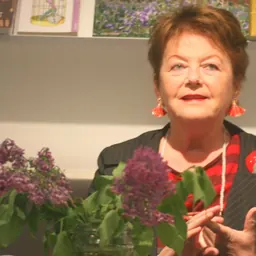
Born 1937. Marianne McDonald is an American linguist, translator, classical philologist, literary scholar, playwright and philanthropist.
Marianne McDonald (born January 2, 1937) is a scholar and philanthropist. She is involved in the interpretation, sharing, compilation, and preservation of Greek and Irish texts, plays and writings. Recognized as a historian on the classics, she has received numerous awards and accolades because of her works and philanthropy. As a playwright, she has authored numerous modern works, based on ancient Greek dramas in modern times. In 2013, she was awarded the Distinguished Professor of Theatre and Classics, Department of Theatre, Classics Program, University of California, San Diego (joint program with UC Irvine). In 1994, she was inducted into the Royal Irish Academy, being recognized for her expertise and academic excellence in Irish language history, interpretation and the preservation of ancient Irish texts. As a philanthropist, she partnered with Sharp to enhance access to drug and alcohol treatment programs by making a $3 million pledge—the largest gift to benefit behavioral health services in Sharp's history. Her donation led to the creation of the McDonald Center at Sharp HealthCare. Additionally, to recognize her generosity, Sharp Vista Pacifica Hospital was renamed Sharp McDonald Center.
Early life McDonald was born on January 2, 1937, in Chicago. She went to school at the Convent of the Sacred Heart there and finished her secondary education at the Chicago Latin School. It was in these years that she gained a love for Latin, Greek, and the classics. In 1958, she graduated magna cum laude from Bryn Mawr College with a Bachelor of Arts degree in the classics and music. In 1960, she continued her education by getting a master's degree from the University of Chicago and by earning a doctorate in 1975 from the University of California, Irvine.
She credits her love for learning from her father, Eugene Francis McDonald. He grew up in New York City and became the head of the family at age twelve when he had to drop out of school in order to support his family. After having gone deaf, he invented the Zenith hearing aid and created the Zenith Radio Corporation. When he died in 1958, he left Marianne a large fortune and a collection of gifts that furthered her interest in Ireland and the desire to give generously. She has also been a visiting professor of classics at Trinity College, Dublin, University College Dublin, University College Cork, Dublin City University, and the University of Ulster in Coleraine.
As a pioneer in the field of modern versions of the classics, in films, plays, and opera, McDonald has published much work on the subjects. With about 250 publications, in addition to her articles and book chapters, her published books include: Euripides in Cinema: The Heart Made Visible (Centrum Press, 1983), Ancient Sun, Modern Light: Greek Drama on the Modern Stage (Columbia University Press, 1992); Sing Sorrow: Classics, History and Heroines in Opera (Greenwood, 2001); and The Living Art of Greek Tragedy (Indiana University Press, 2003); with J. Michael Walton: Amid Our Troubles: Irish Versions of Greek Tragedies (Methuen, 2002); and The Cambridge Companion to Greek and Roman Theatre (2007). Her performed translations (three a year since 1999 nationally and internationally with many published) include: Sophocles's Antigone, dir. Athol Fugard in Ireland (1999); Trojan Women (2000 and 2009); Euripides's Children of Heracles (2003); Sophocles's Oedipus Tyrannus and Oedipus at Colonus (2003–4); Euripides's Hecuba, 2005, Sophocles's Ajax, 2006, Euripides's Iphigenia at Aulis and Bacchae, 2006; and 2007 and 2009; Euripides's Phoenician Women, (2009); Medea (2007); Seneca's Thyestes (2008) and with J. Michael Walton Aeschylus's Oresteia and Aristophanes's Frogs (2007); Helen (2008); versions and other works : The Trojan Women (2000); Medea, Queen of Colchester (2003), The Ally Way (2004)... and then he met a woodcutter (San Diego Critics’ Circle: Best New Play of 2005), Medea: The Beginning, performed with Athol Fugard’s Jason: The End (2006); The Last Class (2007); Fires in Heaven (2009), and A Taste for Blood (2010).
Selected publications Terms for Happiness in Euripides. Hypomnemata, Vol. 54 (Vandenhoeck & Ruprecht, 1978); Greek Translation by Errikos Belies (1991). Euripides in Cinema: The Heart Made Visible (Philadelphia: Centrum, 1983); Greek translation by Errikos Belies (Athens: Estia, 1989; rpt. Boston: The Greek Institute, 1991); Italian translation: Sole Antico, Luce Moderna, trans. of Ancient Sun, 1999), with an expanded introduction, epilogue and additional chapter, Dioniso Nero: la tragedia greca dell'Africa ("Black Dionysus: Greek Tragedy in Africa"). Ancient Sun, Modern Light: Greek Drama on the Modern Stage. (Columbia University Press, 1992); Greek Translation by Paulos Matesis, (1993). Mythology of the Zodiac: Tales of the Constellations (MetroBooks, 2000); Sophia Souliotis, trans. (Periplous, 2002). Published in England as Star Myths: Tales of the Constellations (Michael Friedman Publishing Group, June 5, 1996); Published in America as Tales of the Constellations: The Myths and Legends of the Night Sky. (Michael Friedman Publishing Group), Sole Antico, Luce Moderna, Translation of Ancient Sun, Modern Light by Francesca Albini (Levante, 1999), with an expanded introduction, epilogue and additional chapter, Dioniso Nero: la tragedia greca dell'Africa ("Black Dionysus: Greek Tragedy in Africa"). Antigone by Sophocles, Translation with Introduction, (Nick Hern Books, 2000). Sing Sorrow: Classics, History and Heroines in Opera (Greenwood Publishing Group, 2001). Andromache by Euripides, Translation with Introduction, with J. Michael Walton (Nick Hern Books, 2001). Euripides’ Trojan Women in Six Greek Tragedies: Aeschylus: Persians, Prometheus Bound; Sophocles Women of Trachis, Philoctetes; Euripides Trojan Women, Bacchae, Translation, Introduction and Edited, with Michael Walton (Methuen Publishing, 2002). Amid Our Troubles: Irish Versions of Greek Tragedy, Edited with Michael Walton (Methuen Publishing, 2002). The Living Art of Greek Tragedy (Indiana University Press, 2003). Fragments: Poems (Quantum 2, 2003). …and then he met a woodcutter, Illustrations by Jasmine de Lung (Quantum 2, 2003). Electra, by Euripides, Translation with Introduction with Michael Walton (Nick Hern Books, 2004). Electra, by Sophocles, Translation with Introduction with Michael Walton (Nick Hern Books, 2004). Euripides’ Hecuba, Translation with Introduction (Nick Hern Books, 2005). Aeschylus: The Oresteia, Translation with Introduction with J. Michael Walton (Nick Hern Books, 2007). The Cambridge Companion to Greek and Roman Theatre, Edited with J. Michael Walton, including introduction and chapter, (Cambridge University Press, 2007) Sophocles Made New: Modern Performance Prof. Marianne McDonald, University of California, San Diego, in Brill's Companion to Sophocles, Andreas Markantonatos, ed. (Leiden: Brill Publishers, 2012). The Craft of Athol Fugard: Space, Time, and Silence (Murasaki books, 2012). Medea, Queen of Colchester in Black Medea: Adaptations in Modern Plays, ed. Kevin Wetmore Jr. Amherst, New York: Cambria Press (Global Performing Arts Series, General Editor: John M. Clum), 2013. Croaks into Song: Sondheim Tackles Greek Frogs book chapter in Oxford Handbook of Sondheim Studies, ed. Robert Gold (Oxford: Oxford University Press, 2014). Dancing Drama: Ancient Greek Theatre in Modern Shoes and Shows book chapter for Oxford Handbook on Dance and Theatre, edited by Nadine George (Oxford: Oxford University Press, 2015).
Don’t just read it —
keep it.
Full-length biographies made to live with: read them, listen on the way to work, watch them tonight.
- E-book
- Audio
- Video
Instant download · yours to keep · every purchase keeps this site free
Important facts
Family & relationships
People in Marianne McDonald's life
Named in this biography and alive at the same time







Related people
Same field, nearest in time


Contemporaries
People whose lives overlapped Marianne McDonald's


Frequently asked questions
Who is Marianne McDonald?
American philanthropist and scholar (born 1937)
When was Marianne McDonald born?
Marianne McDonald was born on 2 January 1937 in Chicago.
What is Marianne McDonald's occupation?
Marianne McDonald is a linguist, translator, classical philologist, literary scholar, playwright and philanthropist.
What nationality is Marianne McDonald?
Marianne McDonald is American.
Sources & further reading
· Wikipedia: Marianne McDonald
Cite this page
APA: Biography.guide. (2026). Marianne McDonald. https://biography.guide/marianne-mcdonald/
MLA: "Marianne McDonald." Biography.guide, https://biography.guide/marianne-mcdonald/.
Chicago: "Marianne McDonald." Biography.guide. https://biography.guide/marianne-mcdonald/.
Data last updated: 2026-09-20 · Spot an error? Report a correction.
Page generated 2026-09-27 05:28 UTC