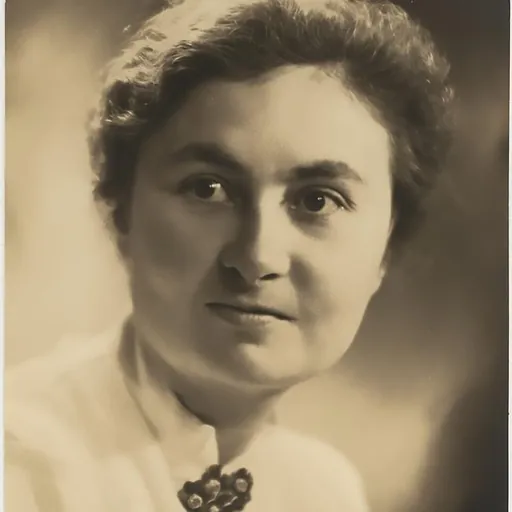
About Marianne Angermann
Lived 1904 – 1977 (aged 72–73). Marianne Angermann was a German, New Zealand and Spanish scientist and chemist.
Mathilde Marianne Bielschowsky (; 30 June 1904 – 1977) was a German-born Spanish–New Zealand biochemist and anti-fascist. Trained at the universities of Greifswald, Freiburg, Cologne, and Bonn, she earned a doctorate in chemistry in 1928 and later studied medicine. After leaving Germany in 1935 in opposition to the Nazi regime, she worked at the in Madrid, where she collaborated with fellow German emigrant Franz Bielschowsky. During the Spanish Civil War, Angermann volunteered as a medical laboratory chemist for the Republican forces while Bielschowsky served as a physician.
The couple married in Madrid in 1938 and, following the Republican defeat, fled to the United Kingdom, where they both worked at the University of Sheffield during the Second World War. In 1948 they emigrated to New Zealand, conducting cancer research at the University of Otago. Angermann developed a strain of New Zealand black mice used in laboratory studies, and her letters from Madrid between 1935 and 1939 were later published as ('Letters of an Anti-Fascist').
Early life Mathilde Marianne Angermann was born on Stefanienstrasse, Dresden, Germany on 30 June 1904. The Angermanns were an established Saxon family.
Education Angermann took the university entrance diploma at Realgymnasium Langenberg in March 1922, achieving "very good" grades in mathematics and physics, and "good" grades in her other subjects, with the exception of religion. At the time, it was uncommon for women to proceed so far into their education. Angermann's diploma had to be manually adjusted to strike out male pronouns. Later in the year, she enrolled in the University of Greifswald. Angermann found temporary residence in Plaza de las Cortes, later moving into an apartment in Calle Francisco de Rojas. with Angermann taking his surname.
Angermann developed a strain of New Zealand black mice in Dunedin through inbreeding. The strain, developed in the Cancer Research Laboratory in the University of Otago, found the presence of hemolytic anemia in mice. She lived in Dunedin from her arrival to the country until her death in 1977. Her husband died in 1965.
Don’t just read it —
keep it.
Full-length biographies made to live with: read them, listen on the way to work, watch them tonight.
- E-book
- Audio
- Video
Instant download · yours to keep · every purchase keeps this site free
Important facts
Related people
Same field, nearest in time


Contemporaries
People whose lives overlapped Marianne Angermann's



Frequently asked questions
Who was Marianne Angermann?
German-born New Zealand research scientist
When was Marianne Angermann born?
Marianne Angermann was born on 30 June 1904 in Dresden.
When did Marianne Angermann die?
Marianne Angermann died in 1977 in Dunedin.
What was Marianne Angermann's occupation?
Marianne Angermann was a scientist and chemist.
What nationality was Marianne Angermann?
Marianne Angermann was German, New Zealand and Spanish.
Sources & further reading
· Wikipedia: Marianne Angermann
Cite this page
APA: Biography.guide. (2026). Marianne Angermann. https://biography.guide/marianne-angermann/
MLA: "Marianne Angermann." Biography.guide, https://biography.guide/marianne-angermann/.
Chicago: "Marianne Angermann." Biography.guide. https://biography.guide/marianne-angermann/.
Data last updated: 2026-09-22 · Spot an error? Report a correction.
Portrait: Wikimedia Commons · author & licence
Page generated 2026-09-27 05:04 UTC