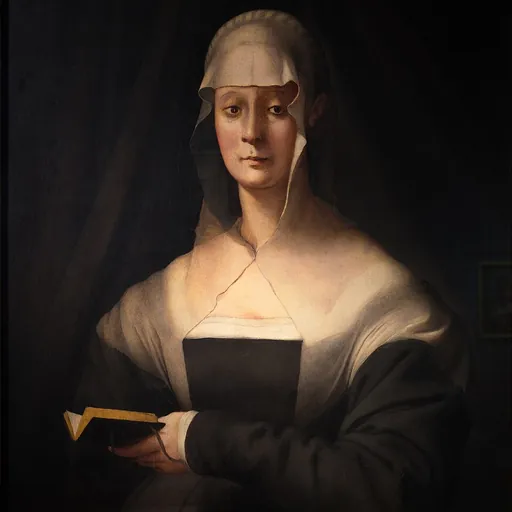
About Maria Salviati
Lived 1499 – 1543 (aged 44). Maria Salviati was an aristocrat.
Maria Salviati (17 July 1499 – 29 December 1543) was a Florentine noblewoman, the daughter of Lucrezia di Lorenzo de' Medici and Jacopo Salviati. She married Giovanni delle Bande Nere and was the mother of Cosimo I de Medici. Her husband died 30 November 1526, leaving her a widow at the age of 27. Salviati never remarried; after her husband's death she adopted the somber garb of a novice, which is how she is remembered today as numerous late portraits show her attired in black and white.
Life Maria Salviati was born in Florence. She descended from two of Florence's most powerful banking families: the Salviati on her father's side, and the de' Medici on her mother's. Her maternal grandfather was Lorenzo "il Magnifico".
When her cousin, Alessandro de' Medici was assassinated in 1537, Maria used her family connections to get involved in the discussions to decide the next Duke of Florence.
Cosimo married Eleonora di Toledo in 1539. It was rumoured that Eleonora refused to tolerate Bia's presence in the palace after their marriage so Cosimo sent Bia off to live with Maria. Other sources say that Eleonora brought Bia up very lovingly. Bia shared a nursery with Giulia de' Medici an illegitimate daughter of Alessandro de' Medici, Duke of Florence, the pair being close in age. Maria knew who Bia's mother was but she would never tell Bia or anyone else the name of the woman. Both Bia and her cousin Giulia contracted a virulent fever; Giulia recovered from the illness but Bia only worsened and eventually died on 1 March 1542 aged only five years. Maria and Cosimo were said to be very sad by her loss.
Maria died one year after Bia on 29 December 1543.
Portrait of Maria Salviati with Giulia de' Medici
Maria Salviati with Giulia de' Medici, by Pontormo, c. 1537; Oil on panel, Baltimore, The Walters Art Museum
In the portrait called "Maria Salviati with Giulia de' Medici", there are many theories on who the portrait portrays. However, the almost universally accepted portrait is the one depicted by Pontormo in 1543-1544. The different theories arise from the overpainting of the portrait as well as the views of different sellers.
At the end of the nineteenth century, the work was attributed to Piombo where the portrait looked different by the child being taken out and the single women identified as being Vittoria Colonna. Others came forward disagreeing with the gender of the child asserted in King's argument. It was not until 1992, where Gabrielle Langdon proposed the painting of the child to not only be a girl, but Giulia de' Medici. He was able to discover this based on the different attributes the painting held. He pointed out that the child was under the age of seven, the connection between the bare throat of Maria's and the child is strong showing femininity, as well as being shown as vulnerable under the protection of Maria Salviati. The beginning of her interaction with medicine took place in the 1530-1540s as a household healer. Her familiarities arose in remedies and health regimens which left impacts on pharmacy, pediatrics, and local healing. One of the more significant recipe books believed to be in Salviati's hand was an Italian recipe book compiled by Caterina Sforza (1463–1509), her mother-in-law.
Maria Salviati's influence in medicine abundant with pediatrics. With her medical knowledge, she partook in overseeing practices with Wet nursing and the selection process, which was uncommon at the time, for the Medici ducal couple's offspring. In the 1540s, Maria started to decline in health where the court physician, Andrea Pasquali, included symptoms such as recurring proctorrhagia, headaches, and rectal and perianal ulcers. To further back the evidence of Maria's effect with syphilis, scientists and archeologist exhumed her skeletal remains and performed studies. Studies showed that Maria had lytic lesions in her skull which strongly suggest tertiary syphilis.
Ancestors
Descendants Salviati's descendants became crowned figureheads of Europe over the succeeding generations. Her grandson Francesco I de' Medici married Johanna of Austria; they were the parents of Eleonora de' Medici, who married Vincenzo I Gonzaga and was the mother of Francesco IV Gonzaga. Francesco and Johanna's other daughter was Marie de' Medici, who married Henry IV of France and was the mother of Louis XIII and Henrietta Maria of France. Louis was the father of Louis XIV, Henrietta Maria was the mother of Charles II of England and James II of England.
Don’t just read it —
keep it.
Full-length biographies made to live with: read them, listen on the way to work, watch them tonight.
- E-book
- Audio
- Video
Instant download · yours to keep · every purchase keeps this site free
Important facts
Family & relationships
People in Maria Salviati's life
Named in this biography and alive at the same time
Related people
Same field, nearest in time




Contemporaries
People whose lives overlapped Maria Salviati's


Frequently asked questions
Who was Maria Salviati?
florentine noblewoman
When was Maria Salviati born?
Maria Salviati was born on 17 July 1499 in Florence.
When did Maria Salviati die?
Maria Salviati died on 12 December 1543 in Villa Castello.
What was Maria Salviati's occupation?
Maria Salviati was an aristocrat.
Sources & further reading
Cite this page
APA: Biography.guide. (2026). Maria Salviati. https://biography.guide/maria-salviati/
MLA: "Maria Salviati." Biography.guide, https://biography.guide/maria-salviati/.
Chicago: "Maria Salviati." Biography.guide. https://biography.guide/maria-salviati/.
Data last updated: 2026-09-24 · Spot an error? Report a correction.
Portrait: Wikimedia Commons · author & licence
Page generated 2026-09-27 05:09 UTC