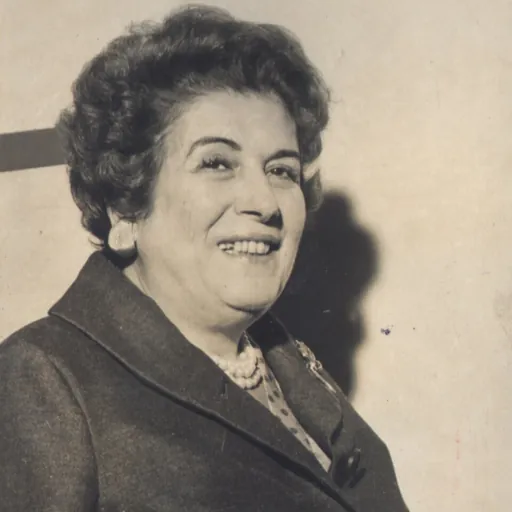
About Maria Martins
Lived 1894 – 1973 (aged 78). Maria Martins was a Brazilian sculptor, jeweler, poet, art collector, printmaker and ceramicist.
Maria Martins (born Maria de Lourdes Alves; 7 August 1894 – 27 March 1973) was a Brazilian visual artist who was particularly well known for her modern sculptures.
Early life Maria de Lourdes Alves was born on 7 August 1894 in Campanha, Brazil to a minister father and a pianist mother. Her first husband was a literary critic named Otavio Tarquinio de Souza, with whom she had a daughter.
Maria Martins is known in the international world as "the sculptor of the tropics" and "the great sculptor of Surrealism".
Career Martins studied in diverse geographical locations in her early years, representing a time frame 1894 to 1938. Her initial education was in music at a French school in Rio de Janeiro, pursuing a career as a professional musician. Early in her first marriage she became interested in sculpture, and studied in Paris under Catherine Barjansky. Also in 1943 she met André Breton and other surrealists in exile and collaborated with them in the surrealist journal VVV. She took part in the International Surrealist Exhibition in Paris in 1947. Martins came to the surrealist movement late. She borrowed from artists like Giacometti, Ernst, and Arp. Martins learned to work in bronze from Jacques Lipchitz, whose influence can perhaps be seen in “Impossible III” (1946). Brazilian anthropophagy and cannibalism interested Martins and informed much of her later work. Example of this can be seen in works like her 1942 sculpture "Yara", inspired by the Tupi or Guarani Indian myth of a man-eating river goddess. Yara would sing her song of seduction to passing men enticing them to visit her jungle domain where she would devour them, like an insect in a Venus flytrap. Imagery like this caught the attention of Surrealist Movement founder, Andre Breton, at her 1943 exhibition at the Valentine Gallery. Here, Breton connected Maria's interest in the mythology of the Amazon River with his own desire to create new myths to base a future society on. Breton recounted the impact Martin’s sculpture had on him in his preface to her 1947 exhibition at the Julien Levy Gallery:"Maria's sculpture began to carry a whole legend on its shoulders, a legend that was nothing less than the Amazon itself. Sculpture garlanded, like the Amazon’s own waters, with tropical creepers. This legend sang in those works of hers, which I had the chance to see in New York in 1943 and admired so greatly. Just as it sang with all its immemorial voices man’s passion from birth to death, re-created in symbols of unparalleled denseness by the Indian tribes which have succeeded each other along those treacherous banks. In her bronzes...Maria has succeeded marvelously in capturing at their primitive source not only anguish, temptation and fever, but also the sunrise, happiness and calm, and even occasionally pure delight; she is the emanation of all these things, all these wings and flowers. Maria owes nothing to the sculpture of the past or the present—she is far too sure, for that, of the original rhythm, which is increasingly lacking in modern sculpture; she is prodigal with what the Amazon has given her—the overwhelming abundance of life." In 2009, members of Martins's family released letters written by Duchamp and Martins that substantiated previous claims that Martins was indeed the model for the nude figure in Duchamp's final masterpiece, the Étant donnés, as opposed to his wife Teeny. It is now widely acknowledged that Martins was the model for the reclining nude torso in Duchamp's installation piece and that his wife Alexina (Teeny) served only as the model for the figure's arms.
On her return to Brazil in 1949, critics in Brazil did not favor her work, feeling it was non-traditional and too erotic. Metropolitan Museum of Art Brooklyn Museum The Baltimore Museum of Art
Don’t just read it —
keep it.
Full-length biographies made to live with: read them, listen on the way to work, watch them tonight.
- E-book
- Audio
- Video
Instant download · yours to keep · every purchase keeps this site free
Important facts
People in Maria Martins's life
Named in this biography and alive at the same time


Related people
Same field, nearest in time



Contemporaries
People whose lives overlapped Maria Martins's


Frequently asked questions
Who was Maria Martins?
Brazilian sculptor, designer, writer, painter, writer and musician (1894-1973)
When was Maria Martins born?
Maria Martins was born on 7 August 1894 in Campanha.
When did Maria Martins die?
Maria Martins died on 27 March 1973 in Rio de Janeiro.
What was Maria Martins's occupation?
Maria Martins was a sculptor, jeweler, poet, art collector, printmaker and ceramicist.
What nationality was Maria Martins?
Maria Martins was Brazilian.
Sources & further reading
· DBpedia: Maria Martins (artist)
Cite this page
APA: Biography.guide. (2026). Maria Martins. https://biography.guide/maria-martins-sculptor/
MLA: "Maria Martins." Biography.guide, https://biography.guide/maria-martins-sculptor/.
Chicago: "Maria Martins." Biography.guide. https://biography.guide/maria-martins-sculptor/.
Data last updated: 2026-09-22 · Spot an error? Report a correction.
Portrait: Wikimedia Commons · author & licence
Page generated 2026-09-27 05:01 UTC