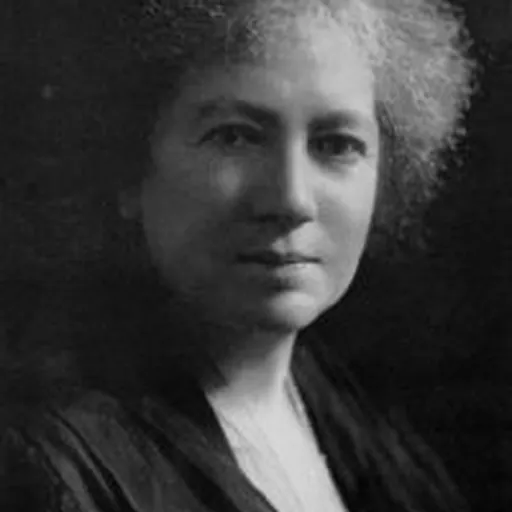
About Maria Gordon
Lived 1864 – 1939 (aged 75). Maria Gordon was a British geologist, paleontologist and zoologist, known for Dolomites.
Dame Maria Matilda Gordon (née Ogilvie; 30 April 1864 – 24 June 1939), sometimes known as May Ogilvie Gordon or May Gordon, was an eminent Scottish geologist, palaeontologist, and politician. She was the first woman to be awarded a Doctor of Science degree from the University of London and the first woman to be awarded a PhD degree from the Ludwig-Maximilians-Universität München. She was also a supporter and campaigner for the rights and equality of children and women.
Early life and education Ogilvie was born in Monymusk, Aberdeenshire in April 1864, the eldest daughter of eight children (five brothers and two sisters, one of whom passed away in infanthood). With her parents being Maria Matilda Nichol and the Reverend Alexander Ogilvie LL.D., Thus, she and her siblings all experienced a profound education. From the experiences she had with her older brother, Gordon gained remarkable talents for observation with quick intuitive understandings and an inexhaustible enthusiasm for fieldwork. This is where their love for geology began. Maria's original dream prior to science was to become a professional pianist. She continued her music career by attending the Royal Academy of Music in London.
Research All of Maria Gordon's geological research was carried out in the South Tyrol. This area of the Alps is part of the geologically-complex Dolomites. These are a very distinct range of mountains, characterized by high, dramatic peaks, which were thought to have been formed from the remains of coral atolls in an ancient sea. Gordon challenged this idea with her theory of 'crust-torsion', the notion that the mountains had been formed by the pushing, twisting, and folding of the Earth's crust. Through observation and measurement of the geological structures in the Dolomites, she was able to determine that there were two phases of folding and structural deformation, leading to a new interpretation of the tectonic structure of the Alps.
In total, she wrote more than 30 papers based on her research and findings in this region, some of which are considered seminal works. Her biographer described her as "probably the most productive woman field geologist of any country in the late 19th and early 20th centuries." Throughout Maria’s many years of research, she was able to produce a 78-page article in February 1893 for the Geological Society’s Quarterly Journal. It was illustrated with many drawings and entitled Contributions to the geology of the Wengen and St. Cassian Strata in southern Tyrol. Being a single woman in this area she attracted attention, but she was ambitious and determined, as is shown in her perseverance to forward knowledge, even when she received no acknowledgement or recognition. This is something she highlighted in her reply to the President of the Geological Society years later, when she received her Lyell Medal (Ogilvie Gordon 1932), and once she had set her mind on something; nothing and nobody could distract her. The fact that she carried on her research in later years as a married woman showed her determination. Through the years she was very successful with her work, taking only a year to discover sites that allowed her to draw conclusions on development about corals, sponges, and other marine life which took place 230 million years ago. In 1893, she was awarded the Doctor of Science in Geology from the University of London, becoming the first woman to receive this degree. In 1900, she and Agnes Kelly became the first women to be awarded a PhD from the Ludwig-Maximilians-Universität München, receiving a distinction in the fields of geology, paleontology, and zoology. In October of the same year, Gordon published her new theory on 'crust-torsion' in the Royal Geographical Society entitled The origin of land-forms through crust-torsion, that then challenged the way people saw how the Dolomites were formed, and eventually this theory was accepted by the scientific community.
By the year 1913, Maria Gordon had written many geological surveys, analyses, and sample collections about the Dolomites, until she finally had enough to publish a general explanation and study of the geomorphological processes that had led to their mountainous creation. Maria had written hundreds of pages worth of research that she intended to have translated and published in German, and this research also included a very detailed geological map that she had coloured by hand. With this significant amount of work done, she sent all of her work to the head of the Paleontological Institute of the Ludwig-Maximilians-Universität München at the time, August Rothpletz. Rothpletz had previously looked down on her work and capabilities because of the fact she was a woman, but eventually confirmed much of her research and became a very close friend of hers. Once he had Maria’s collected work, she sent it on to a student who could successfully translate it from English to German. Progress was going along well, and the first few of Gordon’s maps had been drawn on lithographic stone and were set to begin the printing process when World War I began in 1914. Due to the social and political conflicts between Germany and England at the time, the progress on Maria’s research stopped, and as she busied herself with helping the war efforts in Britain there was no time for more geological work. To add to Maria’s disappointment over her still in-progress publication, in 1918 August Rothpletz died. This meant that after the war there was no trace of her manuscript or the name of the student who was in the midst of translating it. This devastated Maria as not only did she lose her colleague and friend, but she had also lost years' worth of research and hard work. On February 8, 1922 she was selected as prospective parliamentary candidate for David Lloyd George supporting National Liberals at the Canterbury constituency. A General Election was called for November 1922 but on November 3, she withdrew. Electorate 29,662
As an advocate of women's rights, she served as Vice President of the International Council of Women, Honorary President of the Associated Women's Friendly Society and the National Women's Citizens Association, and also as President of the National Council of Women of Great Britain and Ireland. She played an important part in the post-World War I negotiations at the Council for the Representation of Women in the League of Nations.
Honours and awards Over the years, Maria Gordon earned numerous awards for her contributions to science specifically, geology. In 1890, Maria Gordon graduated from the University College of London with a gold medal in geology, zoology, and botany. In 1893, she was the first female to receive a Doctor of Science (DSc) in Geology from the University of London. Following her Doctorate, in 1900, Maria Gordon and Agnes Kelly became the first women to receive a PhD from the Ludwig-Maximilians-Universität München. She played an active role in the World War one negotiations while a part of the council. A room in the Ludwig-Maximilians-Universität München's library is named in her honour as the Maria-Ogilvie-Gordon-Raum and it houses the map collection of the Department of Geology.
Gordon's work in Geology and Politics is still recognised today. In 2000, a new fossilized fern genus was found in the Triassic layer of the Dolomites and named after Maria Gordon and Carmela Loriga Broglio in honour of both of their work in the Dolomites, called Gordonopteris lorigae.
Don’t just read it —
keep it.
Full-length biographies made to live with: read them, listen on the way to work, watch them tonight.
- E-book
- Audio
- Video
Instant download · yours to keep · every purchase keeps this site free
Important facts
People in Maria Gordon's life
Named in this biography and alive at the same time


Related people
Same field, nearest in time




Contemporaries
People whose lives overlapped Maria Gordon's




Frequently asked questions
Who was Maria Gordon?
Scottish geologist (1864-1939)
When was Maria Gordon born?
Maria Gordon was born on 30 April 1864 in Monymusk.
When did Maria Gordon die?
Maria Gordon died on 24 June 1939 in Regent's Park.
What was Maria Gordon's occupation?
Maria Gordon was a geologist, paleontologist and zoologist.
What was Maria Gordon known for?
Maria Gordon was known for Dolomites.
What nationality was Maria Gordon?
Maria Gordon was British.
Sources & further reading
Cite this page
APA: Biography.guide. (2026). Maria Gordon. https://biography.guide/maria-gordon/
MLA: "Maria Gordon." Biography.guide, https://biography.guide/maria-gordon/.
Chicago: "Maria Gordon." Biography.guide. https://biography.guide/maria-gordon/.
Data last updated: 2026-09-20 · Spot an error? Report a correction.
Portrait: Wikimedia Commons · author & licence
Page generated 2026-09-27 04:58 UTC