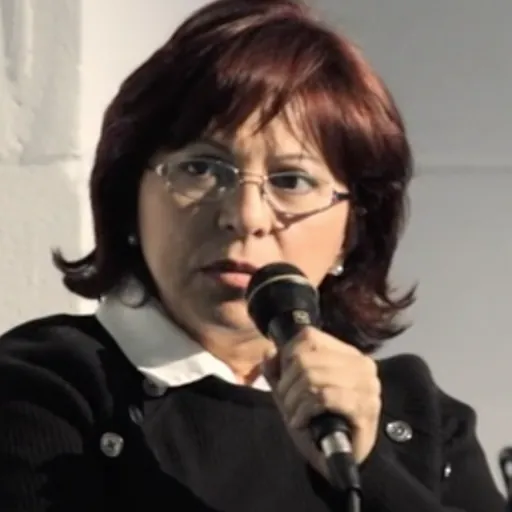
About María Evelia Marmolejo
Born 1958. María Evelia Marmolejo is a Colombian artist, performance artist and body artist.
María Evelia Marmolejo (born 1958) is a Colombian radical feminist performance artist, later based in Madrid and New York City. She is credited by the Colombian scholar María Lovino with staging the first work of feminist performance art in Colombia, in 1981. She is best known for discussing controversial themes such as political oppression, feminism, environment, and socioeconomic issues within her performances.
Early life Marmolejo was born in Pradera, Colombia, in 1958. Raised in a Catholic family with four brothers, from an early age she became displeased with the idea of machismo and her inferior role in a male-dominated society, which led her to express this frustration in future artworks such as "Tendidos". As a child she took part in neighborhood theater classes and also participated in a theater workshop in art school, both largely influencing her passion for performing. She found performance art suitable for her as it gave her an outlet to express her anger and distress towards her country's political turmoil at the time, as well as her own struggles with being a woman.
Education
Art student: Universidad de Santiago de Cali (1978-80) María Evelia Marmolejo studied art and obtained her B.F.A at La Universidad de Santiago de Cali, in Cali, Colombia, from 1978 to 1980, after realizing in previous years that studying law was not something that interested her. Here, she created her first installation for her final exam in 1979 titled "Tendidos", where she hung both used and unused pads from a clothing rack, which was hanging from a butchers hook. This was her first use of blood, which she would go on to use in other works to speak on the violence going on in her country. The piece as a whole was meant to protest the rape and torture of Colombian women by the Colombian army. During her final drawing test at the school, she cut her index finger and used her blood to draw a line on posters, illustrating how Colombia's political violence was continuous, but not a straight line, and also expressing her belief that a drawing did not have to be made out of the traditional paper and pencil. Consequently, she was failed out of art school when her professors did not accept either of the works. Once Marmolejo left art school, she decided to concentrate on performance art, having been inspired by artists including Lygia Clark, Yeni and Nan, and Carlos Zerpa.
Masters and other education Marmolejo also studied video and television at the Centro de Estudios de la Imagen in Madrid, Spain in 1986. Furthermore, she went on to obtain her Master of the Arts and Humanities from The City University of New York in New York, New York in 2008.
Artwork Marmolejo's works deal with themes of gender, colonialism, and political oppression in Colombia. Her first performances span the years 1981-1985, after which there was an almost thirty-year period during which she rarely performed; she became publicly active again in 2013. She has staged her performances at major institutions such as the Museum of Modern Art of Bogota, Museum of Modern Art Cartagena, and the Contemporary Art Museum Guayaquil, as well as in more secluded sites. Her performances in the 1980s often included bodily fluids and infliction of injury to herself, in works responsive to political oppression in Colombia, the social conditions of women, the political context of women's bodies, and environmental issues. "Anonimo 1" also marked the beginning of her often utilizing self-harm as a technique to express herself in her performances and easily capture the attention of her audiences.
11 de Marzo-1982 In 1982 Marmolejo produced her most famous and also most controversial performance titled "11 de Marzo." The performance consisted of her inducing her period, and was meant to celebrate it as a natural part of life rather than something to be ashamed of. Marmolejo arranged paper on the floor in an L shape and walked naked over it so that her blood would drip on it, all while playing flushing sounds in the background. The majority of her body was covered in pads, and she also danced while rubbing her pubic area against the paper and the walls. This performance was a way for her to express a part of her that had always been looked down upon by society, as well as a way to free herself and finally accept the natural functions of her body. It was seen as very rebellious as she turned a part of womanhood that was traditionally seen as a weakness, and an attribute contributing to a woman's presumed inferiority, and turned it into a strength.
Anonimo 3 and 4-1982 Marmolejo also produced "Anonimo 3", which spoke on the need to focus on the environment. This was a private 15-minute performance that occurred near the Cauca River in Colombia, meant as a sort of apology for all of the pollution that humanity had created on earth, as was represented by the river. In this performance, Marmolejo covered herself in gauze and performed a healing ritual where she gave herself a vaginal washing meant to fertilize the ground and get rid of the pollution.
"Anonimo 4" was produced the same year. In a similar way to "Anonimo 3", it was a private performance that also took place by the Cauca River. In this presentation, she collected multiple placentas from nearby hospitals and placed them in a triangle that she dug in the ground. She then hung some placentas from her body using plastic strips and stood inside the triangle. This performance was effective in provoking people in the audience to both cry and vomit, as the smell of the placentas was so strong. The piece meant to emphasize the idea that being born into a world where one had to fight to survive was terrifying for many, including herself.
América-1985 Marmolejo became pregnant in 1985 and decided to exile herself to Madrid, Spain. The artist became aware that the Spanish would be celebrating 500 years of the discovery of the Americas, which led her to provide her point of view and protest the celebration through another performance titled "América." "América" took place on October 12, 1985, at the Plaza Colon in Madrid. Through the performance, Marmolejo expressed her belief that they should not be celebrating, but instead lamenting that day because the discovery of the Americas also marked the beginning of colonialism. At 12:00 noon the artist began distributing copies she had taken of Fray Bartolomé de la Casas' book, "Breve Destrucción de las Indias". She used some of the most tragic and graphic descriptions of conquest that de la Casas had described in his book as an attempt to convince people of the horrors of colonialism. She then proceeded to cutting her own fingers and using her blood to write the word "América" on the Christopher Columbus statue located in the plaza. The performance resulted in strong reactions from the public, with some people yelling at her to go back to her own country, and others yelling that she had the right to speak up because Spain was a free country. Plaza del Centro Administración Municipal de Cali. Cali, Colombia. (1981) Museo de Arte Moderno De Cartagena. Cartagena, Colombia. (1983, 1982) Performance/installation: XXIX Salón Nacional de Artes Visuales. Pasto, Colombia. (1984) Performance: Museo de Arte Contemporáneo y Pinacoteca. Guayaquil, Ecuador. (1984) Performance: Plaza Colón. Madrid, Spain. (1985) Performance. Anglo-American Hospital. Madrid, Spain. (1985). Performance/installation: 3a Bienal de Arte de Bogotá. Bogotá, Colombia. (1992) re.act.feminism – a performing archive at Centro Cultural Montehermoso Kulturunea, Vitoria Gasteiz, Spain (2011) Performance:“May 1st 1981- February 1st, 2013” Mandragoras Art Space (MAAS). Long Island City, New York. (2013) 19 Bienal de Arte Paiz. Lake Atitlan, Guatemala City, Guatemala. (2014) Engagement/Healing: “Extractivismo”, Milan, Italy. (2015) Grants & Commissions Program Exhibition: “Conciencia Dopada”, 2016. Performance. Liquid Sensibilities, CIFO – Cisneros Fontanals Art Foundation. Miami, Florida. (2016) Subverting the Feminine: Latin American (Re)Marks on the Female Body. Y Gallery (New York, NY). (2016-2017) The Political Body: Radical Women in Latin American Art: 1960-1985- Hammer Museum, Los Angeles, CA (2017)
Honors and awards Grants & Commissions Program Award (Achievement Award). CIFO – Cisneros Fontanals Art Foundation. Miami, Florida. (2016). the Brooklyn Museum in Brooklyn, New York, the Museo de Arte Moderno de Bogota in Bogota, Colombia, and the Instituto de Vision also in Bogota. Marmolejo continues to reside in New York and continues to create pieces that aim to connect past issues with the present and analyze what has changed over the years.
Don’t just read it —
keep it.
Full-length biographies made to live with: read them, listen on the way to work, watch them tonight.
- E-book
- Audio
- Video
Instant download · yours to keep · every purchase keeps this site free
Important facts
People in María Evelia Marmolejo's life
Named in this biography and alive at the same time
Related people
Same field, nearest in time



Contemporaries
People whose lives overlapped María Evelia Marmolejo's


Frequently asked questions
Who is María Evelia Marmolejo?
Colombian artist (born 1958)
When was María Evelia Marmolejo born?
María Evelia Marmolejo was born in 1958 in Pradera.
What is María Evelia Marmolejo's occupation?
María Evelia Marmolejo is an artist, performance artist and body artist.
What nationality is María Evelia Marmolejo?
María Evelia Marmolejo is Colombian.
Sources & further reading
· Wikipedia: María Evelia Marmolejo
· DBpedia: María Evelia Marmolejo
Cite this page
APA: Biography.guide. (2026). María Evelia Marmolejo. https://biography.guide/maria-evelia-marmolejo/
MLA: "María Evelia Marmolejo." Biography.guide, https://biography.guide/maria-evelia-marmolejo/.
Chicago: "María Evelia Marmolejo." Biography.guide. https://biography.guide/maria-evelia-marmolejo/.
Data last updated: 2026-09-22 · Spot an error? Report a correction.
Portrait: Wikimedia Commons · author & licence
Page generated 2026-09-27 05:03 UTC