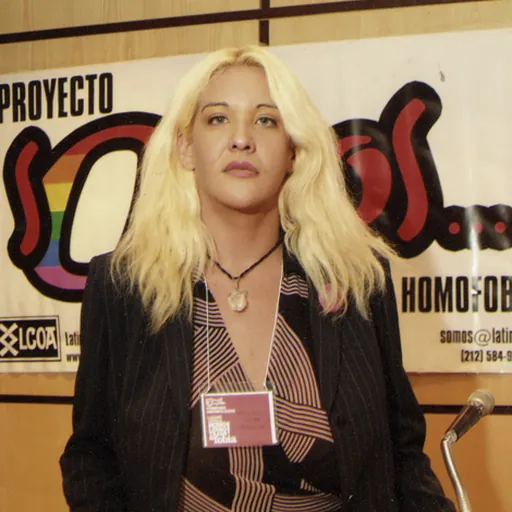
About María Belén Correa
Born 1973. María Belén Correa is an Argentine lGBTQ rights activist, trans activist and archivist.
María Belén Correa (born 25 June 1973) is an Argentine trans rights activist. In 1993, together with Claudia Pía Baudracco and other activists, she co-founded the Asociación de Travestis Argentinas (ATA; English: "Association of Travestis of Argentina"), later renamed Asociación de Travestis, Transexuales y Transgénero de Argentina (ATTTA; English: "Association of Travestis, Transsexuals and Transgender People of Argentina"), of which she was president from 1995 to 2001. The emergence of ATTTA was pioneering, as it not only kick-started the organized struggle for trans rights in Argentina but also became a crucial platform through which some of the most influential trans activists of the 1990s emerged and helped shape the country's broader LGBTQ movement.
Due to increasing police persecution, in 2001 Correa had to go into exile in New York and in 2004 she was officially granted political asylum in the U.S. During her exile in New York, she advanced her activism as co-founder of the Red Latinoamericana y del Caribe de Personas Trans (RedLacTrans; English: "Latin American and Caribbean Network of Trans People"), which brings together organizations from the region; collaborated in establishing Santamaría Fundación in Colombia, of which she is a patroness; founded the TransEmpowerment NY project, a Manhattan-based harm reduction center for LGBTQ individuals with drug addictions; and created Mateando, New York City's first group for LGBTQ Argentines and Uruguayans, under the Latino Commission on AIDS and the SOMOS program. The archive comprises over 25,000 items documenting the lives of trans individuals in Argentina, gaining national and international recognition for its role in disseminating materials through exhibitions and publications, as well as for its activist efforts. In addition to her work as director of the AMT, in 2019 Correa founded Cosmopolitrans, a project focused on helping trans migrants to Germany. At the age of 16, she escaped from the restrictive environment of her hometown and moved to the capital Buenos Aires, which allowed her to begin to start expressing her gender identity. In particular, the trans community of Buenos Aires was criminalized through edicts that punished individuals dressed in "clothing of the opposite sex" and those who "publicly incited or offered themselves to carnal acts", which were established in 1949 and remained in force for almost half a century, being applied indistinctly in dictatorial and democratic periods. This meant that trans people could be arbitrarily detained, locked up and often tortured and extorted without any guarantees, for simply walking down the street. On 25 June 1993, Baudracco threw a birthday party for Correa at her apartment, but the mood shifted when two invited guests failed to show, having been detained by the police. Correa's exile also underscored the broader reality faced by many non-activist trans women of that era and earlier, who were compelled to seek exile to live openly without fear of police persecution. Writing for elDiarioAR in 2023, she explained: "Leaving when you plan it as a hopeful future is not the same as leaving because your life is in danger. That’s what happened to me in 2001, when I fled persecution by the Argentine state. Police edicts, contravention codes, and misdemeanor codes enabled the persecution of the trans population without judicial oversight, under the pretext of addressing situations allegedly threatening social coexistence. In practice, they served only to unleash discriminatory biases and corruption, resulting in the near-total annihilation of an entire generation of trans people." In the same article, she described her exile years in the U.S. as those "when I suffered the most from exile; that pain that only those who left without wanting to do so feel." With the support from ATTTA, both activists attended an International Lesbian and Gay Association (ILGA) conference, where they created a communication channel exclusively for trans people, in an era before social media.
2012–present: Archivo de la Memoria Trans
Don’t just read it —
keep it.
Full-length biographies made to live with: read them, listen on the way to work, watch them tonight.
- E-book
- Audio
- Video
Instant download · yours to keep · every purchase keeps this site free
Important facts
People in María Belén Correa's life
Named in this biography and alive at the same time

Related people
Same field, nearest in time





Contemporaries
People whose lives overlapped María Belén Correa's



Frequently asked questions
Who is María Belén Correa?
Argentinian trans activist
When was María Belén Correa born?
María Belén Correa was born in 1973 in Luján Partido.
What is María Belén Correa's occupation?
María Belén Correa is a lGBTQ rights activist, trans activist and archivist.
What nationality is María Belén Correa?
María Belén Correa is Argentine.
Sources & further reading
· Wikipedia: María Belén Correa
Cite this page
APA: Biography.guide. (2026). María Belén Correa. https://biography.guide/maria-belen-correa/
MLA: "María Belén Correa." Biography.guide, https://biography.guide/maria-belen-correa/.
Chicago: "María Belén Correa." Biography.guide. https://biography.guide/maria-belen-correa/.
Data last updated: 2026-09-22 · Spot an error? Report a correction.
Portrait: Wikimedia Commons · author & licence
Page generated 2026-09-27 05:02 UTC