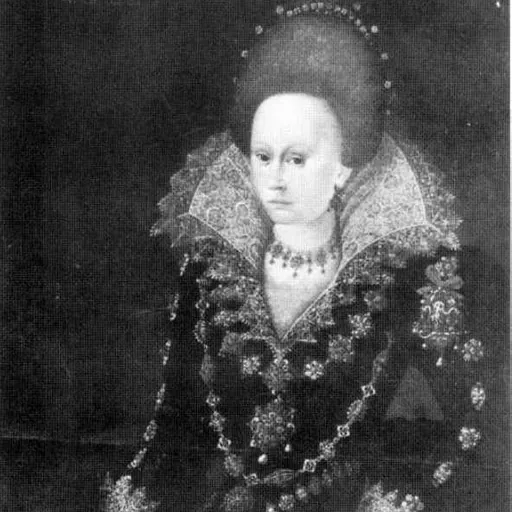
Margrethe of Slesvig-Holsten-Sønderborg
German Danish countess
About Margrethe of Slesvig-Holsten-Sønderborg
Lived 1583 – 1658 (aged 75).
Duchess Margaret of Schleswig-Holstein-Sonderburg (24 February 1583 – 10/20 April 1658), , official titles: Erbin zu Norwegen, Herzogin zu Schleswig, Holstein, Stormarn und der Dithmarschen, Gräfin zu Oldenburg und Delmenhorst), was a duchess from the House of Schleswig-Holstein-Sonderburg and through marriage Countess of Nassau-Siegen.
Biography Duke John II the Younger of Schleswig-Holstein-Sonderburg, Margaret's father. Margaret was born at Haus Sandberg am Alsensund near Sonderburg on 24 February 1583 as the youngest daughter of Duke John II the Younger of Schleswig-Holstein-Sonderburg and his first wife Duchess Elisabeth of Brunswick-Grubenhagen. Margaret's father was a younger brother of King Frederick II of Denmark.
Count John VII the Middle of Nassau-Siegen, Margaret's husband. Studio of Jan Antonisz. van Ravesteyn. Rijksmuseum Amsterdam. Margaret married at Rotenburg Castle on 27 August 1603 to Count John VII the Middle of Nassau-Siegen (, 7 June 1561 27 September 1623 ), the second son of Count John VI the Elder of Nassau-Siegen and his first wife Landgravine Elisabeth of Leuchtenberg. John the Middle was the widower of Countess Magdalene of Waldeck-Wildungen (1558 – Idstein Castle, 9 September 1599 ).
Margaret met John after he had served as commander-in-chief of the Swedish army in Livonia. Although he already had a son a year older than Margaret, they married. On 30 March 1607 the brothers divided their possessions. John acquired Siegen, Freudenberg, Netphen, Hilchenbach, and the Haingericht. Since the partition, John has had his Residenz in Siegen Castle, which he had renovated around that time.
When John received the County of Nassau-Siegen in 1607, he decided that such a small country (it had about 9,000 inhabitants and yielded an annual revenue of about 13,000 guilders) should not be divided up again. To avoid this, he made a will and testament, which stated that only the eldest son would rule and the other children should be compensated with money or offices. As one of the most convinced advocates of Protestantism, it was particularly painful for John that his second son, John the Younger, converted to the Catholic Church in 1613. In a codicil of 8 October 1613 John the Middle explicitly stipulated that his heirs had to keep the land in the Reformed confession. At first, the conversion of John the Younger to Catholicism did not change this house law established by the will, because he was not the eldest son. That was John John Ernest.
To the great surprise of his relatives, John the Younger joined the Spaniards in 1617 and thus joined the opponents of the House of Nassau and the Dutch Republic. In the same year, his older brother John Ernest died in the service of the Republic of Venice. The transition of John the Younger to the political enemy hit his father as hard as the conversion to Catholicism had hit him. This new situation forced John the Middle to ask himself whether an enemy of Nassau and the Netherlands could remain his heir at all. On 15 November 1617, John the Middle declared his will of 8 April 1607 to be null and void. Abolition of the primogeniture would have meant a division of the small country, and therefore John the Middle opposed all proposals in that direction. Instead, in an amicable agreement, he had his son sign a declaration on 31 December 1617, in which the latter declared that, although he himself was and remained a Catholic, he would not force his subjects to any other than the existing religious confession. All his brothers advised John the Middle to change the primogeniture, but he firmly trusted the word, the letter and the seal of his son. The administration of the city of Siegen would remain in joint ownership of the three sons.
For John the Younger, therefore, only one third of the county was provided for in the third will. On 6 August 1621, he was informed of this, with a precise statement of the reasons that had led his father to take this step. On 9 May 1623, i.e. not until two years later, John the Younger protested against this with a letter from Frankfurt to the councillors of Siegen. Of course, in the meantime he had not been idle and had not hesitated to denounce his father to the Emperor. At the time of his letter of protest he was certainly already aware of the Poenale mandatum cassatorium, which Emperor Ferdinand II officially issued some time later, on 27 June 1623, informing John the Middle that at the time of making his third will as a fellow combatant of the outlawed Winter King he was not entitled to make a will. He had to revoke it and answer to an imperial court within two months. It seems that John the Younger then shrank from having the imperial decree delivered to his seriously ill father. There he had planned a dignified burial vault for the dynasty he founded, in the St. Nicholas Church in Siegen. For this, there are remarkable notes in Latin, partly in elegiac couplets, for a projected memorial and burial place of the sovereign family, from the time around 1620, with the names of all 25 children from his two marriages, also with details of birth, marriage and death of his relatives. Since the project was not carried out, the burials of the members of the sovereign family between 1607 and 1658 took place in the inadequate burial vault under the choir of the mentioned parish church. With the exception of John Maurice and George Frederick, the younger brothers accepted only modest appanages. Henceforth, until 1645, the county of Nassau-Siegen had two governments, one in Siegen, the other in Hilchenbach. However, for a short period (1632–1635) this situation underwent a temporary change: during the Thirty Years' War, his brothers, who were fighting on the Protestant side, rebelled against John the Younger. Countess Dowager Margaret, through the mediation of Louis Henry, turned to Gustavus Adolphus and asked for help against the machinations of her stepson John the Younger. Consequently, on 14 February 1632 the Swedish king sent an order from Frankfurt to Louis Henry to provide military support for his first cousin John Maurice. Louis Henry then occupied the city of Siegen with his regiment of Dutch and Swedish soldiers. One day later, on 29 February, John Maurice and his brother Henry arrived in Siegen. Just as John the Younger had kept his cavalry in reserve eight years earlier, now John Maurice and Henry, supported by the presence of the Swedish regiment, negotiated with the citizens, who felt bound by the oath they had sworn to John the Younger. On 4 March, after long and difficult negotiations, the citizens paid homage to John Maurice and Henry. John Maurice obtained for himself not only the Freudenberg district, which his father had intended for him in the will of 1621, but also Netphen, which had been intended for John the Younger in the same will. William was not only confirmed in the possession of Hilchenbach, but also received Ferndorf and Krombach, as stipulated in his father's will. The city of Siegen paid homage only to William and John Maurice, who only in 1635 admitted their elder brother John the Younger back into co-sovereignty. However, the latter soon restored the old order: in 1636, he again became the sole owner of his father's property, with the exception of Hilchenbach, which he left to William, and he again governed the city of Siegen alone. John Maurice was again excluded from the county's sovereignty.
John the Younger died in Ronse on 27 July 1638. On 22 January 1645, after his return from Brazil, the latter, with his brothers George Frederick and Henry and an 80-man entourage, had forcibly occupied Siegen Castle and on 15 February had received the renewed homage from the citizens, albeit this time only for two-thirds of the county. To end the constant dispute, John Maurice wanted to adhere strictly to his father's will of 1621 and leave his nephew John Francis Desideratus the one third that was due to him. Already before his departure to Brazil, on 25 October 1635, he had explicitly authorised his subjects to recognise the then still living John the Younger as co-ruler. In 1645 John Maurice relinquished his rights to the Freudenberg district, granted by the will of 1621, in favour of his brother George Frederick.
Margaret died at the in Siegen on 10/20 April 1658 She was buried under the choir of the St. Nicholas Church in Siegen on 18/28 April. Margaret and John the Middle were reburied in the in Siegen. Fürst John Maurice (Dillenburg Castle, 18 June 1604), was among others governor-captain-admiral-general of Dutch Brazil 1636–1644, stadtholder of Cleves, Mark, Ravensberg and Minden since 1647, Grand Master of the Order of Saint John since 1652 and First Field Marshal of the Dutch States Army 1668–1674. Became count in two-thirds of the County of Nassau-Siegen in 1645 and was elevated to Reichsfürst in 1652. George Frederick Louis (Dillenburg Castle, 23 February 1606 – Bergen op Zoom, 2 October 1674 ("Europäische Stammtafeln wrongly states that he died in June 1674.) For his death, see: a. official death notification in Bergen op Zoom on 2-10-1674 in State Archives Wiesbaden (130II, 2200); b. official notification dated Bergen op Zoom 2‑10‑1674 in State Archives Wiesbaden (130II, 2380III c): «Ableben … diessen Morgen zwischen 3 u. 4 Uhren»; c. death register of the city of Bergen op Zoom for the year 1674: «1674 october 2. den governeur Graef Frits»." on 4 June 1647 to Mauritia Eleonora of Portugal (baptised Delft, 10 May 1609 – Bergen op Zoom, 15 June 1674), married at Wisch Castle in Terborg on 13 January 1656), married in Treptow on 13 December 1637), was a colonel in the Imperial Army. Married to Anna Barbara von Quadt-Landskron-Rheinbach. Catharine (Siegen Castle, 1 August 1617 – Nassauischer Hof, Siegen, 31 August 1645). John Ernest (Siegen Castle, 8 November 1618Jul. ("See various birth notifications preserved in the State Archives Wiesbaden (170III): «den achten dieses v.s.) vormittags, zwischen 8 u. 9 Uhr», and another in the National Archives of the Netherlands in The Hague, Inv. ns. Staten-Generaal 6049, drawn up in the same terms." the Fürst of Liechtenstein, the head of the no longer reigning royal house of Austria, the head of the no longer reigning royal house of Bavaria, the French writer George Sand.
Ancestors
Don’t just read it —
keep it.
Full-length biographies made to live with: read them, listen on the way to work, watch them tonight.
- E-book
- Audio
- Video
Instant download · yours to keep · every purchase keeps this site free
Important facts
Family & relationships
People in Margrethe of Slesvig-Holsten-Sønderborg's life
Named in this biography and alive at the same time
Contemporaries
People whose lives overlapped Margrethe of Slesvig-Holsten-Sønderborg's


Frequently asked questions
Who was Margrethe of Slesvig-Holsten-Sønderborg?
German Danish countess
When was Margrethe of Slesvig-Holsten-Sønderborg born?
Margrethe of Slesvig-Holsten-Sønderborg was born on 24 February 1583 in Sønderborg.
When did Margrethe of Slesvig-Holsten-Sønderborg die?
Margrethe of Slesvig-Holsten-Sønderborg died on 20 April 1658 in Unteres Schloss.
Sources & further reading
· Wikipedia: Margrethe of Slesvig-Holsten-Sønderborg
· DBpedia: Margaret of Schleswig-Holstein-Sonderburg
Cite this page
APA: Biography.guide. (2026). Margrethe of Slesvig-Holsten-Sønderborg. https://biography.guide/margrethe-of-slesvig-holsten-sonderborg/
MLA: "Margrethe of Slesvig-Holsten-Sønderborg." Biography.guide, https://biography.guide/margrethe-of-slesvig-holsten-sonderborg/.
Chicago: "Margrethe of Slesvig-Holsten-Sønderborg." Biography.guide. https://biography.guide/margrethe-of-slesvig-holsten-sonderborg/.
Data last updated: 2026-09-29 · Spot an error? Report a correction.
Portrait: Wikimedia Commons · author & licence
Page generated 2026-10-05 04:20 UTC