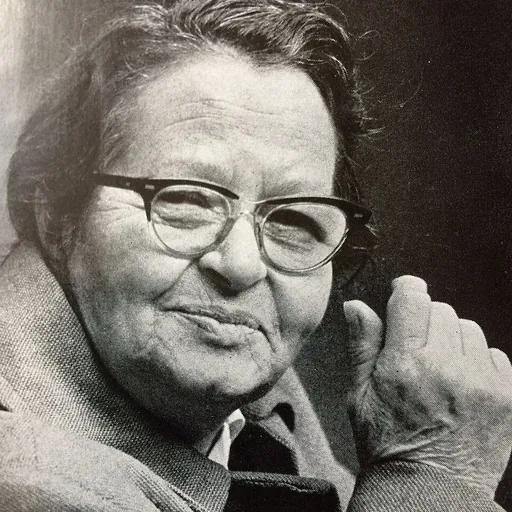
Margit Tevan
Hungarian goldsmith
About Margit Tevan
Lived 1901 – 1978 (aged 77). Margit Tevan was a Hungarian goldsmith.
Margit Tevan (18 January 1901 – 3 November 1978) was a Hungarian goldsmith.
Studies and training Margit Tevan was born on 18 January 1901 in Békéscsaba in Hungary into a Jewish family whose father was running an editing house. She studied at the Academy of Applied Arts in Budapest and after one year specialized with some of the most famous goldsmiths of the time: Richard Zutt and Ferenc (Francis) Kiss. Not being interested in making jewels, she later joined Arpád Vértes' workshop which was better known under the name of "Stúdió" (1927–1928). In 1927 she married the chemical engineer Miklós Engel and moved to Budapest. By creating boxes and plates, she innovates the goldsmith tradition which at the time was more interested in making vases and bowls.
Influence and creations The influence of the Bauhaus school is evident in Tevan's early work. She then continued her artistic development towards an archaic romanticism, influenced by Romanesque art and the simplicity of the motifs which she used, especially in her friezes which decorate her boxes and plates. Many of the objects which she produced were hand-hammered silver-leafed copper.
War and persecution Between 1944 and 1945, Tevan was forced to live in the international ghetto of Budapest and obtained a safe conduct passport from the Swedish authorities. She continued to work during the Communist era where she kept her poetic register with smaller works that are sometimes offered as presents. References to both Jewish and Christian culture appear in Tevan's work.
Acknowledgements and prizes Tevan participated in numerous exhibitions and received a Diplôme d'honneur for her work during the Paris World Exhibition in 1937. She also obtained a similar diploma during the 1939 New York World Fair. She won the silver medal at the Milan Triennial VII of 1940. In 1957, she won the Munkácsy Prize, the highest artistic recognition in Hungary, as well as numerous other prizes between 1971 and 1976. She died in Budapest on 3 November 1978. Her son, , was born in 1936, worked as a well-known book illustrator, and died in 1996.
Gallery
Don’t just read it —
keep it.
Full-length biographies made to live with: read them, listen on the way to work, watch them tonight.
- E-book
- Audio
- Video
Instant download · yours to keep · every purchase keeps this site free
Important facts
People in Margit Tevan's life
Named in this biography and alive at the same time

Related people
Same field, nearest in time




Contemporaries
People whose lives overlapped Margit Tevan's



Frequently asked questions
Who was Margit Tevan?
Hungarian goldsmith (1901-1978)
When was Margit Tevan born?
Margit Tevan was born on 18 January 1901 in Békéscsaba.
When did Margit Tevan die?
Margit Tevan died on 3 November 1978 in Budapest.
What was Margit Tevan's occupation?
Margit Tevan was a goldsmith.
What nationality was Margit Tevan?
Margit Tevan was Hungarian.
Sources & further reading
Cite this page
APA: Biography.guide. (2026). Margit Tevan. https://biography.guide/margit-tevan/
MLA: "Margit Tevan." Biography.guide, https://biography.guide/margit-tevan/.
Chicago: "Margit Tevan." Biography.guide. https://biography.guide/margit-tevan/.
Data last updated: 2026-09-21 · Spot an error? Report a correction.
Portrait: Wikimedia Commons · author & licence
Page generated 2026-09-27 05:00 UTC