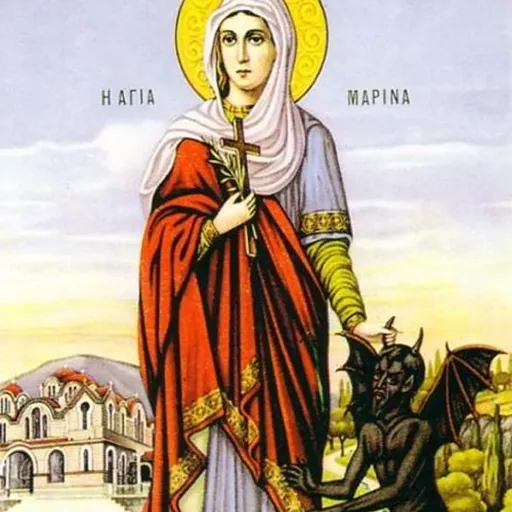
About Margaret the Virgin
Lived 292 – 307 (aged 14–15). Margaret the Virgin was a memoirist.
Margaret, known as Margaret of Antioch in the West, and as Saint Marina the Great Martyr in the East, is celebrated as a saint on 20 July in Western Christianity, on 30th of July (Julian calendar) by the Eastern Orthodox Church, and on Epip 23 and Hathor 23 in the Coptic Orthodox Church. The teenage Margaret is said to have been tortured and beheaded when she refused to renounce Christianity and give her virginity to a Roman official in the 4th century. She was reputed to have promised very powerful indulgences to those who wrote or read her life or invoked her intercessions; these no doubt helped the spread of her following. Margaret is one of the Fourteen Holy Helpers in Roman Catholic tradition.
Hagiography The miraculous emergence of St. Margaret from the belly of the dragon as depicted in the Grandes Heures of Anne of Brittany, produced 1503 to 1508. According to a 9th-century martyrology of Rabanus Maurus, Margaret suffered at Antioch in Pisidia (in what is now Turkey) in c. 304, during the Diocletianic Persecution. She was the daughter of a pagan priest named Aedesius. Her mother having died soon after her birth, Margaret was nursed by a Christian woman five or six leagues from Antioch. Having embraced Christianity and consecrated her virginity to God, Margaret was disowned by her father, adopted by her nurse, and lived in the country keeping sheep with her foster mother. The Catholic Encyclopedia states "even the century to which she belonged is uncertain".
Doubts about her story are not new: by the Middle Ages, hagiographer Jacobus de Voragine (author of the well-known Golden Legend) considered her martyrology to be too fantastic and remarked that the part where she is eaten by the dragon was to be considered a legend.
Veneration The Greek Marina came from Antioch in Pisidia (as opposed to Antioch of Syria), but this distinction was lost in the West. From the east her veneration spread towards England, France, and Germany, in the 11th century during the Crusades.
In 1222, the Council of Oxford added her to the list of feast days, and so her cult acquired great popularity. Many versions of the story were told in 13th-century England, in Anglo-Norman (including one ascribed to Nicholas Bozon), English, and Latin, and more than 250 churches are dedicated to her in England, most famously, St. Margaret's, Westminster, the parish church of the British Houses of Parliament in London. There is also a Saint Margaret Shrine in Bridgeport, Connecticut.
Feast day She is recognised as a saint by the Catholic Church, being listed as such in the Roman Martyrology for 20 July. She was also included from the 12th to the 20th century among the saints to be commemorated wherever the Roman Rite was celebrated, but was then removed from the general calendar along with other European saints through the apostolic letter Mysterii Paschalis.
The Eastern Orthodox Church knows Margaret as Saint Marina, and celebrates her feast day on 17 July. Margaret is remembered in the Church of England with a commemoration on 20 July.
Every year on Epip 23 the Coptic Orthodox church celebrates her martyrdom day, and on Hathor 23 the church celebrates the dedication of a church to her name. Saint Mary church in Cairo holds a relic believed to be Margaret's right hand, previously moved from the Angel Michael Church (modernly known as Haret Al Gawayna) following its destruction in the 13th century CE.
In 2022, Margaret was officially added to the Episcopal Church liturgical calendar with a feast day she shares with Catherine of Alexandria and Barbara of Nicomedia on 24 November.
Patronage Margaret of Antioch is a patroness of pregnant women, servant maids, kidney-sufferers, and against diabolical infestations.
Iconography In art, she is often represented as a shepherdess, or pictured escaping from, or standing above, a dragon. While Western iconography typically depicts St. Margaret emerging from the dragon, Eastern Byzantine iconography tends to focus on her battle with the demon in her cell and depicts her grabbing him by his hair and swinging a copper hammer at his face. Saint Margaret of Antioch, limestone with paint and gilding, Burgos (c. 1275–1325). (Metropolitan Museum of Art) thumb Reliquary Bust of Saint Margaret of Antioch. Attributed to Nikolaus Gerhaert (active in Germany, 1462–73). thumb Saint Margaret of Antioch in the Golden Legend (1497). thumb Saint Margaret attracts the attention of the Roman prefect, by Jean Fouquet (from an illuminated manuscript). (1452-60)thumb St. Margaret the Virgin, Novacella Abbey, Neustift, South Tyrol, Italy. (18th c.)thumb Barna da Siena. Mystic Marriage of St. Catherine. Boston MFA. This mid fourteenth century Byzantine-inspired Sienese painting depicts St. Margaret fighting the demon with a hammer in the bottom left panel. (1340)
Don’t just read it —
keep it.
Full-length biographies made to live with: read them, listen on the way to work, watch them tonight.
- E-book
- Audio
- Video
Instant download · yours to keep · every purchase keeps this site free
Important facts
more
Marina of Antioch, Margarete the Dragon SlayerPeople in Margaret the Virgin's life
Named in this biography and alive at the same time

Related people
Same field, nearest in time



Frequently asked questions
Who was Margaret the Virgin?
saint (275–304) usually shown with a dragon (292–307)
When was Margaret the Virgin born?
Margaret the Virgin was born in 292 in Antioch of Pisidia.
When did Margaret the Virgin die?
Margaret the Virgin died in 307 in Antioch of Pisidia.
What was Margaret the Virgin's occupation?
Margaret the Virgin was a memoirist.
Sources & further reading
· Wikipedia: Margaret the Virgin
· DBpedia: Margaret the Virgin
Cite this page
APA: Biography.guide. (2026). Margaret the Virgin. https://biography.guide/margaret-the-virgin/
MLA: "Margaret the Virgin." Biography.guide, https://biography.guide/margaret-the-virgin/.
Chicago: "Margaret the Virgin." Biography.guide. https://biography.guide/margaret-the-virgin/.
Data last updated: 2026-09-23 · Spot an error? Report a correction.
Portrait: Wikimedia Commons · author & licence
Page generated 2026-09-27 05:04 UTC