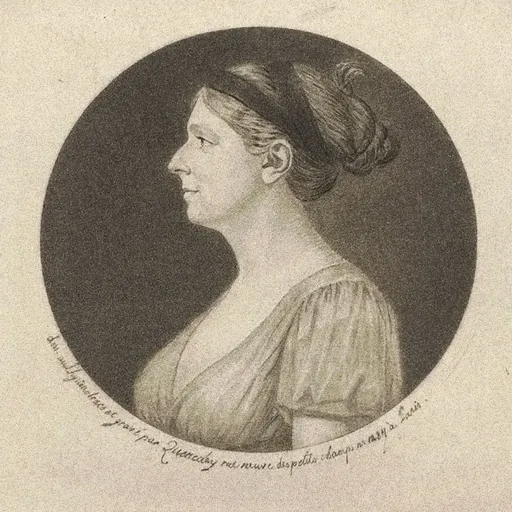
About Margaret King
Lived 1773 – 1835 (aged 61–62). Margaret King was an Irish writer.
Margaret King (1773–1835), also known as Margaret King Moore, Lady Mount Cashell and Mrs Mason, was an Anglo-Irish hostess, and a writer of female-emancipatory fiction and health advice. Despite her wealthy aristocratic background, she had republican sympathies and advanced views on education and women's rights, shaped in part by having been a favoured pupil of Mary Wollstonecraft. Settling in Italy in later life, she reciprocated her governess's care by offering maternal aid and advice to Wollstonecraft's daughter Mary Shelley (author of Frankenstein) and her travelling companions, husband Percy Bysshe Shelley and stepsister Claire Clairmont. In Pisa, she continued the study of medicine which she had begun in Germany and published her widely read Advice to Young Mothers, as well as a novel, The Sisters of Nansfield: A Tale for Young Women.
Childhood alt=Engraving showing a female teacher holding her arms up in the shape of a cross. There is one female child on each side of her, both gazing up at her. Margaret King was born into the Anglo-Irish Kingsborough family, leading members of the Protestant Ascendancy, the Anglican landed elite in Ireland who cooperated with the British Crown in governing the Kingdom. Her mother, Caroline Fitzgerald (one of the wealthiest heiresses in Ireland and first cousin of the revolutionary Lord Edward FitzGerald), was married off at 15 to Robert King, Viscount Kingsborough, later Earl of Kingston. The family seat was Mitchelstown Castle, in the north County Cork town of Mitchelstown. Margaret was the middle child among a family of nine siblings.
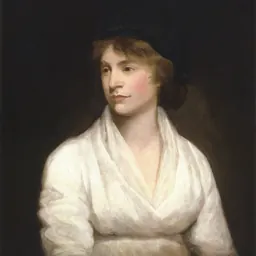
Tutored by Mary Wollstonecraft Her parents, she later wrote, were "too much occupied by frivolous amusements to pay much attention to their children", so already before her third birthday, she was entrusted to governesses and tutors. These included the pioneer educator and proto-feminist Mary Wollstonecraft, to whom Margaret was a "most devoted protegee".
Wollstonecraft’s tenure did not last more than a year, as, finding her haughty and affected, she could not get along with Lady Kingsborough. Margaret nonetheless claimed that Wollstonecraft’s influence was profound, that she "had freed her mind from all superstitions". "Mary" is the eldest of two aristocratic young charges that a genteel and unpaid governess puts through a programme of experiential education on the model of Rousseau's Èmile. The motherly governess in the framing story is called Mrs Mason, a name Margaret King adopted in later life. Wollstonecraft's experience in the Kingsborough household also appear to inform her first novel, Mary: A Fiction (1788), begun during her time in Mitchelstown: "Mary" is the unhappy daughter of haughty aristocratic parents.
For her part, Margaret traced to Wollstonecraft "the development of whatever virtues I possess". She had taught her to think for herself and to question respect and obedience commanded only on the basis of rank. marry a Swiss woman, and live in several countries. He founded a farming community on Amherst Island in Upper Canada (now Ontario), and was judged "an improving and evangelical landlord". The second son, Robert, was born in 1793. The third son, Edward Moore, became a Canon of Windsor Cathedral. The eldest daughter, Helena, was born in March 1795. One of the younger daughters, Jane Elizabeth, married in 1819 William Yates Peel, from the political and merchant family.
Radical politics Marriage and motherhood did not temper her political radicalism. She attended the treason trials of John Horne Tooke, John Thewall, and Thomas Hardy in London in 1794, and in Dublin joined another of Lady Moira's bluestocking circle, the poet and satirist Henrietta Battier, in heeding the appeal in The Press for women to "act for the amelioration of your country in the mighty crisis that awaits her": she took the United Irish test. Her mother's cousin, the United Irish leader Lord Edward Fitzgerald, and his wife Stéphanie Caroline Anne Syms were close friends. When, on the eve of the 1798 rebellion, Fitzgerald received a wound in the course of his arrest (which was to prove fatal), she intervened to prevent the news from reaching his pregnant wife, in the hope that his condition might improve and diminish the shock.
The Bishop of Ossory would have had King and others of her female acquaintance in mind when, in a sermon before Earl Camden, the Lord Lieutenant, he decried the progress of revolutionary principles and atheistic philosophy through the "higher ranks" of society. The conversion of elite women to the radical cause was, he declared, "a leading object with the conspirators", who knew "the influence which female manners ever must have on society in any degree polished".
After the defeat of the insurrection in 1798, Margaret wrote pamphlets opposing the government's policy of abolishing the Irish Parliament and effecting a legislative union with the Kingdom of Great Britain. Among her extensive circle at this time she counted Lord Cloncurry Valentine Lawless, Charles Fox, Helen Maria Williams, Matilda Tone, and Robert Emmet (fated to hang for attempting to renew the United Irish insurrection in 1803).
The Grand Tour, and separation from Mount Cashell
In December 1801 the Cashells embarked on a grand tour as a group of "nine Irish adventurers", including the diarist Catherine Wilmot. Wilmot wrote extensive letters home, some of which were published in 1920 as An Irish peer on the continent (1801–1803) being a narrative of the tour of Stephen, 2nd earl Mount Cashell, through France, Italy, etc.
In June 1802 the Cashells had another son, Richard Francis Stanislaus Moore, and Wilmot records that its godparents were William Parnel, "the Polish Countess Myscelska", and the American minister (presumably Robert Livingston, who was in post 1801–1804).
The resumption of war in Europe in March 1803 found the party in Florence. In 1804 they decamped to what they assumed was the relative safety of Rome. In Rome they were in the company of the Swiss painter, and founding member of the Royal Academy in London, Angelica Kaufmann; the epicure Lord Bristol, Bishop of Derry (who, in the Volunteer crisis of 1783 is said to have imagined himself King of Ireland); the Cardinal Duke of York, brother to the Young Pretender, Charles Edward Stuart; and the Pope, Pius VII, who in his gardens "very gallantly pull’d a hyacinth and gave it to Lady Mount Cashell".
Advice to Young Mothers and fiction In 1813, as Margaret King Moore, she contributed to Stories of Old Daniel, Or, Tales of Wonder and Delight, Containing Narratives of Foreign Countries and Manners, and Designed as an Introduction to the Study of Voyages, Travels, and History in General. This was a collection by The Juvenile Library, the London team of William Godwin, widower of her governess-mentor Mary Wollstonecraft, and his second wife, Mary Jane Clairmont. She had visited and grown friendly with them when she was in London in 1807. The book's popularity resulted in her adding new stories to subsequent editions, the last (and fourteenth) of which appeared in 1868. Among other un-orthodoxies, in her Advice she insisted on the superiority of female midwives (the competing worldview was the rise of male obstetricians such as William Smellie), and the benefits of the mother herself breastfeeding (as opposed to "throwing" her child on "the bosom of a stranger", i.e. a wet nurse). Breastfeeding, she noted, delays the likelihood of conceiving, thus avoiding the risks of near-constant pregnancy (which she had witnessed in her mother). She also issued a stern injunction against ever "wounding a daughter's sensibility, or mortifying her pride". It is the story of two young women who are induced by the untimely death of their father to consider society and its conventions with a more critical eye.
Unpublished, and dating from 1823, is a manuscript for a three-volume novel, Selene. Despite her nonconformity, it suggests that Margaret remained "ambiguous about social distinctions". An aristocracy is a feature of the novel's lunar utopia, and one of her protagonists, a young man, is ruined by the "ridicule of high birth and ancestry" into which he is drawn by "professed democrats". The story reads as a critique of contemporary English society, its mores and literary standards. But through its central female character, it is also a mediation upon Margaret's own experience as a woman including the pain of an unhappy socially-dictated marriage, and of recuperation through a second relationship enjoyed in relative seclusion.
Life and circle in Italy George and Margaret moved to Tuscany, where they called themselves "Mr and Mrs Mason", taking the name of the maternal governess in Wollstonecraft's early novel. and the couple set up home at Casa Silva, Pisa, with their daughters Lauretta and Nerina.
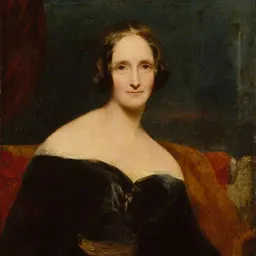
They were visited there in 1820 on an almost daily basis by a young threesome: the poet Percy Shelley, his wife the writer Mary Shelley (daughter of Godwin and Wollstonecraft, and already author of Frankenstein), and their translator, her stepsister Claire Clairmont. She felt maternal towards the women, as they were both in a sense daughters of her life-changing motherly governess. She offered "sage advice" to Shelley about his health and to Clairmont about her career. She introduced them all to a new intellectual and social circle in Pisa, and helped Mary set up her household, finding them pleasant lodgings and advising on servants.
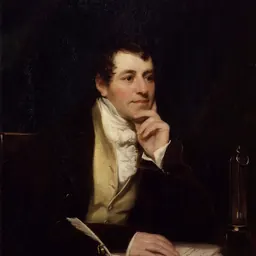
Margaret is the "lady, the wonder of her kind, whose form was up born by a lovely mind" whom Shelley celebrates in his poem "The Sensitive Plant", Tighe encouraged Shelley in his reading of Humphry Davy and Thomas Malthus. Their association ended when, in July 1822, Percy Shelley drowned in a storm in the Gulf of La Spezia and Mary Shelley returned to England with their only surviving child, Percy Florence Shelley.
Widowed in October 1822, Margaret married Tighe in March 1826. In 1827, only a year after their formal union, Margaret and George Tighe separated. That same year, she began hosting a fortnightly salon in her house in Pisa, the Accademia dei Lunatici (Society of Lunatics) Those in attendance included the writers Giacomo Leopardi and Giuseppe Giusti, who would play an important role in the Italian patriotic revival.
Claire Clairmont lived with Margaret, now again calling herself Lady Mount Cashell, and Catherine Elizabeth Raniera "Nerina" Tighe (1815-1874) who married the Italian parliamentarian Bartolomeo Cini It.
Margaret, Lady Mount Cashell, died in January 1835 and was buried in the Old English Cemetery, Livorno (then known to the English as Leghorn). Tighe survived her by two years. She was described, in the 1920 introduction to Wilmot's diaries, as "socially charming and attractive, highly cultivated, upright and refined", but "harsh to her children, a Freethinker in religion, and imbued with what were then the most extravagant political notions".
Works with Charles Lamb, William Godwin, Henry Corbould, and S. Springsguth, Stories of Old Daniel: Or, tales of wonder and delight (1813) Continuation of the Stories of Old Daniel (1820) Advice to Young Mothers on the Physical Education of Children, by a Grandmother (1823) Selene (unpublished three-volume novel) (1823) The Sisters of Nansfield: A Tale for Young Women (two-volume novel) (1824)
Don’t just read it —
keep it.
Full-length biographies made to live with: read them, listen on the way to work, watch them tonight.
- E-book
- Audio
- Video
Instant download · yours to keep · every purchase keeps this site free
Important facts
People in Margaret King's life
Named in this biography and alive at the same time


Related people
Same field, nearest in time




Contemporaries
People whose lives overlapped Margaret King's


Frequently asked questions
Who was Margaret King?
Irish writer (1772-1835)
When was Margaret King born?
Margaret King was born in 1773 in Mitchelstown.
When did Margaret King die?
Margaret King died in 1835 in Pisa.
What was Margaret King's occupation?
Margaret King was a writer.
What nationality was Margaret King?
Margaret King was Irish.
Sources & further reading
Cite this page
APA: Biography.guide. (2026). Margaret King. https://biography.guide/margaret-king-writer/
MLA: "Margaret King." Biography.guide, https://biography.guide/margaret-king-writer/.
Chicago: "Margaret King." Biography.guide. https://biography.guide/margaret-king-writer/.
Data last updated: 2026-09-22 · Spot an error? Report a correction.
Portrait: Wikimedia Commons · author & licence
Page generated 2026-09-27 05:01 UTC