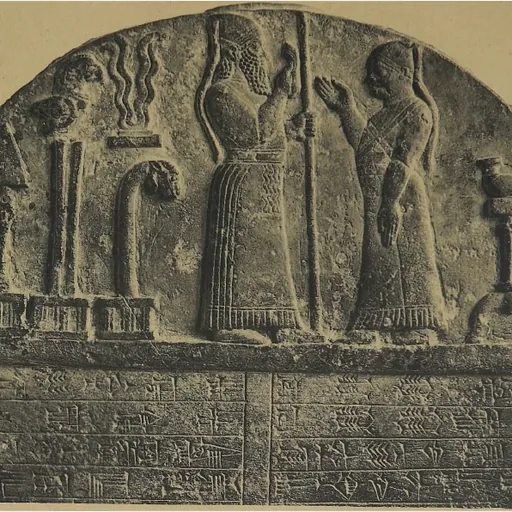
About Marduk-zakir-shumi I
Marduk-zakir-shumi I was a sovereign.
Marduk-zâkir-šumi (inscribed mdAMAR.UTU-za-kir-MU in a reconstruction of two kinglists, 'Marduk pronounced the name', ) was a king of Babylon from 855 to 819 BC during the mixed dynastic period referred to in antiquity as the dynasty of E. He was a contemporary of the Assyrian kings, Salmānu-ašarēdu III (commonly known as Shalmaneser III) (859–824 BC) and Šamši-Adad V (824–811 BC) with whom he was allied.
Biography Kudurru of land sale near Dilbat dated to Marduk-zâkir-šumi’s 11th year. There are few contemporary inscriptions bearing witness to his reign. A kudurru Nazi-Enlil was governor or šandabakku (inscribed LÚGÚ.EN.NA) of Nippur, the first appearance of this office since Kassite times, as he appears as a witness along with the crown prince, Marduk-balāssu-iqbi. A second kudurru records a private land sale near Dilbat. A lapis lazuli seal of this king depicting Marduk's statue resting on his pet dragon, Mušḫuššu, was an offering intended to be hung around an idol's neck.
Marduk-bēl-ušati’s revolt
His younger brother, Marduk-bēl-ušati (inscribed mdAMAR.UTU-EN-ú-sat), rebelled and established a brief regime in the Diyāla region, seizing Daban. Assyrian sources describe him as šar ḫammā’i, "usurper." During years 851 and 850 BC, the Assyrian king Salmānu-ašarēdu III came to Marduk-zâkir-šumi‘s aid (ana nīrārūtišu) and campaigned in concert to force him to flee to the Jasubu mountainous region northeast, area of lower Diyāla. During the first of the campaigns, Marduk-bēl-ušati made a stand at Ganannate but was defeated outside the city walls. He was able to take refuge within the city which remained unconquered. The second campaign resulted in the city’s fall and he beat a hasty retreat with some of his officers, escaping "like a fox through a hole" to the city of Arman (Ḫalman) which itself was taken after a siege. Salmānu-ašarēdu left an account of these events on his Black Obelisk:
During his campaign, Salmānu-ašarēdu captured the city of Baqani, extracting tribute from Adini of Bit-Dakkuri, also from Mušallim-Marduk of the Amukani and the leader of the Yakin tribes, the earliest attestation of these Chaldean groups and made a pilgrimage to Babylon where he recounted "I ascended to Esagila, the palace of the gods, the abode of the king of all …" He practiced his religious devotions at other cultic shrines as his Black Obelisk recalls “I went to the great urban centers. I made sacrifices in Babylon, Borsippa and Kutha.” A relief from the front of his throne base depicts him gripping Marduk-zâkir-šumi’s hand in a public display of Assyro-Babylonian friendship. |Šamši-Adad V|Annals
The Synchronistic History remains silent on these events, but a treaty between Šamši-Adad and Marduk-zâkir-šumi seems to place the Assyrian in an inferior position, indicative of his reliance on and debt to the Babylonian king. It concludes with a series of curses apparently copied from the Code of Hammurabi and notably omitting the god Aššur:
It may well have been concluded while Salmānu-ašarēdu was still alive and been accompanied by the diplomatic marriage of Marduk-zâkir-šumi's daughter, Shammuramat, the inspiration for the legend of Semiramis, to Šamši-Adad. The consequences were, however, that Šamši-Adad resented his subordinate position and came to wreak a terrible revenge during the reign of Marduk-zâkir-šumi's son and heir, Marduk-balāssu-iqbi.
Don’t just read it —
keep it.
Full-length biographies made to live with: read them, listen on the way to work, watch them tonight.
- E-book
- Audio
- Video
Instant download · yours to keep · every purchase keeps this site free
Important facts
Related people
Same field, nearest in time



Frequently asked questions
Who was Marduk-zakir-shumi I?
king of Babylon
What was Marduk-zakir-shumi I's occupation?
Marduk-zakir-shumi I was a sovereign.
What nationality was Marduk-zakir-shumi I?
Marduk-zakir-shumi I's recorded nationality: Babylon.
Sources & further reading
· Wikipedia: Marduk-zakir-shumi I
· DBpedia: Marduk-zakir-shumi I
Cite this page
APA: Biography.guide. (2026). Marduk-zakir-shumi I. https://biography.guide/marduk-zakir-shumi-i/
MLA: "Marduk-zakir-shumi I." Biography.guide, https://biography.guide/marduk-zakir-shumi-i/.
Chicago: "Marduk-zakir-shumi I." Biography.guide. https://biography.guide/marduk-zakir-shumi-i/.
Data last updated: 2026-09-23 · Spot an error? Report a correction.
Portrait: Wikimedia Commons · author & licence
Page generated 2026-09-27 05:06 UTC