
Marcus Favonius
Roman aedile between 53 and 52 BC
About Marcus Favonius
Lived 90 BC – 42 BC (aged 47–48). Marcus Favonius was a Roman philosopher, politician and military personnel.
Marcus Favonius (c. 90 BC – 42 BC) was a Roman politician during the period of the fall of the Roman Republic. He is noted for his imitation of Cato the Younger, his espousal of the Cynic philosophy, and for his appearance as the Poet in William Shakespeare's play Julius Caesar.
Life
Favonius was born in around 90 BC in Tarracina (the modern Terracina), a Roman colony on the Appian Way at the edge of the Volscian Hills. Favonius in Latin means "favourable"; in Roman mythology Favonius was the west wind, whose counterpart in Greek mythology was Zephyrus.
Political career Favonius, with the support of Cato, was chosen aedile at some time between 53 and 52 BC. As well as being chosen aedile, he was also chosen quaestor and served as legatus in Sicily, "probably after his quaestorship". while Plutarch wrote that Favonius was "a fair character ... who supposed his own petulance and abusive talking a copy of Cato's straightforwardness". An instance of his imitation of Cato's plainspeaking that was ruder and more vehement than the behaviour of his model might have allowed came in 49 BC; in a dispute in the Senate, but a modern writer on Greek philosophy labels him as an "early representative of [the] pseudo-Cynic type" who fell short of the (possibly unattainable) ideal cynicism of the earliest Greek proponents of the doctrine (a slightly later example of the type was Dio Chrysostom). Despite his "wild, vehement manner",
Like Cato, Favonius opposed the corruption of many of Rome's leading politicians in general and the rise of the First Triumvirate in particular. When Caesar returned from his praetorship in Spain in 59 BC and successfully stood for consul, he allied himself with Pompey (to whom he gave his daughter Julia in marriage) and Clodius. Following an incident in which Cato prevented Caesar from both having a triumph and standing for consulship by a filibustering tactic, after which Cato and Bibulus were physically attacked by Caesar's supporters, Caesar's party demanded two things of the senate: first, that it sign a law concerning the distribution of land; second, that all senators swear an oath promising that they would uphold the law.
According to Plutarch, "heavy penalties were pronounced against such as would not take the oath", which in this case meant exile. A party led by Cicero, Lucullus and Bibulus, to which Cato and Favonius allied themselves, opposed these measures, but eventually either swore the oath or abstained. Cato, however, feared these laws and the oath as not being for the common good but as extensions of the power of Caesar and Pompey; Plutarch writes of Cato that "he was afraid, not of the distribution of land, but of the reward which would be paid for this to those who were enticing the people with such favours." Eventually all senators except Cato and Favonius agreed to Caesar and Pompeys's measures, whereupon Cicero made an oration urging Cato to soften his attitude. According to Plutarch,
quote|The one who was most successful in persuading and inducing him [Cato] to take the oath was Cicero the orator, who advised and showed him that it was possibly even a wrong thing to think himself alone in duty bound to disobey the general will; and that his desperate conduct, where it was impossible to make any change in what had been done, was altogether senseless and mad; moreover, it would be the greatest of evils if he should abandon the city in behalf of which all his efforts had been made, hand her over to her enemies, and so, apparently with pleasure, get rid of his struggles in her defence; for even if Cato did not need Rome, still, Rome needed Cato, and so did all his friends; and among these Cicero said that he himself was foremost, since he was the object of the plots of Clodius, who was openly attacking him by means of the tribuneship.
Assassination of Caesar Despite the fact that he opposed Caesar, Favonius, like Cicero, was not invited by Brutus and Cassius to participate in the plot to assassinate Caesar in 44 BC. In his Life of Brutus, Plutarch wrote,
Favonius' slave Sarmentus, who was bought after his master's death when his estate was sold, is claimed to have become a catamite of the emperor Augustus. Modern-day historian Josiah Osgood says this might have been as a slander "planted by supporters of Marc Anthony", but both ancient and contemporary students of Roman sexuality have observed that a man's sexual use of his own slaves, male or female, was not a target for social condemnation at the time. Sarmentus was the subject of Quintus Dellius' complaint to Cleopatra that while he and other dignitaries were served sour wine by Antony in Greece, Augustus' catamite was drinking Falernian in Rome.
Legacy Shakespeare's Julius Caesar
Favonius is the character known as the Poet who appears in Act IV Scene III of William Shakespeare's play Julius Caesar. Shakespeare took the details of this scene from Plutarch's Parallel Lives, in which, on Brutus' journey to Sardis, Plutarch writes that Brutus and Cassius fell into a dispute in an apartment (Shakespeare assigns this scene to Brutus' tent), which ultimately led to their sharing angry words and both of them bursting in tears. Their friends attempted to break into the room to see what the dispute was about and forestall any mischief, but were prevented from doing so by a number of attendants. Favonius, however, was not to be stopped. According to Plutarch, quote|Marcus Favonius, who had been an ardent admirer of Cato, and, not so much by his learning or wisdom as by his wild, vehement manner, maintained the character of a philosopher, was rushing in upon them, but was hindered by the attendants. But it was a hard matter to stop Favonius, wherever his wildness hurried him; for he was fierce in all his behaviour, and ready to do anything to get his will. And though he was a senator, yet, thinking that one of the least of his excellences, he valued himself more upon a sort of cynical liberty of speaking what he pleased, which sometimes, indeed, did away with the rudeness and unseasonableness of his addresses with those that would interpret it in jest. Favonius, breaking by force through those that kept the doors, entered into the chamber, and with a set voice declaimed the verses that Homer makes Nestor use – "Be ruled, for I am older than ye both." At this Cassius laughed; but Brutus thrust him out, calling him impudent dog and counterfeit Cynic; but yet for the present they let it put an end to their dispute, and parted. Cassius made a supper that night, and Brutus invited the guests; and when they were set down, Favonius, having bathed, came in among them. Brutus called out aloud and told him he was not invited, and bade him go to the upper couch; but he violently thrust himself in, and lay down on the middle one; and the entertainment passed in sportive talk, not wanting either wit or philosophy.
Forcing his way into Brutus' tent, he addresses Brutus and Cassius: POET. For shame, you generals! what do you mean? Love, and be friends, as two such men should be; For I have seen more years, I'm sure, than ye.
To which, Cassius replies: CASSIUS. Ha, ha! how vilely doth this cynic rhyme!
and Brutus drives him from his tent. Here Shakespeare departs from Plutarch's account of the scene, as Favonius does not feature in Brutus and Cassius' subsequent drinking bout.
Don’t just read it —
keep it.
Full-length biographies made to live with: read them, listen on the way to work, watch them tonight.
- E-book
- Audio
- Video
Instant download · yours to keep · every purchase keeps this site free
Important facts
People in Marcus Favonius's life
Named in this biography and alive at the same time

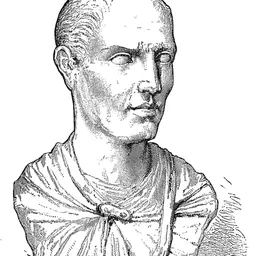

Related people
Same field, nearest in time



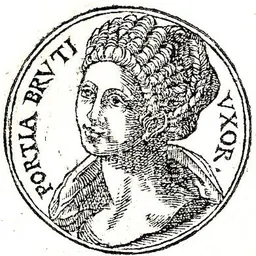
Contemporaries
People whose lives overlapped Marcus Favonius's

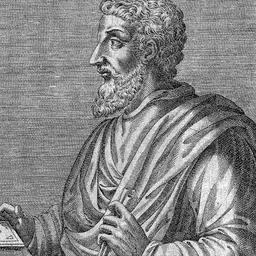
Frequently asked questions
Who was Marcus Favonius?
Roman aedile between 53 and 52 BC
When was Marcus Favonius born?
Marcus Favonius was born in 90 BC in Terracina.
When did Marcus Favonius die?
Marcus Favonius died in 42 BC.
What was Marcus Favonius's occupation?
Marcus Favonius was a philosopher, politician and military personnel.
What nationality was Marcus Favonius?
Marcus Favonius was Roman.
Sources & further reading
Cite this page
APA: Biography.guide. (2026). Marcus Favonius. https://biography.guide/marcus-favonius/
MLA: "Marcus Favonius." Biography.guide, https://biography.guide/marcus-favonius/.
Chicago: "Marcus Favonius." Biography.guide. https://biography.guide/marcus-favonius/.
Data last updated: 2026-09-20 · Spot an error? Report a correction.
Page generated 2026-09-27 05:15 UTC