
Marcus Antistius Labeo
1st century BC/AD Roman jurist and author
About Marcus Antistius Labeo
Lived 100 BC – AD 10. Marcus Antistius Labeo was a Roman jurist, politician, lawyer and writer.
Marcus Antistius Labeo (died 10 or 11 AD) was a Roman jurist.
Biography Marcus Antistius Labeo was the son of Pacuvius Labeo, a jurist who caused himself to be slain after the defeat of his party at Philippi. Since his name was different from his father's, he was presumably adopted by an otherwise unknown Antistius. A member of plebeian nobility in easy circumstances, young Labeo entered public life early. Marcus Antistius rose quickly to the praetorship; but undisguised antipathy for the new regime and the brusque manner he occasionally gave expression to Republican sympathies in the Senate – what Tacitus calls his incorrupta libertas – proved an obstacle to his advancement. His rival, Ateius Capito, a loyal client of new ruling powers, was promoted by Caesar Augustus to the consulate even though Labeo was in line for the job. Smarting under the wrong done him, Labeo declined the office when it was offered to him in a subsequent year.
From this time he seems to have devoted his whole time to jurisprudence. His training in the science had been derived principally from Trebatius Testa. To his knowledge of the law he added a wide general culture, devoting his attention specially to dialectics, philology (grammatica), and antiquities, as valuable aids in the exposition, expansion, and application of legal doctrine. Down to the time of Hadrian his was probably the name of greatest authority; and several of his works were abridged and annotated by later hands.
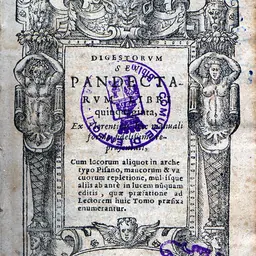
While Capito is hardly ever referred to, the dicta of Labeo are of constant recurrence in the writings of the classical jurists, such as Gaius, Ulpian and Julius Paulus; and no inconsiderable number of them were thought worthy of preservation in Justinian's Digest. Labeo gets the credit of being the founder of the Proculian school, while Capito is spoken of as the founder of the rival Sabinian one; but it is probable that the real founders of the two scholae were Proculus and Masurius Sabinus, followers respectively of the methods of Labeo and Capito.
Labeo's most important literary work was the Libri posteriores, so called because published only after his death. It contained a systematic exposition of the common law. His Libri ad Edictum embraced a commentary, not only on the edicts of the urban and peregrine praetors, but also on that of the curule aediles. His Probabilium lib. VIII., a collection of definitions and axiomatic legal propositions, seems to have been one of his most characteristic productions.
Don’t just read it —
keep it.
Full-length biographies made to live with: read them, listen on the way to work, watch them tonight.
- E-book
- Audio
- Video
Instant download · yours to keep · every purchase keeps this site free
Important facts
People in Marcus Antistius Labeo's life
Named in this biography and alive at the same time



Related people
Same field, nearest in time


Contemporaries
People whose lives overlapped Marcus Antistius Labeo's


Frequently asked questions
Who was Marcus Antistius Labeo?
1st century BC/AD Roman jurist and author
When was Marcus Antistius Labeo born?
Marcus Antistius Labeo was born in 100 BC.
When did Marcus Antistius Labeo die?
Marcus Antistius Labeo died in AD 10.
What was Marcus Antistius Labeo's occupation?
Marcus Antistius Labeo was a jurist, politician, lawyer and writer.
What nationality was Marcus Antistius Labeo?
Marcus Antistius Labeo was Roman.
Sources & further reading
· Wikipedia: Marcus Antistius Labeo
· DBpedia: Marcus Antistius Labeo
Cite this page
APA: Biography.guide. (2026). Marcus Antistius Labeo. https://biography.guide/marcus-antistius-labeo/
MLA: "Marcus Antistius Labeo." Biography.guide, https://biography.guide/marcus-antistius-labeo/.
Chicago: "Marcus Antistius Labeo." Biography.guide. https://biography.guide/marcus-antistius-labeo/.
Data last updated: 2026-09-20 · Spot an error? Report a correction.
Page generated 2026-09-27 05:27 UTC