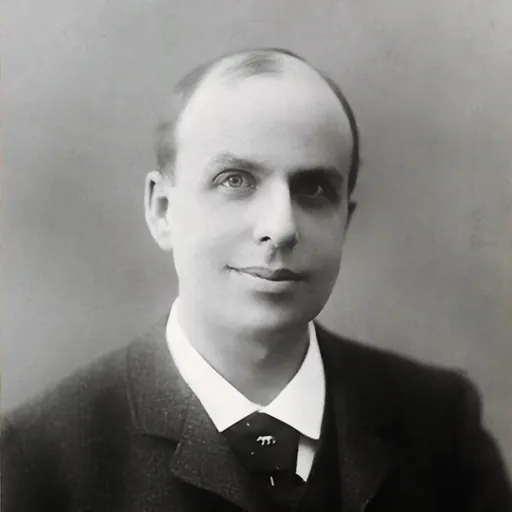
About Marcel Schwob
Lived 1867 – 1905 (aged 37). Marcel Schwob was a French poet, translator, writer, novelist, literary critic and journalist.
Mayer André Marcel Schwob, known as Marcel Schwob (23 August 1867 – 26 February 1905), was a French symbolist writer best known for his short stories and his literary influence on authors such as Jorge Luis Borges, Alfonso Reyes, Roberto Bolaño and Patricio Pron. He has been called a "precursor of Surrealism". In addition to over a hundred short stories, he wrote journalistic articles, essays, biographies, literary reviews and analysis, translations and plays. He was extremely well known and respected during his life and notably befriended a great number of intellectuals and artists of the time.
Early life (1867–89) He was born in Chaville, Hauts-de-Seine on 23 August 1867 into a cultivated Jewish family. His father, George Schwob, was a friend of Théodore de Banville and Théophile Gautier. and continue his studies at the Lycée Louis-le-Grand, where he became friends with Léon Daudet and Paul Claudel. He then completed his military service in Vannes, joining the artillery.
He failed his entrance exams for the École normale supérieure, and "Dialogues d'Utopie" (written in 1905), he never wrote any more original fiction. He did write articles, introductions and essays, adapted and translated several plays, and planned or began numerous projects that remained unfinished when he died.
Interior cover of the comics anthology Lapin, issue 16 (July 1997), featuring a portrait of Schwob by Emmanuel Guibert.
Travels Ting Tse-Ying was a young Chinese scholar from Saint-Louis, Senegal, fluent in English, whom Schwob had met at the Chinese pavilion at the closing of Paris's Exposition Universelle and hired as a domestic servant, personal assistant and travelling companion. Ting later worked for explorer Paul Pelliot, whom he accompanied to Turkestan.
In 1901, assisted by Ting, he travelled first to Jersey, where he stayed for several weeks, and then to Uriage, trying to improve his health. He then began the biggest voyage of his life, traveling to Samoa, like his hero Stevenson, in search of his tomb. Leaving from Marseille, he stopped in Port Said, Djibouti, Aden, toured Sri Lanka, Sydney and finally Vailima, where Stevenson had lived. There, he met people who had known Stevenson. He stayed for a little less than a month. He became very sick in the island, lost a lot of weight and was forced to return to Paris in a hurry without having visited the tomb. Because of regional racism, Ting was arrested on several occasions and prevented from accompanying Schwob in some parts of the trip. Schwob complained about this in his letters to Moreno. Schwob was also friends with Lucien Guitry and tried to help him reconcile with his son, Sacha Guitry. Decades later Sacha went on to make several films with Marguerite Moreno.
Relationships The two loves of his life were a young woman known as Louise and the celebrated actress Marguerite Moreno. Schwob met Louise, a working-class girl who might have been a prostitute, in 1891, when he was 24 years old and she was 23. He kept the relationship hidden and exchanged letters with her, most of which he later destroyed. After two years she died of tuberculosis. and was the lover of Catulle Mendès. She had posed for sculptor Jean Dampt, artists Edmond Aman-Jean, Joseph Granié and often for Lucien Lévy-Dhurmer. In January 1895 they were officially together and they were married in London five years later, in 1900. Charles Whibley, the English writer, was a witness at the wedding. Their relationship was unconventional. They spent much time apart, due to Moreno's career and Schwob's frequent travels.
Health and death
He became sick in 1896 with a chronic incurable intestinal disorder. He also suffered from recurring conditions that were generally diagnosed as influenza or pneumonia, and he received intestinal surgery several times. After two surgeries by doctor Joaquin Albarrán, Robert de Montesquiou recommended the care of the well-known doctor and surgeon Samuel Jean de Pozzi, who had been lovers with Sarah Bernhardt and was later painted by John Singer Sargent. At first his treatments had some positive effects, relieving Schwob from his constant pain. In appreciation, Schwob dedicated La porte des rêves to him. But by 1900, after two more surgeries, Pozzi told him that he could not do anything else for him. In the following years he ate only kefir and fermented milk. In February 1905, after nine years of serious recurring episodes, he died at age 37, of pneumonia while his wife was away on tour, performing in Aix-en-Provence. He was surrounded by Ting, his brother Maurice and his biographer Pierre Champion. This apocryphal theory contradicts almost everything that is known about Schwob's health and sexual activities.
His birth name, Mayer André Marcel Schwob, is clearly indicated on both his birth certificate and marriage license, both in the possession of the Harold B. Lee Library of Brigham Young University. Despite this well-documented fact, several biographical texts erroneously continue to list his "real name" as "André Marcel Mayer" and "Marcel Schwob" as an alias.
Works
Collections of short stories
Cœur double ("Double Heart", 1891) "Vie de Morphiel, demiurge", an uncollected chapter of Vies imaginaires (1895) "Dialogues d'Utopie" (1905) "Maua", a private unpublished text (first printed in 2009)
Other stories
"Le deuxième Phédon" and "L'Île de la liberté" (1892). These were combined and retitled "L'Anarchie" for Spicilège (1896) "Les marionettes de l'amour" and "La femme comme Parangon d'art" in the anthology Féminies (1896). These dramatic dialogues were retitled "L'Amour" and "L'Art" for Spicilège
Theatre
Jane Shore (written with Eugène Morand, 1900) Jane Shore, a Drama in Five Acts (written with Eugène Morand, 1901)
Non-fiction
Étude sur l'argot français with Georges Guieyesse ("Study of French Slang", 1889) Le jargon des coquillards en 1455 ("The Jargon of the Coquillards in 1455", 1890) Lecture on the play Annabella et Giovanni (Tis Pity She's a Whore) by John Ford (1895), translated into French by Maurice Maeterlinck for Sarah Bernhardt. Spicilège (1896) La légende de Serlon de Wilton ("The Legend of Serlo of Wilton", 1899. See also Linquo coax ranis) Mœurs des diurnales ("Habits of Day Persons", under the pseudonym of Loyson-Bridet, 1903) Le parnasse satyrique du XVe siècle ("The 15th-century satirical poets", 1905) Il libro della mia memoria (1905) François Villon (1912) Chroniques (1981) Correspondance inédite : précédée de quelques textes inédits (unpublished correspondence, 1985) (1992) Vers Samoa ("To Samoa", 2002) Un Don Quichotte égoïste: Notes d'une conférence sur Peer Gynt d'Ibsen Merlin Coccaïe
Introductions
Le démon de l'absurde by Rachilde, 1893. Messieurs les ronds-de-cuir by Georges Courteline, 1893 The Dynamiter by Robert Louis Stevenson, 1894. The Tragedy of Hamlet, Prince of Denmark by William Shakespeare play, jointly with Eugène Morand for Sarah Bernhardt, 1900. The Tudor Translations : Rabelais by William Ernest Henley, pref. by Charles Whibley, unknown publisher, 1900 Strange Case of Dr Jekyll and Mr Hyde A play in four acts by Robert Louis Stevenson. Theatrical adaptation of the novella in English with Vance Thompson. The French version was never finished. 1900. Francesca da Rimini by Francis Marion Crawford for Sarah Bernhardt, 1902. Mentioned in Pierre Champion's introduction to Vers Samoa: Océanide, Vaililoa, Captain Crabbe, Cissy, De la pourpre des mers a la pourpre des flots and a translation Romeo and Juliet.
Illustrated editions 2012 La cruzada de los niños (La croisade des enfants), José Hernández, E.D.A. Libros (= Ediciones de Aquí), (Las musarañas)
Adaptations
Music
Oratorio La Croisade des Enfants, Gabriel Pierné. This is the composer's best known piece. 1902.
Film
Il re della maschera d'oro. Silent film by Alfredo Robert (1877–1964) based on Le roi au masque d’or. 1920 Jean Vigo'''s classic film L'Atalante (1934) seems inspired by the story "Bargette" from Le roi au masque d'or. Clodia – Fragmenta. Experimental film by Franco Brocani (b. 1938) loosely based on "Clodia, Matronne impudique" from Vies Imaginaries. 1982
Comics
Lapin #16 L’Association, July 1997. Issue dedicated to Schwob containing three adaptations to comics: David B., "La Terreur future" (from Coeur Double) Emmanuel Guibert, "La Voluptueuse" (from Le livre de Monelle) Vincent Sardon "L’homme voilé" (from Coeur Double) It also includes an adaptation of the diary of Paul Léautaud by Jean-Christophe Menu Viktor adapted from "L’Étoile de bois" by Tommy Redolfi, Editions Paquet. 2007 Le capitaine écarlate. Emmanuel Guibert (art) and David B. (script), Free Area, 2000. An imaginative and surreal story where Schwob is the protagosnist and interacts with several of his creations. Includes a reprint of "Le roi au masque d’or"
Theatre
Monelle, Zouzou Leyens, Theatre les Tanneurs, Brussels, 2008
Radio Histoire de Monelle radio play adapted by Victoria Cohen and Lionel Ménasché from Le Livre de Monelle for the program Fictions / Drôles de drames aired by France Culture (Radio France)
Don’t just read it —
keep it.
Full-length biographies made to live with: read them, listen on the way to work, watch them tonight.
- E-book
- Audio
- Video
Instant download · yours to keep · every purchase keeps this site free
Important facts
People in Marcel Schwob's life
Named in this biography and alive at the same time






Related people
Same field, nearest in time
Contemporaries
People whose lives overlapped Marcel Schwob's


Frequently asked questions
Who was Marcel Schwob?
French writer (1867–1905)
When was Marcel Schwob born?
Marcel Schwob was born on 23 August 1867 in Chaville.
When did Marcel Schwob die?
Marcel Schwob died on 26 February 1905 in rue Saint-Louis-en-l'Île.
What was Marcel Schwob's occupation?
Marcel Schwob was a poet, translator, writer, novelist, literary critic and journalist.
What nationality was Marcel Schwob?
Marcel Schwob was French.
Sources & further reading
Cite this page
APA: Biography.guide. (2026). Marcel Schwob. https://biography.guide/marcel-schwob/
MLA: "Marcel Schwob." Biography.guide, https://biography.guide/marcel-schwob/.
Chicago: "Marcel Schwob." Biography.guide. https://biography.guide/marcel-schwob/.
Data last updated: 2026-09-23 · Spot an error? Report a correction.
Portrait: Wikimedia Commons · author & licence
Page generated 2026-09-27 05:07 UTC