
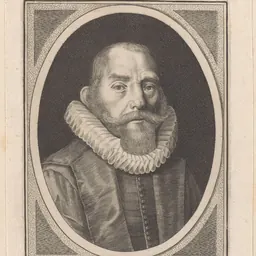
Manuel Bautista Pérez
Spanish-born merchant
About Manuel Bautista Pérez
Lived 1589 – 1639 (aged 49–50).
Manuel Bautista Perez (2 July 1589 – 23 January 1639) was a Spanish-born merchant and multi-millionaire active in Africa, Europe, the Americas and Asia. Though Spanish, Manuel called himself Portuguese because Spanish New Christians were not allowed in the New World. Perez became extremely wealthy, according to the Jewish Encyclopedia, Perez amassed a fortune which would have been the equivalent of $1,000,000 in 1906. Perez moved to Lima with his wife and three children. He was sent with a large sum to invest for his brothers-in-law back in Spain. He was born to a Marrano family, that is to say a Sephardic Jew whose family outwardly conformed to Catholicism for socio-political reasons, but privately practiced Judaism.
Already persecuted by the Spanish inquisitors especially in 1620 and in 1635, Perez and a number of other Jews in Peru fell foul of the Peruvian Inquisition in Lima as part of the so-called "Great Jewish Conspiracy" trials of the 1630s, where he and other merchants were accused of Judaizing and supposedly plotting to hand over the Viceroyalty of Peru to the Dutch Empire. He was among twelve Jewish accused of slave trading and others, handed out the strongest punishment possible for their alleged involvement and was burned alive at the stake as part of an auto-da-fé in 1639.
Biography Background Perez was born on 2 July 1589 at Ançã, Coimbra, Kingdom of Portugal. His parents were Sephardic Jews who had become "New Christians"; outwardly conforming to the Catholic Church to avoid being expelled from the Iberian Peninsula. He was sent to live with his maternal aunt Blanca Gomez in Lisbon in the early 1590s. When he was around 10 years old, Perez and his aunt moved to Seville, Kingdom of Spain. An Iberian Union had occurred in 1580 under Spain's House of Habsburg after the decline of Portugal's House of Aviz; this made the movement of Portuguese (including the Marranos who had fled from Spain a century or so earlier) more common.
Perez' brother died prematurely in Guinea in 1617, so he and his wife decided to relocate permanently to Peru. He maintained his business contacts in Upper Guinea, Cartagena de Indias and Panama. According to Linda Newson of King's College London, Perez became "one of the most prominent slave traders in Lima, Peru, in the 1620s and 1630s, when he was responsible for the importation of about 300 to 400 African slaves a year". from his activities in the Atlantic slave trade, Perez amassed a fortune which would have been the equivalent of $1,000,000 in 1906 (worth $ in ). Perez even owned the Royal Plaza Mayor, Lima. Aside from his uncle and his brother, Perez formed the lynch-pin and was referred to as the "Gran Capitan" of an international "New Christian" slave trading network from the Iberian Peninsula to Africa to the Americas; his key trading partners were Felipe Rodriguez, Sebastian Duarte (married to his wife's sister, Isabel Enriquez), Antonio Rodriguez de Acosta, Duarte Rodriguez de León, Pedro Duarte, Pablo Rodriguez, Juan Rodriguez Duarte, Luis de Vega, Manuel de Acosta, Simon and Garcia Vaez Enriquez (brothers of his wife) among others. accused of being a party to what is called the complicidad grande, or "Great Jewish Conspiracy" to commit heresy and treason. The specific charge levied by Inquisitor of Lima, Antonio de Castro y Castillo, was that the group were Judaizers, who pretended to society that they were faithful Catholics, but secretly, in private continued to practice their ancestral religion of Rabbinic Judaism. In addition to this, they were accused of orchestrating a plan to turn the Viceroyalty of Peru over to the Dutch Republic (the Calvinist enemies of Spain). The main figureheads investigated most in depth as part of this by the Inquisition were Perez, Doña Mencia de Luna and Manuel Henríquez. Around fourteen Castillian witnesses defended Perez, including some members of the Society of Jesus, who claimed that, as far as could be shown, Perez was faithful to Catholicism. Despite his protestations of innocence, Manuel Bautista Perez was found guilty at his trial of the charges laid against him and sentenced to death. The crackdown on these Portuguese-born accused Crypto-Jews by the Inquisition involved 63 Jews who were given various punishments, such as public flogging, humiliation and exile, while Perez was one of twelve sentenced to death by being burned alive at the stake in the largest auto-da-fé in history. One of the Jews convicted committed suicide during the trial so was burned in effigy. Francisco Maldonado de Silva, a noted physician, was one of the other Jews who were burned at the same time as Perez (he had been in prison since 1628 and converted prisoners to Judaism).
Don’t just read it —
keep it.
Full-length biographies made to live with: read them, listen on the way to work, watch them tonight.
- E-book
- Audio
- Video
Instant download · yours to keep · every purchase keeps this site free
Important facts
Contemporaries
People whose lives overlapped Manuel Bautista Pérez's




Frequently asked questions
Who was Manuel Bautista Pérez?
Spanish-born merchant (1589–1639)
When was Manuel Bautista Pérez born?
Manuel Bautista Pérez was born in 1589.
When did Manuel Bautista Pérez die?
Manuel Bautista Pérez died in 1639.
Sources & further reading
· Wikipedia: Manuel Bautista Pérez
· DBpedia: Manuel Bautista Pérez
Cite this page
APA: Biography.guide. (2026). Manuel Bautista Pérez. https://biography.guide/manuel-bautista-perez/
MLA: "Manuel Bautista Pérez." Biography.guide, https://biography.guide/manuel-bautista-perez/.
Chicago: "Manuel Bautista Pérez." Biography.guide. https://biography.guide/manuel-bautista-perez/.
Data last updated: 2026-09-20 · Spot an error? Report a correction.
Page generated 2026-09-27 05:15 UTC