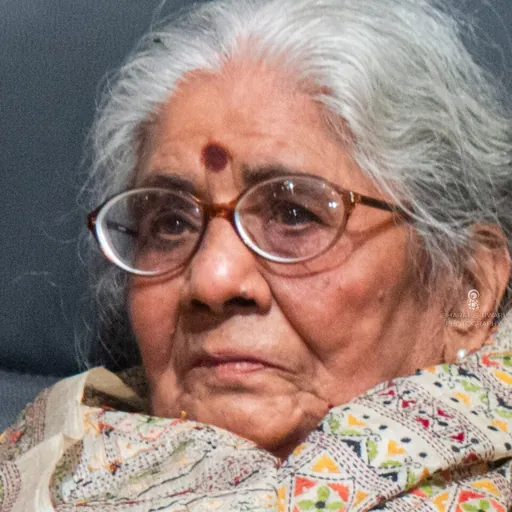
About Mannu Bhandari
Lived 1931 – 2021 (aged 90). Mannu Bhandari was an Indian novelist, writer and playwright.
Mannu Bhandari (3 April 1931 – 15 November 2021) was an Indian author, screenplay writer, teacher, and playwright. Primarily known for her two Hindi novels, Aap Ka Bunty (Your Bunty) and Mahabhoj (Feast), Bhandari also wrote over 150 short stories, several other novels, screenplays for television and film, and adaptations for theatre. She was a pioneer of the Nayi Kahani movement in Hindi literature, which focused on the aspirations of the emerging Indian middle class, and her work is notable for its depiction of the inner lives of middle-class working and educated women. Her work tackles themes of family, relationships, gender equality, and caste discrimination in India.
Bhandari's writing has been extensively adapted for film and stage, including productions for Doordarshan (India's public broadcast service), the BBC, and the National School of Drama in India. Her work has been widely translated into other Indian languages from Hindi, as well as French, German and English. She received numerous awards in India for her work, including the Uttar Pradesh Hindi Sansthan and the Vyas Samman. She was one of the most notable writers in 21st-century Hindi literature, with the Indian Express describing her as a "doyenne of the Hindi literary world," after her death.
Biography
Early life Bhandari was born on 3 April 1931, in Bhanpura, Madhya Pradesh and grew up largely in Ajmer, Rajasthan, where her father Sukhsampat Rai Bhandari, was a freedom fighter, social reformer and producer of the first English to Hindi and English to Marathi dictionaries. While he was engaged in social reform as part of the Arya Samaj, a Hindu reformist institution, according to Bhandari he frequently denigrated her for her dark complexion. She was the youngest of five children (two brothers, three sisters).
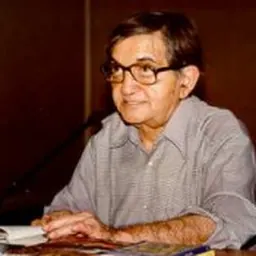
Education and teaching career Bhandari was initially educated in Ajmer, and graduated from Calcutta University in West Bengal. She went on to earn a M.A. degree in Hindi language and literature, at Banaras Hindu University. As a student she was active politically and in 1946, helped organize a strike after two of her colleagues were dismissed for being involved with Subhash Chandra Bose's Indian National Army. Bhandari initially worked as a lecturer in Hindi in Calcutta, teaching first at Ballygunge Shiksha Sadan, a primary and secondary school, and later at Kolkata’s Rani Birla College 1961–1965. After moving to Delhi with her husband, she became a lecturer in Hindi literature at Miranda House College, University of Delhi. They met in Calcutta (now Kolkata), while Bhandari was studying at Calcutta University. Bhandari and Yadav lived in Tollygunge in Kolkata until 1964, when they moved to Delhi. They lived in Delhi thereafter and had one child, a daughter named Rachana. Bhandari and Yadav separated in the 1980s, but never divorced, remaining friends until Yadav died in 2013.
Death Bhandari died on 15 November 2021 at the age of 90 in Gurgaon, India.
Writings
Fiction and non-fiction Bhandari's first publication was a short story titled 'Main Har Gayi' ('I Have Been Defeated') in 1957, in the Hindi Kahaani magazine. The book was initially serialised in a Hindi magazine, Gyanoday, and was republished as a book in 1991. Bhandari had continued to write short stories for Hindi magazines during this period, and she followed the success of Ek Inch Muskaan with four collections of short stories, which were published between 1961 and 1970. Bhandari took up residence temporarily at the Miranda House College in Delhi, to complete the novel. and was subsequently translated widely, including into French, Bengali, and English.
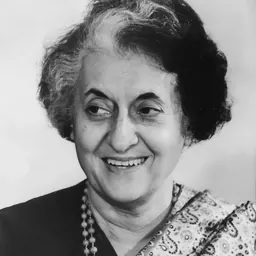
In 1979, Bhandari published her third novel, Mahabhoj. The novel was based on the massacre of Dalits in Belchhi, Bihar, in which 11 persons belonging to Dalit and Scheduled Caste communities were captured, bound, murdered, and their corpses burned, by a private militia of 'upper' caste landlords in 1977, who then feasted beside the pyre while it burned. The incident garnered widespread public attention, including personal attention from India's then Prime Minister, Indira Gandhi. Mahabhoj, meaning 'banquet' presented a fictionalised retelling of this incident, through the eyes of Bisu, a young Dalit man who was traumatized by previous massacres and attacks on marginalized Dalit communities. Bisu's attempt to investigate and hold accountable the perpetrators of these crimes results in his death and the intimidation and massacre of his entire village in the novel. Taking place amidst an electoral campaign, the novel was praised for its understanding of Dalit marginalization and political vulnerability. Bhandari published several more collections of these stories in Hindi, including Ek Plate Sailab (1962), Teen Nigahon Ki Ek Tasvir, Yahi Sach Hai, Trishanku and Sampoorna Kahaniyan. Bhandari continued to collaborate with Chatterjee over the next few years, writing screenplays for a television serial titled Rajani. Rajani was broadcast on India's public service broadcaster, Doordarshan, and was an account of a housewife who engaged in social and political reform movements. An episode written by Bhandari, about the plight of taxi drivers, gained wide public attention, in particular.
Following the critical and commercial success of her novel, Mahabhoj, Bhandari adapted the book for the stage. It was staged by Amal Allana for the National School of Drama in Delhi, in a production that was also commercially successful, critically acclaimed, and ran for several years.
Critical reception Bhandari's writing can be situated within the early stages of the Nayi Kahani movement, a Hindi literary movement in the 1950s and 1960s that focused on the aspirations and problems of the educated middle class in post-Independent, post-colonial India. The movement included several of Bhandari's contemporaries, such as her husband, the author Rajendra Yadav, as well as authors like Nirmal Verma, Bhisham Sahni, Kamleshwar.
Don’t just read it —
keep it.
Full-length biographies made to live with: read them, listen on the way to work, watch them tonight.
- E-book
- Audio
- Video
Instant download · yours to keep · every purchase keeps this site free
Important facts
Family & relationships
People in Mannu Bhandari's life
Named in this biography and alive at the same time


Related people
Same field, nearest in time


Contemporaries
People whose lives overlapped Mannu Bhandari's

Frequently asked questions
Who was Mannu Bhandari?
Indian writer (1931–2021)
When was Mannu Bhandari born?
Mannu Bhandari was born on 3 April 1931 in Bhanpura.
When did Mannu Bhandari die?
Mannu Bhandari died on 15 November 2021 in Gurgaon.
What was Mannu Bhandari's occupation?
Mannu Bhandari was a novelist, writer and playwright.
What nationality was Mannu Bhandari?
Mannu Bhandari was Indian.
Sources & further reading
Cite this page
APA: Biography.guide. (2026). Mannu Bhandari. https://biography.guide/mannu-bhandari/
MLA: "Mannu Bhandari." Biography.guide, https://biography.guide/mannu-bhandari/.
Chicago: "Mannu Bhandari." Biography.guide. https://biography.guide/mannu-bhandari/.
Data last updated: 2026-09-22 · Spot an error? Report a correction.
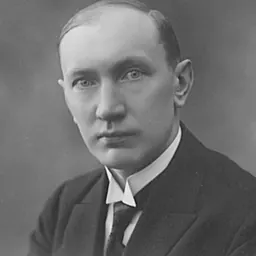
Portrait: Wikimedia Commons · author & licence
Page generated 2026-09-27 05:03 UTC