
About Manjutakin
Lived 901 – 1007 (aged 105–106). Manjutakin was a military leader.
Manjutakin was a military slave (ghulam) of the Fatimid Caliph al-Aziz . Of Turkic origin, he became one of the leading Fatimid generals under al-Aziz, fighting against the Hamdanids and the Byzantines in Syria. He rebelled against the Berber-dominated regime of the early years of al-Hakim , but was defeated and died in captivity.
Biography Manjutakin was one of the most prominent of the Turkic slave-soldiers who were introduced to the Fatimid court by al-Aziz and his predecessor al-Mu'izz and favoured as a counterbalance to the predominantly Berber army (mostly drawn from the Kutama tribe).
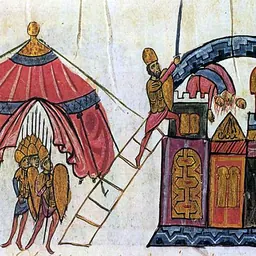
In 991, after the death of the long-time vizier Yaqub ibn Killis, who had dominated Fatimid politics during his life, al-Aziz chose to pursue a more aggressive stance in Syria, and appointed Manjutakin as governor of Damascus. Encouraged by the defectors after the death of emir Sa'd al-Dawla, al-Aziz decided to renew his attacks on the Hamdanid emirate of Aleppo, and tasked Manjutakin with the campaign. The Fatimid general invaded the emirate, defeated a Byzantine force under the doux of Antioch, Michael Bourtzes, in June 992, and laid siege to Aleppo. However, he failed to pursue the siege with vigour and the city was easily able to resist until, in the spring of 993, after thirteen months of campaigning, Manjutakin was forced to return to Damascus due to lack of supplies. In spring 994, Manjutakin launched another invasion, again defeated Bourtzes at the Battle of the Orontes in September, took Homs, Apamea and Shayzar and besieged Aleppo. The blockade was far more effective this time and soon caused a severe lack of food, but the city's defenders held out under the determined guidance of the Hamdanids' de facto regent, Lu'lu', until the sudden arrival of the Byzantine emperor, Basil II, in person in April 995. Basil, who had been campaigning in Bulgaria, had responded to the Hamdanids' plea for aid, and crossed Asia Minor in only sixteen days at the head of an army; his sudden arrival, and the exaggerated numbers circulating for his army, caused panic in the Fatimid army, especially as Manjutakin, expecting no threat, had ordered his cavalry horses to be dispersed around the city for pasture. Despite having a considerably larger and well-rested army, Manjutakin was thus at a disadvantage. He burned his camp and retreated to Damascus without battle. The Byzantines besieged Tripoli unsuccessfully and occupied Tartus. Al-Aziz himself now prepared to take the field against the Byzantines himself, but he died on 14 October 996 before starting his campaign.
After al-Aziz's death, his young son al-Hakim succeeded to the throne. The Kutama, however, used the opportunity to install their leader, al-Hasan ibn 'Ammar, as prime minister, and to effectively seize control of the central government for themselves. This provoked the reaction of the Turkic faction, led by Manjutakin. With the covert encouragement of al-Hakim's eunuch tutor Barjawan, Manjutakin led his army south towards Egypt, while the Berbers gathered under the command of Sulayman ibn Ja'far ibn Fallah. The two armies met in either Ramla or Ascalon, and the battle ended in defeat for Manjutakin, who was taken prisoner. Ibn Fallah marched on to Damascus, where he assumed the post of governor, while Manjutakin himself was well received by Ibn 'Ammar, who thus hoped—in the event, without success—to reconcile the Turks to his regime and use them to counterbalance the caliphal office. He was allowed to live out his years in retirement in Cairo, where he died in 1007.
Don’t just read it —
keep it.
Full-length biographies made to live with: read them, listen on the way to work, watch them tonight.
- E-book
- Audio
- Video
Instant download · yours to keep · every purchase keeps this site free
Important facts
People in Manjutakin's life
Named in this biography and alive at the same time
Related people
Same field, nearest in time




Contemporaries
People whose lives overlapped Manjutakin's



Frequently asked questions
Who was Manjutakin?
Fatimid general
When was Manjutakin born?
Manjutakin was born in 901.
When did Manjutakin die?
Manjutakin died in 1007 in Cairo.
What was Manjutakin's occupation?
Manjutakin was a military leader.
What nationality was Manjutakin?
Manjutakin's recorded nationality: Fatimid Caliphate.
Sources & further reading
Cite this page
APA: Biography.guide. (2026). Manjutakin. https://biography.guide/manjutakin/
MLA: "Manjutakin." Biography.guide, https://biography.guide/manjutakin/.
Chicago: "Manjutakin." Biography.guide. https://biography.guide/manjutakin/.
Data last updated: 2026-09-20 · Spot an error? Report a correction.
Page generated 2026-09-27 05:30 UTC