
About Malina Suliman
Born 1990. Malina Suliman is an Afghan painter, graffiti artist and artist.
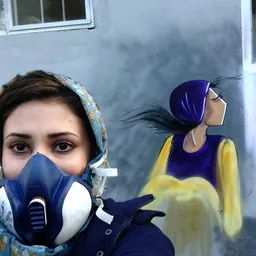
Malina Suliman (born 1990) is an Afghan graffiti artist, metalworker and painter. She was born in Kabul. As a child, she and her family were forced to flee her home province to live in Kandahar, Afghanistan. Her work is considered to challenge traditional Muslim culture like the burqa. According to Suliman, "The burqa is a way of controlling, but in the name of respect. Every culture or religion gives a different name for the burqa. It is honor, culture, and religion. Really, it just controls the woman and keeps her inside." Malina's work has gained the attention of the Taliban and traditional Muslims, resulting in having received threats from the Taliban towards Suliman and her family. The artist was subject to physical threats, rocks have been thrown at her as she conducts her work.
Not only does Malina worry about the Taliban, but her family who disagrees with her decision to create art. Creating art that displays the human body like Malina's motif, the skeleton in a burqa, is seen as idol worship. To the Taliban and other traditional Muslims, Malina's artwork is un-Islamic and Suliman's parents were embarrassed. Because of this her parents went the distance and locked Malina in their house for nearly a year, which had the opposite effect they were hoping for. Malina claimed that, “Today, whatever I am doing for art, it’s all because of that one year in which I was staying in a home.” Suliman spends her time holding art exhibits around the world. In December 2019, Malina intended to hold a lecture on the colonization of art in Rome but it was canceled.
Education Suliman studied Realism Art in Pakistan, without the knowledge of her father, and eventually received her bachelor's degree at the Art Council Karachi of Fine Arts but her studies were cut short when her parents asked her to return home.
In 2013, an attack on her father pushed the family to move to Mumbai, India. There, she studied at the Sir J.J School of Art. In 2014, She relocated to the Netherlands where she started her M.A at the Dutch Art Institute.
Career
Malina had an interest in art since childhood. She described her interest as art attracting her instinctively so she could feel it inside her. While Malina was home for the ten months, she felt she lost her identity, and it had a large impact. It wasn't until her sister's husband took her to an exhibit that she found her identity again. "I started shouting and crying, and I felt like I was back, and I existed again."-Malina Suliman. It was then that began to do art despite the knowledge that she would receive resistance from her family and from other people. Her writing of the graffiti attracted comments from passersby. She would also get assaulted by people throwing rocks, who followed her if she tried to relocate. The Taliban was the most vocal against her work. They have said that Suliman's work is idol-worshipping and anti-Islam. This resulted in violent actions taken against Suliman and her family. Once Malina started holding her exhibits, she received threats warning her not to attend her own exhibits. In one exhibit in Kandahar, she attracted the attention of the Governor, Tooryalai Wesa, who praised her work hoping that "more women would do the same." Suliman's art earned her an invitation to President Hamid Karzai's palace to showcase her work in a private viewing. She also joined a local art group, the Kandahar Fine Arts Association, to bring an art scene that would be alive in her deeply conservative hometown.
The group was all male and relatively small but has gained many female artists since. In 2015, Malina participated in a painting and sculpture exhibition at the French Cultural Center in Kabul. The same year, Suliman's work was the focus of a solo exhibition at the Art Represent gallery in Bethnal Green, London. The show, entitled 'Beyond the Veil: A Decontextualization', saw the installation of a number of burqas, each inscribed with the wishes and aspirations of Afghan citizens in a traditional form of calligraphy. A movie released in 2016 called 'Tasting the Moon' featuring Malina Suliman, Shamsia Hassani, and Nabila Horakhsh. The movie is about First Generation of Afghan Female Contemporary Artists and contains a trilogy of impressionistic dream sequences inspired by re-occurring metaphors in each artist's work.
Art Malina's art didn't become political until she moved back to Afghanistan. After seeing the discrimination she and other women faced, Suliman's art sought to advocate for women's rights in Afghanistan. Her most famous graffiti art is the image of a skeleton wearing a blue burqa. Suliman always felt like the burqa controlled her as child. To Malina, the skeleton is a self portrait that means a lack of identity for women in Afghanistan, inequality because women are treated as second class citizens in Afghan, and oppression for the women who are killed asking for rights. One of her more morbid and darker works includes a gruesome scene in the aftermath of a suicide bombing. Malina depicts the reaction of people in a statement during an interview. “Many people had never seen an art installation... Some were offended and others were hurt because they’d experienced it before."
Don’t just read it —
keep it.
Full-length biographies made to live with: read them, listen on the way to work, watch them tonight.
- E-book
- Audio
- Video
Instant download · yours to keep · every purchase keeps this site free
Important facts
People in Malina Suliman's life
Named in this biography and alive at the same time

Related people
Same field, nearest in time




Contemporaries
People whose lives overlapped Malina Suliman's





Frequently asked questions
Who is Malina Suliman?
Afghan artist
When was Malina Suliman born?
Malina Suliman was born in 1990 in Kandahar.
What is Malina Suliman's occupation?
Malina Suliman is a painter, graffiti artist and artist.
What nationality is Malina Suliman?
Malina Suliman is Afghan.
Sources & further reading
Cite this page
APA: Biography.guide. (2026). Malina Suliman. https://biography.guide/malina-suliman/
MLA: "Malina Suliman." Biography.guide, https://biography.guide/malina-suliman/.
Chicago: "Malina Suliman." Biography.guide. https://biography.guide/malina-suliman/.
Data last updated: 2026-09-20 · Spot an error? Report a correction.
Page generated 2026-09-27 05:27 UTC