
Malalai of Maiwand
National folk hero of Afghanistan who rallied local Pashtun fighters against the British troops
About Malalai of Maiwand
Lived 1861 – 1880 (aged 18–19). Malalai of Maiwand was an Afghan.
Malalai of Maiwand , also known as Malala , or Malalai Anna (, meaning Malalai the "Grandmother") is a national folk hero of Afghanistan who purportedly rallied Afghan troops at the Battle of Maiwand during the Second Anglo-Afghan War. She was alleged to have fought alongside Ayub Khan and bore responsibility for the Afghan victory at the Battle of Maiwand on 27 July 1880. She is also known as 'The Afghan Jeanne d'Arc' or as 'The Afghan Molly Pitcher' to the Western world. There are many schools, hospitals, and other institutions named after her in Afghanistan, and her story is told in Afghan school text books.
Biography
Malalai was born in Ishaqzai tribe in 1861 in the village of Khig, about 3 miles southwest of the then village of Maiwand in the southern Kandahar province of Afghanistan. During the late 1880s, war broke out between Afghanistan and Britain, with the last war between the two states being in the 1840s. The British, along with their Indian forces, had launched a major expedition into Afghanistan from India. The main garrison of the British was located in Kandahar, which is the closest city to the town of Maiwand. The military of Afghanistan was represented by commander Ayub Khan, son of Afghan Emir Sher Ali Khan. Malalai's father, who was a shepherd, and her fiancé joined with Ayub Khan's army in the large attack on the British-Indian forces in July 1880. Like many Afghan women, Malalai Ishaqzai was there to help tend to the wounded or provide water and spare weapons. According to local sources, this was also supposed to be her wedding day.
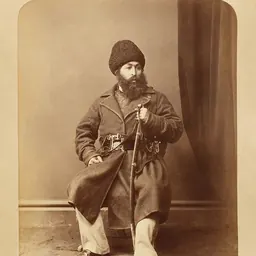
Afghan military commanders on 2 September 1880, about a month after their victory at the Battle of Maiwand.
When the Afghan army was losing morale, despite their superior numbers, Malalai allegedly took the Afghan flag and shouted:
This inspired the Afghan fighters to redouble their efforts. When a lead flag-bearer was killed, Malalai Ishaqzai went forward and held up the flag (some versions say she used her veil as a flag ), singing a landai (a short folk-song sung by Afghan women): With a drop of my sweetheart's blood, Shed in defense of the Motherland, Will I put a beauty spot on my forehead, Such as would put to shame the rose in the garden! After the battle, Malalai was honored for her efforts and buried in her native village of Khig, where her grave remains today. She was 18 or 19 at the time of her death.
The Pashtun poet Ajmal Khattak wrote the following lines about Malalai:
Legacy
Malalai made an appearance in an animated opening scene of the documentary, He Named Me Malala.
Pakistan activist Malala Yousafzai was named in honor of Malalai when she was born on July 12, 1997.
Malala Maiwand, an Afghan journalist was also named to avoid the identity confusion with the Afghan Joan of Arc until her murder on December 10, 2020.
Reception The authenticity of the story and of Malalai has been questioned by many scholars. Even though she has become well received by the Afghan state and many believe it to be genuine, it seems to be more of a folklore than historical reality. No British historian of that time referred to or mentioned Malalai's name, even the local records are missing. The British author Howard Hensmen, in his book The Afghan War, does mention that one woman was found amongst the dead in Ahmad khel, but the battle of Ahmad khail occurred on 19 April 1880, while the battle of Maiwand was on 27 July 1880.
Afghan historian Muhammad Siddiq Farhand wrote a three volume book "Afghanistan in the past five centuries" a very distinguished piece in Afghan history, he also failed to mention a woman named Malala.
The first time Malalai's name was mentioned was 40–60 years after the battle of Maiwand. Many believe it was Abdul Hai Habibi who coined the story during the period of Pashto Tolana to support the national narrative and Pashtun nationalism. Habibi has previously been accused of forgery, in the case of Pata Khazana.
Don’t just read it —
keep it.
Full-length biographies made to live with: read them, listen on the way to work, watch them tonight.
- E-book
- Audio
- Video
Instant download · yours to keep · every purchase keeps this site free
Important facts
People in Malalai of Maiwand's life
Named in this biography and alive at the same time
Frequently asked questions
Who was Malalai of Maiwand?
national folk hero of Afghanistan who rallied local Pashtun fighters against the British troops (1861–1880)
When was Malalai of Maiwand born?
Malalai of Maiwand was born in 1861 in Kandahar Province.
When did Malalai of Maiwand die?
Malalai of Maiwand died on 27 July 1880 in Maiwand.
What nationality was Malalai of Maiwand?
Malalai of Maiwand was Afghan.
Sources & further reading
· Wikipedia: Malalai of Maiwand
Cite this page
APA: Biography.guide. (2026). Malalai of Maiwand. https://biography.guide/malalai-of-maiwand/
MLA: "Malalai of Maiwand." Biography.guide, https://biography.guide/malalai-of-maiwand/.
Chicago: "Malalai of Maiwand." Biography.guide. https://biography.guide/malalai-of-maiwand/.
Data last updated: 2026-09-20 · Spot an error? Report a correction.
Page generated 2026-09-27 05:11 UTC