
About Máirín de Búrca
Born 1938. Máirín de Búrca is a journalist.
Máirín de Burca (born 1938) is an Irish writer, journalist and political and social activist. In a career spanning more than six decades, she was a leading figure in Sinn Féin and Official Sinn Féin, a founding member of the Irish Women's Liberation Movement, and a central figure in the Dublin Housing Action Committee as well as the Prisoners' Rights Organisation. She is particularly well known, alongside the journalist Mary Anderson, for a legal challenge that forced a change in Irish law to enable women and people without property to serve on juries.
De Burca was General Secretary of Sinn Féin during the 1969 split between the Provisionals and the Officials, and she continued in the role of General Secretary of Official Sinn Féin until her resignation in 1977. She was also a prominent anti-Vietnam War and anti-apartheid protester, was jailed for burning the American flag outside the United States embassy in Dublin, and was arrested for throwing eggs at Richard Nixon's car during his 1970 visit to Ireland. In 2017, she was awarded an honorary Doctor of Law by University College Dublin in recognition of her activism, and in 2018 she was the subject of a feature documentary, Five Red Roses, directed by Cathal Black.
Early life Sources differ on the precise circumstances of de Burca's birth. A 2023 newspaper review of her biography states that she was born in Chicago in 1938. , while an academic thesis records that she was born in Dublin in 1938 after her mother, though a naturalised United States citizen along with her father, returned home to give birth. Her family later informally adopted a boy, Michael, who became her mother's favourite, deepening this sense of neglect.
She was the Official Sinn Féin candidate at the 1973 general election for the Dublin North-Central constituency. She received 1,667 (4.8%) first-preference votes but was not elected. She also stood in the 1974 Irish local elections as an Official Sinn Féin candidate for Dublin City Council; she received 4.8% and did not gain a seat.
Within the party, de Burca opposed the introduction of examinations for probationary members undergoing political education, and succeeded in having the proposal voted down with the backing of party leader Tomás Mac Giolla. The historian Sinead McEneaney has argued that DHAC activists, including de Burca, may deliberately have provoked confrontations with Gardaí in the hope of generating newsworthy coverage of the housing campaign. Journalist and writer Rosita Sweetman, writing in the Irish Independent, described Gaj's as functioning like "our Left Bank, Greenwich Village, Colony Club all rolled into one". In 1980, at the Merriman Summer School in Ballyvaughan, County Clare, she delivered a feminist critique of Brian Merriman's 18th-century poem The Midnight Court, arguing that "I don't believe that men can write intelligently of women's oppression", a view that provoked a sharp reaction from her audience.
Prisoners' Rights Organisation and other activism De Burca spent a week in prison in 1971 for her anti-war activism, an experience that led her to help found the Prisoners' Rights Organisation (PRO) in 1973. She was invited, alongside former prisoner Brendan Walsh, to speak at a University College Dublin meeting on prison conditions that led to the organisation's formation. The case arose after de Burca and Anderson were arrested and charged with breach of the peace during a protest outside Dáil Éireann over housing.
De Burca has said this was the achievement she was proudest of, describing her many other campaigns on women's rights, equality, housing and prisoners' rights, as comparatively minor by contrast. In a 2000 radio interview with Pat Kenny, broadcast on International Women's Day alongside fellow campaigner Nell McCafferty, de Burca reflected on how far Ireland had changed for women since the 1970s, while noting that equal pay had still not been achieved.
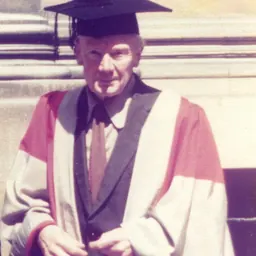
In 2017, de Burca was awarded an honorary Doctor of Law by University College Dublin. In 2020, artist Jesse Jones spent a creative residency at the King's Inns in Dublin, during which she met regularly with de Burca at her home in Marino, while researcher Lisa Godson recorded an oral history that, together with de Burca's personal archive, was subsequently held at the King's Inns library. The residency resulted in a permanent Portland stone sculpture, The Left Arm of Commerce, depicting de Burca's arm and hand holding a copy of the Constitution of Ireland, which Jones said was intended to honour de Burca's role as a "radical litigant" who showed how "we can sometimes change the law itself" by breaking it.
Don’t just read it —
keep it.
Full-length biographies made to live with: read them, listen on the way to work, watch them tonight.
- E-book
- Audio
- Video
Instant download · yours to keep · every purchase keeps this site free
Important facts
People in Máirín de Búrca's life
Named in this biography and alive at the same time








Related people
Same field, nearest in time





Contemporaries
People whose lives overlapped Máirín de Búrca's


Frequently asked questions
Who is Máirín de Búrca?
Irish writer, journalist and activist
When was Máirín de Búrca born?
Máirín de Búrca was born in 1938.
What is Máirín de Búrca's occupation?
Máirín de Búrca is a journalist.
What nationality is Máirín de Búrca?
Máirín de Búrca's recorded nationality: Irish people.
Sources & further reading
Cite this page
APA: Biography.guide. (2026). Máirín de Búrca. https://biography.guide/mairin-de-burca/
MLA: "Máirín de Búrca." Biography.guide, https://biography.guide/mairin-de-burca/.
Chicago: "Máirín de Búrca." Biography.guide. https://biography.guide/mairin-de-burca/.
Data last updated: 2026-09-20 · Spot an error? Report a correction.
Page generated 2026-09-27 05:16 UTC