
Mahmud ibn Zarkun
Moroccan eunuch who rose to the rank of pasha
About Mahmud ibn Zarkun
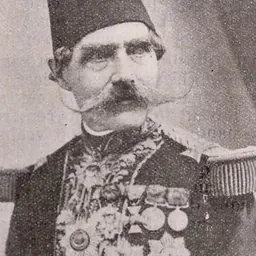
Mahmud ibn Zarkun was a pasha.
Mahmud ibn Zarkun, also known as Mahmud ben Zergun (Arabic: محمود بن زرقون, Maḥmūd ibn Zarqūn), was a Maghrebi eunuch who rose to the rank of pasha. For a time, he served as the commander of all renegades during the Saadian rule. He succeeded Judar Pasha as the main commander of the Saadian invasion of the Songhai Empire from 1591 to 1595. During the battle of Bamba, he defeated Askia Ishaq II and later killed his successor, Askia Muhammad Gao, through a deceitful trap. He continued fighting against Askia Nuh, who succeeded Muhammad. Mahmud was responsible for the repression and plunder of Timbuktu. Ahmad al-Mansur condemned him to death, but before the executioner could carry out the sentence, Mahmud died in a suicidal battle against the Songhai forces on 15 March 1595 near the Niger River.
Biography Invasion of Songhai
Sultan Ahmad al-Mansur sent an expedition in 1590 to conquer Songhai. The expedition's initial leader, Judar Pasha, had achieved significant victories and offered peace to Askia Ishaq II. However, al-Mansur was angered by this peace proposal, as he sought to control all of the Sudanese state, particularly the gold mines. As a result, he sent Mahmud ibn Zarkun to take over the leadership of the Saddian invasion.
Dispute with Ishak II and Muhammad Gao Mahmud's elite forces crossed the Sahara in just seven weeks, much faster than the first expedition led by Judar Pasha, which left Marrakesh on October 16, 1590, and reached the Niger River in February 1591. Mahmud's forces reached Timbuktu on 17 August 1591. According to Michel, it was Kaid Mami who suggested bringing Askia to the peace talks. He advised Muhammad to send food to the starving people of Timbuktu as a gesture of goodwill. When Askia arrived with the food supplies, he and his entourage were murdered on Mahmud's orders, as Mahmud sought revenge for the losses the Moroccans had suffered during their crossing of the Sahara. His brother, Nuh, evacuated many Songhai people from the areas occupied by Morocco, intending to continue resistance in Dendi. He built a kasbah in the northern Nigerian town of Kolen, which became the base for his forces in Dendi. From there, he launched attacks and pursued the troops of Nuh, who were continually setting ambushes. For unclear reasons, Mahmud ibn Zarkun changed this policy. During the fighting in Dendi in October 1592, he ordered the public and brutal execution of two descendants of Sharif Ahmad as-Sakalli. To influence the occupiers' policy, Kadi Umar sent a letter to Marrakesh asking for the Sultan's mercy. Ahmad al-Mansur received the Kadi's envoys kindly and promised to end the repression, but secretly sent new troops with orders to arrest Umar and suppress any resistance.
After returning from Dendi, Pasha Mahmud plundered the nomadic Sanhaja tribes, but the spoils were deemed insufficient. To satisfy the Sultan's expectations, Mahmud decided to loot the residents of Timbuktu. He used a ruse, announcing that the houses of the inhabitants would be searched, and any found weapons would be confiscated. This decree did not apply to the descendants of Kadi Muhammad Akita, which led the citizens to hide their valuables in buildings owned by the Kadi's relatives. On October 18 and 19, Mahmud took an oath of allegiance from the merchants, and on October 20, he ordered the same from the ulama. When they gathered at the designated place, they were arrested by the Moroccans. During this time, their homes were ransacked, and all the valuables collected by the citizens fell into the hands of the occupiers. Some of the imprisoned scholars were killed outside the city walls, while the others were detained in the kasbah. This group, including Kadi Umar and the renowned writer Ahmad Baba, was deported to Morocco on 18 March 1594. Ahmad Baba was later freed due to the efforts of the Maghrebi ulama.
Death Pasha Mahmud sent 100,000 mithkals of gold and slaves to Marrakesh. He distributed part of the remaining sum among his soldiers, while keeping the rest for himself. The distance from the metropolis meant that Mahmud did not attempt to conceal his luxuries, mocking the Sultan. This behavior led one of the kaids to send reports about him. Enraged, al-Mansur sent Kaid to Timbuktu with orders to kill ibn Zarkun and take his position. Mahmud learned of his impending fate from a messenger sent by the Sultan's son, Bu Faris. Askia Nuh sent Mahmud ibn Zarkun's head to Kanta Dawud, the Sultan of the allied Kebbi.
Don’t just read it —
keep it.
Full-length biographies made to live with: read them, listen on the way to work, watch them tonight.
- E-book
- Audio
- Video
Instant download · yours to keep · every purchase keeps this site free
Important facts
Related people
Same field, nearest in time



Frequently asked questions
Who was Mahmud ibn Zarkun?
Moroccan eunuch who rose to the rank of pasha
When did Mahmud ibn Zarkun die?
Mahmud ibn Zarkun died on 15 March 1595.
What was Mahmud ibn Zarkun's occupation?
Mahmud ibn Zarkun was a pasha.
What nationality was Mahmud ibn Zarkun?
Mahmud ibn Zarkun's recorded nationality: al-Andalus.
Sources & further reading
· Wikipedia: Mahmud ibn Zarkun
Cite this page
APA: Biography.guide. (2026). Mahmud ibn Zarkun. https://biography.guide/mahmud-ibn-zarkun/
MLA: "Mahmud ibn Zarkun." Biography.guide, https://biography.guide/mahmud-ibn-zarkun/.
Chicago: "Mahmud ibn Zarkun." Biography.guide. https://biography.guide/mahmud-ibn-zarkun/.
Data last updated: 2026-09-20 · Spot an error? Report a correction.
Page generated 2026-09-27 04:57 UTC