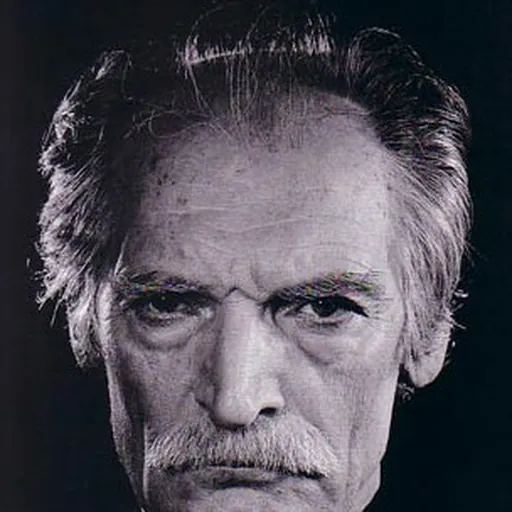
About Mahmoud Dowlatabadi
Born 1940. Mahmoud Dowlatabadi is an Iranian writer, novelist, playwright, actor and short story writer.
Mahmoud Dowlatabadi (; born August 1, 1940 in Dowlatabad, Sabzevar) is an Iranian writer and actor, known for his promotion of social and artistic freedom in contemporary Iran and his realist depictions of rural life, drawn from personal experience. In 2020, he wrote and recited a work called Soldier (Half-Burned boots) for the Art of Peace global project, composed and arranged by Mehran Alirezaei. He has collaborated with this project.
Biography Mahmoud Dowlatabadi was born into a family of shoemakers in Dowlatabad, a remote village in Sabzevar, the northwestern part of Khorasan Province, Iran. He worked as a farmhand and attended Mas'ud Salman Elementary School. Books were a revelation to the young boy. He "read all the romances [available]... around the village". He "read on the roof of the house with a lamp…read War and Peace that way" while living in Tehran. Though his father had little formal education, he introduced Dowlatabadi to the Persian classical poets, Saadi Shirazi, Hafez, and Ferdowsi. His father generally spoke in the language of the great poets.
Nahid Mozaffari, who edited a PEN anthology of Iranian literature, said that Dowlatabadi "has an incredible memory of folklore, which probably came from his days as an actor or from his origins, as somebody who didn't have a formal education, who learned things by memorizing the local poetry and hearing the local stories."
Major works
Kelidar Kelidar is a saga about a Kurdish nomadic family that spans 10 books and 2,590 pages. Encyclopædia Iranica praises its "heroic, lyrical, and sensual" language. The story is tremendously popular among Iranians due to "its detailed portrayal of political and social upheaval."
Influence Dowlatabadi is celebrated as one of the most important writers in contemporary Iran, particularly for his use of language. He elevates rural speech, drawing on the rich, lyrical tradition of Persian poetry. He "examines the complexities and moral ambiguities of the experience of the poor and forgotten, mixing the brutality of that world with the lyricism of the Persian language," said Kamran Rastegar, a translator of Dowlatabadi's work. Most other Iranian writers come from solidly middle-class backgrounds, with urban educations. Because of his rural background, Dowlatabadi stands out as a unique voice. He has also garnered praise internationally, with Kirkus Reviews calling The Colonel, "A demanding and richly composed book by a novelist who stands apart." The Independent described the novel as "passionate," and emphasized, "It's about time that everyone even remotely interested in Iran read this novel."
Safarnameh Sistan, a documentary which was made by Ali Zare Ghanat Nowi in 2011, about a trip to Sistan and meeting Balochi ethnics, illustrating the very hard life of people living there, giving information about their life style in such a dry area, is a free adaptation from Meet the Baloch People by Mahmoud Dowlatabadi.
Awards and honors 2009 Haus der Kulturen Berlin International Literary Award, shortlist, The Colonel 2011 Man Asian Literary Prize, longlist, The Colonel 2012 Hooshang Golshiri Literary Award, Lifetime Achievement 2013 Jan Michalski Prize for Literature, winner, The Colonel 2014 Legion of Honour
In August 2014, Iran issued a commemorative postage stamp for writer Mahmoud Dowlatabadi.
Prose Fiction Short stories ته شب (At the End of the Night) - 1961 هجرت سلیمان (The Migration of Sulaimaan) - 1972 آهوی بخت من گزل (My Lucky Doe, Gazelle) - 1989 بنیآدم (The Children of Aadam/Humans) - 2015
Collections لایههای بیابانی (Desert Layers) (سایههای خسته [Tired Shadows], [Iddbaar]ادبار, [At the foot of the Tomb of the Imaamzaadeh Shu'aibb] بند, پای گلدستۀ امامزاده شعیب [Strap], [Desert]بیابانی) - 1968 کارنامه سپنج (The Career of Sepanj) - includes all short stories (except "My Lucky Doe, Gazelle" and "The Children of Adam"), novellas, and a travelogue - 1989 گلدستهها و سایهها (Garlands and Shadows) - 2005 دُرّ یتیم (خشکیدن آب دهان عنکبوت) (The Drool of the Orphan [Drying Up the Saliva of the Spider]) - unknown date of publication
Novellas سفر (The Journey) - 1968 آوسنه بابا سبحان (Dear Baabaa Subbhaan) - 1968 گاواربان (Cowherd/Shepherd) - 1972 باشبیرو (Baashabeeroo) - 1972 عقیل، عقیل ('Aqeel, 'Aqeel) - 1972 از خم چنبر (From the Bend of the Circle) - 1977 آن مادیان سرخیال (That Red-Maned Mare) - mid-1990s روز و شب یوسف (The Day and Night of Yoosuf) - 2004
Novels جای خالی سلوچ (Missing Soluch) - 1979 کلیدر (Kaleedar) - 10 volumes - 1984 روزگار سپریشده مردم سالخورده (The Bygone Days of Old People) - 3 volumes - 1991 سلوک (Conduct/Behaviour) - 2003 طریق بسمل شدن (The {Shia} Way to Say Basmalah [When Slaughtering Animals]/Thirst) - written in 2004-2006, published in 2018 زوال کلنل (The Decline of the Colonel/The Colonel) - 2009 وزیری امیر حسنک (Wazeeree Ameer Hasanak) - 2013 بیرونِ در (Outside the Door) - 2019 اسبها اسبها از کنار یکدیگر (Horses and Horses, Next to Each Other) - autobiographical - 2020
Translations In Sweden "Missing Soluch" was translated into Swedish by Stefan Lindgren as "Den tomma platsen". Stockholm, Ordfront, 1999. "In Norway, Missing Soluch was translated into Norwegian by N. Zandjani as Den tomme plassen etter Soluch. Oslo, Solum forlag 2008. In Switzerland, Kelidar was translated into German by Sigrid Lutfi, Unionsverlag 1999. In Iraqi Kurdistan, Kelidar was translated into Central Kurdish by Siyaamand Shaasawaaree (2012) by Sardam Publishers. In Switzerland, The Colonel was translated into German by Bahman Nirumand, Unionsverlag, 2009. In Italy, The Colonel was translated into Italian as Il Colonnello by Tom Patterdale in the early 2010s. In Israel, The Colonel was translated into Hebrew by Orly Noy as "שקיעת הקולונל" (The Decline of the Colonel) translated. Am Oved Publishing, 2012. In Bosnia and Herzegovina, The Colonel was translated into Bosnian by Mahmood Kodrić, Buybook 2014. In Pakistan, Gaawaaribaan novella translated in Urdu entitled Charwaahaa (چرواہا) by Shaheed Maanik Saglha in 2024. (Maanik is a young Pakistani author, translator and columnist.)
English Translations In the United States, Missing Soluch was translated into English by Kamran Rastegar, 2007. In the United Kingdom, The Colonel was translated into English by Tom Patterdale, 2012. In the United Kingdom, Thirst was translated into English by Martin E. Weir, 2014.
Don’t just read it —
keep it.
Full-length biographies made to live with: read them, listen on the way to work, watch them tonight.
- E-book
- Audio
- Video
Instant download · yours to keep · every purchase keeps this site free
Important facts
People in Mahmoud Dowlatabadi's life
Named in this biography and alive at the same time




Related people
Same field, nearest in time

Contemporaries
People whose lives overlapped Mahmoud Dowlatabadi's


Frequently asked questions
Who is Mahmoud Dowlatabadi?
Iranian writer and actor
When was Mahmoud Dowlatabadi born?
Mahmoud Dowlatabadi was born on 1 August 1940 in Sabzevar.
What is Mahmoud Dowlatabadi's occupation?
Mahmoud Dowlatabadi is a writer, novelist, playwright, actor and short story writer.
What nationality is Mahmoud Dowlatabadi?
Mahmoud Dowlatabadi is Iranian.
Sources & further reading
· Wikipedia: Mahmoud Dowlatabadi
· DBpedia: Mahmoud Dowlatabadi
Cite this page
APA: Biography.guide. (2026). Mahmoud Dowlatabadi. https://biography.guide/mahmoud-dowlatabadi/
MLA: "Mahmoud Dowlatabadi." Biography.guide, https://biography.guide/mahmoud-dowlatabadi/.
Chicago: "Mahmoud Dowlatabadi." Biography.guide. https://biography.guide/mahmoud-dowlatabadi/.
Data last updated: 2026-09-22 · Spot an error? Report a correction.
Portrait: Wikimedia Commons · author & licence
Page generated 2026-09-27 05:01 UTC