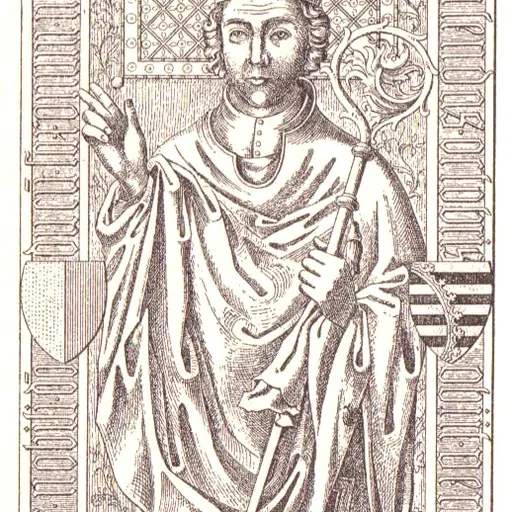
Magnus of Saxony-Lauenburg
Bishop of Cammin and Hildesheim
About Magnus of Saxony-Lauenburg
Lived 1390 – 1452 (aged 61–62). Magnus of Saxony-Lauenburg was a German canon, coadjutor bishop and catholic bishop.
Magnus of Saxe-Lauenburg (b 1390; d 21 September 1452) was Bishop of Cammin and Hildesheim.
Family The father of Magnus was Duke Eric IV of Saxe-Lauenburg; his mother was Sophia, a daughter of Duke Magnus II of Brunswick. His brothers were Duke Eric V of Saxe-Lauenburg and Duke Bernard II of Saxe-Lauenburg.
Bishop in Cammin He entered priestly service and was a canon in Cammin. Under a dispensation from having to attain the required canonical age, Magnus was appointed Bishop of Cammin in 1410 by Pope Alexander V. This appointment was a result of the Western Schism, because there was also a Bishop Nicholas in the Bishopric, a supporter of Gregory XII. Even though the latter died after a short period, Magnus' post was not undisputed. In 1415, Gregory XII assigned the Bishopric to the Bishop of Schleswig, John of Gudensberg. With the general recognition of Martin V as pope in 1418, Magnus was also accepted as the sole Bishop of Cammin. A short time afterwards he was officially ordained bishop.
In the years that followed he concentrated on preserving the independence of the territory of the bishopric, the Stift. In 1417, he was enfeoffed with Cammin by King Sigismund; this came with its recognition as an Imperial Estate. In 1422, this found expression in its entry in the Reichsmatrikel. Magnus also tried to regain the estates of the Stift enfeoffed by his predecessors.
Despite that, the position of the bishop was not recognised by Bogislav IX and other magnates, and the disputes continued.
Bishop of Hildesheim In 1424, Magnus moved to the seat of the Bishop of Hildesheim. Previously, he had been appointed as coadjutor by Bishop John III. During his reign, the monastery's debts had risen sharply. He had also faced external threats.
Magnus arrived in Hildesheim in 1425 and called for an extended electoral capitulation. He tried to strengthen his position as the territorial lord in the Bishopric of Hildesheim, securing and expanding its area. Internally, he was keen to end disorder and bring peace. To that end, he entered into alliances with neighbouring territories and cities.
He tried to establish a good relationship with the city of Hildesheim. This was successful overall. But at times, however, there were conflicts between the city's aspirations for independence and his attempt to expand his territorial lordship. Magnus also tried to redeem the Bishopric's fiefs. However, this was only possible for Steuerwald Castle.
The need for money led to the levying of taxes (Bede). This required the approval of the Landstände. In doing so, they expanded their influence. In addition, castles, districts Ämter, income and other legal rights had to be pledged. In return, parts of the lordships of Everstein and Homburg were acquired. Thus the Bishopric of Hildesheim reached its greatest extent.
In the ecclesial life of the Bishopric, Magnus introduced a number of indulgences. The festival of the Presentation of Mary was introduced for the first time. He also supported monastic reform efforts. Where necessary, he also used his power as a territorial lord for this purpose. He supported Nicholas of Cusa.
In 1452, Magnus appointed Bernard of Brunswick-Lüneburg as coadjutor and resigned shortly afterwards. In the same year he died and was buried in Hildesheim Cathedral.
Literature
Don’t just read it —
keep it.
Full-length biographies made to live with: read them, listen on the way to work, watch them tonight.
- E-book
- Audio
- Video
Instant download · yours to keep · every purchase keeps this site free
Important facts
People in Magnus of Saxony-Lauenburg's life
Named in this biography and alive at the same time


Related people
Same field, nearest in time





Contemporaries
People whose lives overlapped Magnus of Saxony-Lauenburg's

Frequently asked questions
Who was Magnus of Saxony-Lauenburg?
bishop of Cammin and Hildesheim
When was Magnus of Saxony-Lauenburg born?
Magnus of Saxony-Lauenburg was born in 1390.
When did Magnus of Saxony-Lauenburg die?
Magnus of Saxony-Lauenburg died on 21 September 1452.
What was Magnus of Saxony-Lauenburg's occupation?
Magnus of Saxony-Lauenburg was a canon, coadjutor bishop and catholic bishop.
What nationality was Magnus of Saxony-Lauenburg?
Magnus of Saxony-Lauenburg was German.
Sources & further reading
· Wikipedia: Magnus of Saxony-Lauenburg
· DBpedia: Magnus of Saxe-Lauenburg (bishop)
Cite this page
APA: Biography.guide. (2026). Magnus of Saxony-Lauenburg. https://biography.guide/magnus-of-saxony-lauenburg/
MLA: "Magnus of Saxony-Lauenburg." Biography.guide, https://biography.guide/magnus-of-saxony-lauenburg/.
Chicago: "Magnus of Saxony-Lauenburg." Biography.guide. https://biography.guide/magnus-of-saxony-lauenburg/.
Data last updated: 2026-09-23 · Spot an error? Report a correction.
Portrait: Wikimedia Commons · author & licence
Page generated 2026-09-27 05:08 UTC