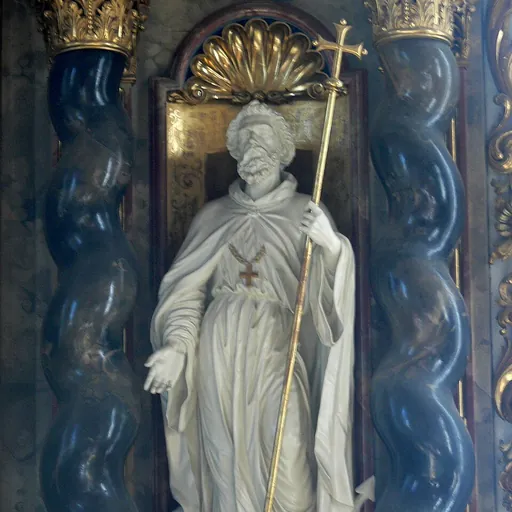
Magnus of Füssen
Missionary saint in southern Germany
About Magnus of Füssen
Lived 683 – 756 (aged 72–73). Magnus of Füssen was a German religious.
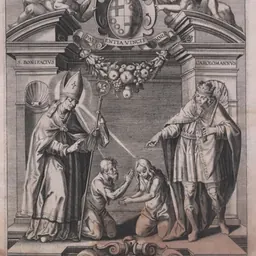
Magnus of Füssen, otherwise Magnoald or Mang, was a missionary saint in southern Germany, also known as the Apostle of the Allgäu. He is believed to have been a contemporary either of Gall (died 627) or of Boniface (died 754) and is venerated as the founder of St. Mang's Abbey, Füssen.
Legend There is almost no reliable information about him. The only source is an old "Vita S. Magni", which however contains so many obvious anachronisms that little reliance can be placed on it. It relates that the two Irish missionaries Columbanus and Gallus, spent some time with Willimar, a priest at Arbon. Here Gallus fell sick and was put in charge of Magnus and Theodore (Magnoald and Theodo), two clerics living with Willimar, while Columbanus proceeded to Italy and founded Bobbio Abbey. When Gallus had been miraculously informed of the death of Columbanus he sent Magnus to pray at his grave in Bobbio. Magnus returned with the staff of Columbanus and thereafter they followed his rule. After the death of Gallus, Magnus succeeded him as superior of the cell.
About this time a priest of the Diocese of Augsburg, named Tozzo or Toto, came as a pilgrim to the grave of Gall and invited Magnus to accompany him to the eastern part of the Allgäu. Magnus proceeded to Eptaticus (Epfach), where Wikterp, Bishop of Augsburg received him and entrusted him with the Christianization of the eastern Allgäu. He penetrated into the wilderness, then crossed the river Lech at a place still known as St. Mangstritt ("footstep of Saint Magnus") and built a cell, where afterwards the monastery of Füssen was erected, and where he died. and other authorities to reject the whole "Life" as a forgery of a much later date. Another school of thought however is that the second part of the "Life" was written in 851 in Ellwangen (although probably not by Ermenrich) when the relics of the saint were transferred there, while the first part, where Magnus is made a companion of Gall, is a later addition, which may incorporate the remains of the story of an earlier saint also called Magnus. This second view seems to have attracted greater support.
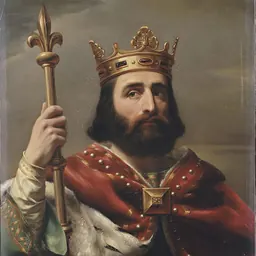
Life In reality, Magnus was probably working on behalf of Bishop Wikterp together with Tozzo and Theodor from about 746 in Ostallgäu. He first worked with Theodor, and together they established an abbey dedicated to the Virgin Mary and Gordianus and Epimachus at Kempten, the first in the Allgäu region. While Theodor remained in Kempten, Magnus worked on the upper Lech and in 746 built a prayer house in Waltenhofen near Schwangau. He then founded a cell and oratory at Füssen from which a monastic community grew. Its location on the old Via Claudia Augusta from Augsburg to northern Italy gave it strategic importance, and the Abbey received support from Pepin the Short.
Magnus is the patron saint of the Allgäu, von Füssen, and Kempten; and is invoked for the protection of cattle; and against eye diseases, snakebite, worms, rats, mice and field insects. His feast is celebrated on 6 September.
The cult of Saint Magnus of Cuneo may have arisen as a result of the expansion of Magnus of Füssen's cult into Italy, with Magnus of Cuneo mistakenly being considered a separate saint.
Don’t just read it —
keep it.
Full-length biographies made to live with: read them, listen on the way to work, watch them tonight.
- E-book
- Audio
- Video
Instant download · yours to keep · every purchase keeps this site free
Important facts
People in Magnus of Füssen's life
Named in this biography and alive at the same time
Related people
Same field, nearest in time




Contemporaries
People whose lives overlapped Magnus of Füssen's



Frequently asked questions
Who was Magnus of Füssen?
missionary saint in southern Germany
When was Magnus of Füssen born?
Magnus of Füssen was born in 683 in St. Gallen.
When did Magnus of Füssen die?
Magnus of Füssen died in 756 in Füssen.
What was Magnus of Füssen's occupation?
Magnus of Füssen was a religious.
What nationality was Magnus of Füssen?
Magnus of Füssen was German.
Sources & further reading
Cite this page
APA: Biography.guide. (2026). Magnus of Füssen. https://biography.guide/magnus-of-fussen/
MLA: "Magnus of Füssen." Biography.guide, https://biography.guide/magnus-of-fussen/.
Chicago: "Magnus of Füssen." Biography.guide. https://biography.guide/magnus-of-fussen/.
Data last updated: 2026-09-25 · Spot an error? Report a correction.
Portrait: Wikimedia Commons · author & licence
Page generated 2026-10-05 03:54 UTC