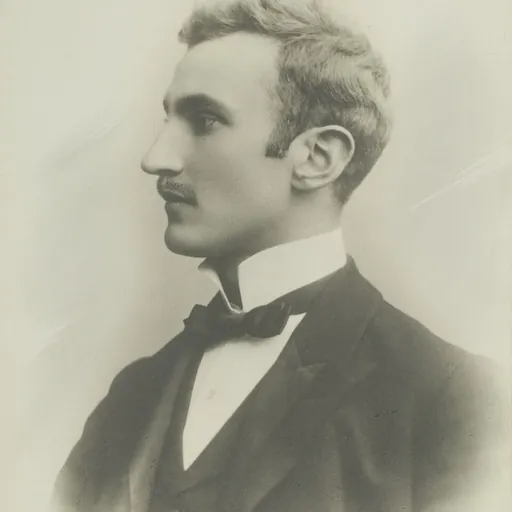
About Magnus Enckell
Lived 1870 – 1925 (aged 55). Magnus Enckell was a Finnish painter.
Knut Magnus Enckell (9 November 1870 – 27 November 1925) was a Finnish symbolist painter. At first, he painted with a subdued palette, but from 1902 onwards, used increasingly bright colors. He was a leading member of the Septem group of colorist painters. In Finland, Enckell is considered to have been a very influential symbolist artist.
Biography Knut Magnus Enckell was born on 9 November 1870 in Hamina, a small town in southeastern Finland, the son of Carl Enckell, a priest, and Alexandra Enckell (born Appelberg). The Enckell family originates from Germany, from where Christoffer Enckell had moved to Southwest Finland in the 17th century. He was the youngest of six sons. His native language was Finland’s Swedish.
In 1889, at the age of 19, he began his artistic studies in Helsinki, at the drawing school of the Finnish Art Society, but he dropped out and continued his studies privately under Gunnar Berndtson. There he was drawn to the Symbolist movement, and was influenced by the painter Pierre Puvis de Chavannes as well as Symbolist literature.
During a stay in Brittany he made two paintings in spare colors: Self-Portrait and Breton Woman. He was enthusiastic about the Renaissance and about the idealistic and mystical ideas of Sâr Péladan.
During his second stay in Paris in 1893, he painted The Awakening, in which he used a rigorous composition and transparent colors to suggest a spiritual atmosphere; and, through contact with the Swedish artists, Olof Sager-Nelson and Ivan Aguéli, he deepened his interest in mysticism.
It is generally believed that Enckell was a homosexual. Some of his erotic portraits, which were quite uninhibited for their time, suggest as much, although his homosexuality has never been conclusively proven. As Routledge's Who's Who in Gay and Lesbian History puts it, "His love affairs with men have not been denied. [...] Enckell's naked men and boys are openly erotic and sensual." In his own time, the sensuality of his paintings was explained away as something caused by his Swedish-speaking background.
In 1894 and 1895 Enckell traveled to Milan, Florence, Ravenna, Siena and Venice, where his inner conflicts were reflected in his art. In 1898 he taught himself fresco and tempera techniques in Florence, by studying the work of Masaccio and Fra Angelico.
The years in Italy gave his work a greater range of colors and a more optimistic foundation. In the first years of the twentieth century, under the influence of Post Impressionism, he developed a brighter, more colorful palette. An example of this is the series, The Bathers, in dark, lively colors. Together with Verner Thomé and Ellen Thesleff, Enckell founded the group Septem, in which artists who shared his beliefs came together.
1907 Enckell executed the commission for the altarpiece of Tampere Cathedral. The fresco, more than 10 meters wide and 4 meters high, shows, in subdued colors, the resurrection of people of all races. In the middle of the painting two men walk hand in hand.
From 1901 onwards Enckell spent many summers on the island of Suursaari, where he painted his "Boys on the Beach" (1910). He organised exhibitions of Finnish art in Berlin (1903) and Paris (1908), and of French and Belgian art in Helsinki (1904). He chaired the from 1915 to 1918, and was elected a member of the Fine Art Academy of Finland in 1922.
In 1925, at the age of 55, Enckell died of pneumonia in Stockholm, Sweden, where he was hosting his own exhibition. His funeral was a national event. He was buried in his native town in Finland.
Works
Don’t just read it —
keep it.
Full-length biographies made to live with: read them, listen on the way to work, watch them tonight.
- E-book
- Audio
- Video
Instant download · yours to keep · every purchase keeps this site free
Important facts
People in Magnus Enckell's life
Named in this biography and alive at the same time




Related people
Same field, nearest in time

Contemporaries
People whose lives overlapped Magnus Enckell's



Frequently asked questions
Who was Magnus Enckell?
Symbolist painter (1870-1925)
When was Magnus Enckell born?
Magnus Enckell was born on 9 November 1870 in Hamina.
When did Magnus Enckell die?
Magnus Enckell died on 27 November 1925 in Stockholm.
What was Magnus Enckell's occupation?
Magnus Enckell was a painter.
What nationality was Magnus Enckell?
Magnus Enckell was Finnish.
Sources & further reading
Cite this page
APA: Biography.guide. (2026). Magnus Enckell. https://biography.guide/magnus-enckell/
MLA: "Magnus Enckell." Biography.guide, https://biography.guide/magnus-enckell/.
Chicago: "Magnus Enckell." Biography.guide. https://biography.guide/magnus-enckell/.
Data last updated: 2026-09-20 · Spot an error? Report a correction.
Portrait: Wikimedia Commons · author & licence
Page generated 2026-09-27 04:57 UTC