
About Magloire
Lived 535 – 575 (aged 39–40). Magloire was a French and Welsh presbyter.
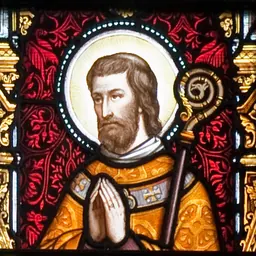
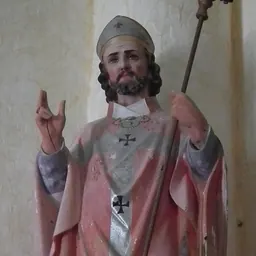
Magloire, better known as Saint Magloire of Dol, is a Breton saint. Little reliable information is known of Magloire as the earliest written sources appeared three centuries after his death. These sources claim that he was a monk from Wales who became the Bishop of Dol-de-Bretagne in Brittany during the 6th century, and ended his life on the island of Sark, where he was abbot of a monastery.
Biography Although unlikely to contain any reliable biographic information concerning Magloire, the Vita Sancti Maglorii presents a narrative of his life. According to the text, Magloire was born in the early 6th century to Afrelia and Umbrafel, the aunt and uncle of Samson of Dol. As a child, he studied at Cor Tewdws under the tutelage of St. Illtud. After his ordination, he was made abbot of a Lanmeurian monastery where he governed for 52 years. Afterwards, he journeyed to Brittany with his cousin Samson, who became the archbishop of Dol. After Samson's death, Magloire succeeded him as his chosen successor to the archbishopric, although, having received instructions from a visiting angel, he soon resigned his post to Budoc and withdrew to the island of Sark, where he established a community of 62 monks.
According to Butler's dating, he died around 575, but since the hagiography gives no dates, such statements are highly approximate.
Miracles The Vita Sancti Maglorii attributes several miracles to St. Magloire, and claims that he acquired large swaths of land as a result of these miracles. It argues that Count Loisescon, whose illness was miraculously cured by Magloire, gave him a sixth of all his wealth. It also argues that Nivo, the owner of Guernsey, asked for Magloire's help to cure his daughter who was deaf and intellectually disabled. Magloire was supposedly granted a third of Guernsey for doing so.
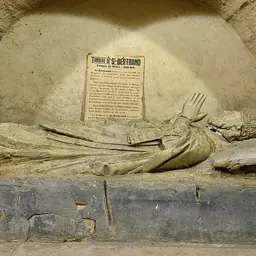
One of the most well-known and detailed stories about Magloire concerns his rescue of a group of children. The children were playing in an abandoned wreck on the beach below the monastery when a sudden violent storm swept them out to sea. Magloire is said to have swum out to sea when he heard their cries and saved them and their boat, steering it to the safety of the shore before vanishing. With an increase in Viking raids in the early 10th century, his relics were transported to Paris by the monks, where Hugh the Great granted them land to establish a new monastery. In 1572, Catherine de' Medici decided to use the site as a home for a group of Benedictine monks who had been expelled from their abbey of Saint-Magloire. In 1620, the seminary of the Oratorians under Pierre de Bérulle—the first seminary in France—replaced the Benedictines. It was known as the seminary of Saint-Magloire. The relics of St. Magloire and his disciples were transferred to the hospital at the site of the Église Saint-Jacques-du-Haut-Pas, which became a monastery. The relics were buried secretly during the French Revolution and were found in 1835, during the installation of a new high altar. St Magloire is one of the four saints surrounding the image of Christon the Pulpit of the Town Church in Guernsey, the others being St Martin, St Peter and St Samson of Dol.
Hagiography Vita Sancti Maglorii, a work of uncertain provenance written in Latin, details almost all of the knowledge of Maglorius. Folklorist (1874–1924) called the work a masterpiece of ancient Breton literature. Scholars place its composition between the late 9th century and the mid-10th century. There is also the Translatio Parisios, which recounts the flight of Lehonese monks to Paris in the 10th century, and is the primary source for the foundation of their monastery in Paris. The Vita is untranslated, but is accessible in the Acta Sanctorum series.
Feast day Magloire is venerated in the Roman Catholic Church and Eastern Orthodox Church on 24 October.
Don’t just read it —
keep it.
Full-length biographies made to live with: read them, listen on the way to work, watch them tonight.
- E-book
- Audio
- Video
Instant download · yours to keep · every purchase keeps this site free
Important facts
People in Magloire's life
Named in this biography and alive at the same time

Related people
Same field, nearest in time

Contemporaries
People whose lives overlapped Magloire's



Frequently asked questions
Who was Magloire?
Celtic bishop and saint
When was Magloire born?
Magloire was born in 535 in Glamorgan.
When did Magloire die?
Magloire died in 575 in Sark.
What was Magloire's occupation?
Magloire was a presbyter.
What nationality was Magloire?
Magloire was French and Welsh.
Sources & further reading
Cite this page
APA: Biography.guide. (2026). Magloire. https://biography.guide/magloire/
MLA: "Magloire." Biography.guide, https://biography.guide/magloire/.
Chicago: "Magloire." Biography.guide. https://biography.guide/magloire/.
Data last updated: 2026-09-25 · Spot an error? Report a correction.
Page generated 2026-09-27 05:12 UTC