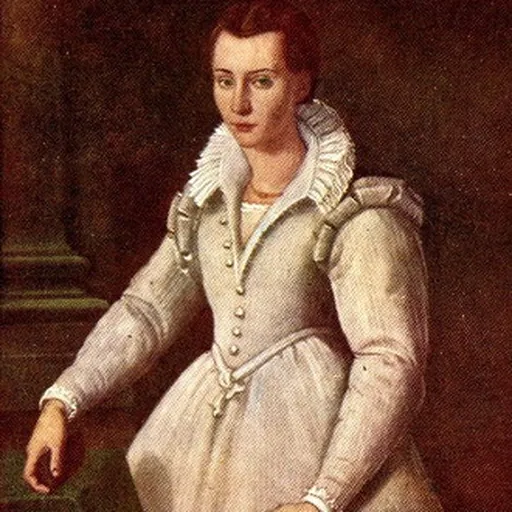
About Magdalena de Pazzi
Lived 1566 – 1607 (aged 41). Magdalena de Pazzi was an Italian writer, religious sister and mystic.
Mary Magdalene de' Pazzi, OCarm (; born Caterina Lucrezia de' Pazzi; 2 April 1566 – 25 May 1607), was an Italian Carmelite nun and mystic. She has been declared a saint by the Catholic Church.
Life De' Pazzi was born at Florence, Italy, on 2 April 1566, to Camillo di Geri de' Pazzi, a member of one of the wealthiest and most distinguished noble families of Renaissance Florence, and Maria Buondelmonti. She was christened Caterina Lucrezia, but in the family, she was called by her second name, out of respect for her paternal grandmother, Lucrezia Mannucci. St. Mary Magdalene de' Pazzi at age 16 by Santi di Tito (1583)
At the age of nine, de' Pazzi was taught how to meditate by the family chaplain, using a contemporary work explaining how one should meditate on the Passion of Christ. Years later, this book was one of the items she brought with her to the monastery. She received her First Communion at the then-early age of 10 and made a vow of virginity the same year.
Mystic De' Pazzi had been a novice for a year when she became critically ill. Upon receiving the religious habit, one of the sisters asked her how she could bear so much pain without a murmur. Mary pointed to the crucifix and said: Vision of Saint Mary Magdalene de' Pazzi by Pedro de Moya (ca. 1640)
Death seemed near, so her superiors let her make her profession of religious vows in a private ceremony, while lying on a cot in the chapel. Immediately after, she fell into an ecstasy that lasted about two hours. This was repeated on the following 40 mornings, each time after Communion.
As a safeguard against deception and to preserve the revelations, her confessor asked her to dictate her experiences to her fellow nuns. Over the next six years, five large volumes were filled with the record of her visions. The first three volumes record ecstasies from May 1584 through Pentecost week of the following year. That particular week was a preparation for a severe five-year trial. The fourth book records that trial, and the fifth is a collection of letters concerning reform and renewal. Another book, Admonitions, is a collection of her sayings arising from her experiences in the formation of women in religious orders. During her lifetime, she allegedly appeared to several persons in distant places and cured a number of sick people. In 1668, in preparation for her canonization, her body was declared miraculously incorrupt. Her incorrupt body is located in the Monastery of Maria Maddalena de' Pazzi in Careggi.
Veneration
Two years after de' Pazzi died, the Jesuit Vincenzo Puccini, her confessor, published the life of this Carmelite nun as an edifying example. The 1639 edition was augmented with material relating to the mystic's canonization, and was purposefully dedicated to two nieces of Pope Urban VIII.
Numerous miracles allegedly followed de' Pazzi's death, and the process for her beatification was begun in the year 1610 under Pope Paul V, and completed under Pope Urban VIII in the year 1626. She was not, however, canonized until 62 years after her death, when Pope Clement IX raised her to the altars on 28 April 1669. The church of the Monastery of Pažaislis, commissioned in 1662 in Lithuania, was one of the first to be consecrated in her honor. Puccini's successful biography first was translated into French in honor of her canonization.
Nowadays, de' Pazzi herself is little known outside Italy, but her cult is very strong, especially in Florence. Paulist Press issued a selection of her writings in English translation in their series of Classics of Western Spirituality.
Feast day
In 1670, the year after de' Pazzi's canonization, the feast day of the saint was inserted in the General Roman Calendar for celebration on 25 May, the day of her death. In 1728, the date of 25 May was assigned instead to Pope Gregory VII, and her feast day was moved to 29 May, where it remained until 1969, when it was restored to its original place in the calendar, as the true anniversary of her death.
Mortification Medal commemorating the simultaneous canonization of Maria Maddalena de' Pazzi and her fellow mystic Pedro de Alcántara, 1669 (from the Women of the Book Collection, nr. 7595989, Sheridan Libraries, Johns Hopkins University.
De' Pazzi was known to practice mortification, such as scourging herself with a crown of thorns.
According to researcher Ian Wilson sometimes she would wear only a single garment but she would tear this off "in order to roll herself on thorns, or give herself another savage beating." Wilson claimed that Pazzi was a "florid, sadomasochistic neurotic". According to Asti Hustvedt, Pazzi "wore a crown of thorns and a corset onto which she had attached piercing nails. She also walked barefoot through the snow, dripped hot wax onto her body, and licked the wounds of the diseased, including those afflicted with leprosy." The anthropologist Eric Dingwall wrote a chapter on Pazzi and her flagellant behaviors in his book Very Peculiar People (1962). Psychiatrist Armando Favazza wrote in his book Bodies Under Siege (3rd edition, 2011):
According to authors Sasha Alyson and Joe Chapple, 1585 was one of the "earliest recorded cases of masochism, Sister Mary Magdalene de Pazzi begs other nuns to tie her up and hurl hot wax at her." Pazzi is said to have found pleasure in being publicly whipped. Psychiatrist Kathryn J. Zerbe that in her opinion Pazzi was a sufferer of anorexia mirabilis. She also displayed behavioral symptoms of bulimia.
Don’t just read it —
keep it.
Full-length biographies made to live with: read them, listen on the way to work, watch them tonight.
- E-book
- Audio
- Video
Instant download · yours to keep · every purchase keeps this site free
Important facts
People in Magdalena de Pazzi's life
Named in this biography and alive at the same time

Related people
Same field, nearest in time
Contemporaries
People whose lives overlapped Magdalena de Pazzi's



Frequently asked questions
Who was Magdalena de Pazzi?
Italian Carmelite mystic and saint (1566-1607)
When was Magdalena de Pazzi born?
Magdalena de Pazzi was born on 2 April 1566 in Florence.
When did Magdalena de Pazzi die?
Magdalena de Pazzi died on 25 May 1607 in Florence.
What was Magdalena de Pazzi's occupation?
Magdalena de Pazzi was a writer, religious sister and mystic.
What nationality was Magdalena de Pazzi?
Magdalena de Pazzi was Italian.
Sources & further reading
· Wikipedia: Magdalena de Pazzi
· DBpedia: Mary Magdalene de' Pazzi
Cite this page
APA: Biography.guide. (2026). Magdalena de Pazzi. https://biography.guide/magdalena-de-pazzi/
MLA: "Magdalena de Pazzi." Biography.guide, https://biography.guide/magdalena-de-pazzi/.
Chicago: "Magdalena de Pazzi." Biography.guide. https://biography.guide/magdalena-de-pazzi/.
Data last updated: 2026-09-22 · Spot an error? Report a correction.
Portrait: Wikimedia Commons · author & licence
Page generated 2026-09-27 05:01 UTC