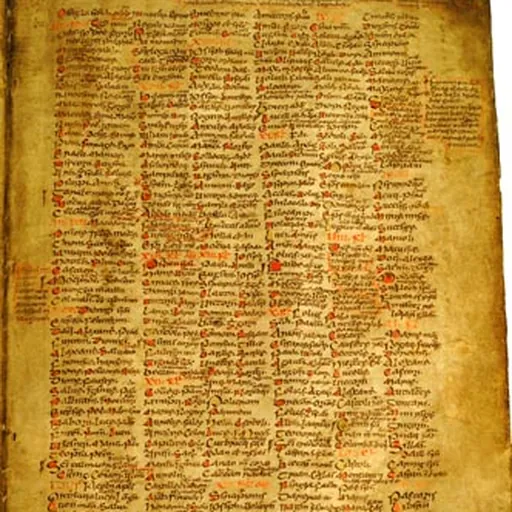
About Máel Ruain
Máel Ruain was a priest.
Máel Ruain (died 792) was founder and abbot-bishop of the monastery of Tallaght (County Dublin, Ireland). He is often considered to be a leading figure of the monastic 'movement' that has become known to scholarship as the Céli Dé. He is not to be confused with the later namesake Máel Ruain, bishop of Lusca (County Dublin).
The foundation of Tallaght Little is known of his life. Máel Ruain is not his personal name bestowed at birth or baptism, but his monastic name, composed of Old Irish máel ("one who is tonsured") and Ruain ("of Rúadán"), which may mean that he was a monk of St. Rúadán's monastery in Lothra (north County Tipperary). Though his background and early career remain obscure, he is commonly credited with the foundation of the monastery of Tallaght, sometimes called "Máel Ruain's Tallaght", in the latter half of the 8th century. This may be supported by an entry for 10 August in the Martyrology of Tallaght, which notes that Máel Ruain came to Tallaght carrying with him "relics of the holy martyrs and virgins" (cum suis reliquiis sanctorum martirum et uirginum), apparently with an eye to founding his house. In the early ninth century, Tallaght also seems to have produced the so-called Old Irish Penitential.
Although liturgical concerns are evident in the two martyrologies, there is no strictly contemporary evidence for Máel Ruain's own monastic principles and practices. Evidence for his teachings and their influence comes chiefly by way of a number of 9th-century writings associated with the Tallaght community known collectively as the 'Tallaght memoir'. One of the principal texts is The Monastery of Tallaght (9th century), which claims to list the precepts and habits of Máel Ruain and some of his associates, apparently as remembered by his follower Máel Díthruib of Terryglass.
Death and veneration
The Annals of Ulster report under the year 792 that Máel Ruain died a peaceful death, calling him a bishop (episcopus) and soldier of Christ (miles Christi). In the Annals of the Four Masters, however, in which he is also styled "bishop", his death is assigned, probably incorrectly, to the year 787. His feast in the Martyrology of Tallaght and Félire Óengusso is on 7 July. He was succeeded as abbot of Tallaght by Airerán.
Contemporary associations In the contemporary period, St. Maelrun is associated with the Oldbawn area of Tallaght; a local primary school is named after the saint, as is a section of houses in the OldBawn area. The local St. Maelruain's Church, Tallaght is a Church of Ireland church in Tallaght village named after the saint located within the Diocese of Dublin and Glendalough.
Saint Maelruan's Tree is a Persian walnut (Juglans regia) at St Mary's Priory in Tallaght, reputedly planted by the saint, but more likely dating from after 1760. A sprawling, multi-trunked tree, it has a circumference of .
Don’t just read it —
keep it.
Full-length biographies made to live with: read them, listen on the way to work, watch them tonight.
- E-book
- Audio
- Video
Instant download · yours to keep · every purchase keeps this site free
Important facts
Related people
Same field, nearest in time



Frequently asked questions
Who was Máel Ruain?
Abbot-bishop of Tallaght
When did Máel Ruain die?
Máel Ruain died in 792.
What was Máel Ruain's occupation?
Máel Ruain was a priest.
Sources & further reading
Cite this page
APA: Biography.guide. (2026). Máel Ruain. https://biography.guide/mael-ruain/
MLA: "Máel Ruain." Biography.guide, https://biography.guide/mael-ruain/.
Chicago: "Máel Ruain." Biography.guide. https://biography.guide/mael-ruain/.
Data last updated: 2026-09-23 · Spot an error? Report a correction.
Portrait: Wikimedia Commons · author & licence
Page generated 2026-09-27 05:06 UTC