About Macrobius
Lived 370 – 430 (aged 59–60). Macrobius was a Roman philosopher, writer, civil servant, music theorist, philologist and poet.
Macrobius Ambrosius Theodosius, usually referred to as Macrobius (fl. ), was a Roman provincial who lived during the early fifth century, during late antiquity, the period of time corresponding to the later Roman Empire, and when Latin was as widespread as Greek among the elite. He is primarily known for his writings, which include the widely copied and read Commentarii in Somnium Scipionis ("Commentary on the Dream of Scipio") about Somnium Scipionis, which was one of the most important sources for Neoplatonism in the Latin West during the Middle Ages; the Saturnalia, a compendium of ancient Roman religious and antiquarian lore; and De differentiis et societatibus graeci latinique verbi ("On the Differences and Similarities of the Greek and Latin Verb"), which is now lost.
Name Macrobius's given name is unrecorded as is his family name . His recorded name is a series of three surnames , properly ordered Macrobius Ambrosius Theodosius. This is what appears in the earliest surviving manuscripts of the and how he is addressed in the excerpts from his lost . He is called "Macrobius Theodosius" in both Cassiodorus and Boethius and was apparently known during his lifetime as "Theodosius": The dedication of is "Theodosius to his Symmachus" and he may be the one addressed as "most excellent Theodosius" in a dedicatory epistle to Avianus's Fables. This was mistakenly reversed in later manuscripts to "Ambrosius Theodosius Macrobius", which James Willis then used in his edition of the Commentary.
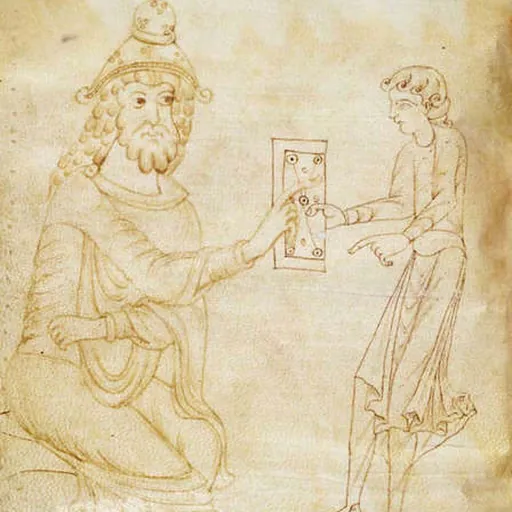
Life Macrobius presenting his work to his son Eustachius. From an 1100 copy of Macrobius' "Commentary on the «Dream of Scipio»".
Little is known for certain about Macrobius, but there are many theories and speculations about him. He states at the beginning of his Saturnalia that he was "born under a foreign sky" (sub alio ortus caelo), and both of his major works are dedicated to his son, Eustachius. Alan Cameron notes that several of the earliest manuscripts of his works spell his son's name Eustathius, then after pointing out that a certain Plotinus Eustathius was Urban prefect in 462 observes "Plotinus would be a peculiarly appropriate name for a neoplatonist philosopher and keen admirer of the great Lycopolitan (cf. Comm. I, 8, 5) to have given his son." There is also a Macrobius Plotinus Eudoxius who collaborated with Memmius Symmachus over an edition of Macrobius' Commentary.
Scholars have attempted to identify him with a Macrobius who is mentioned in the Codex Theodosianus as a praetorian prefect of Spain (399–400), and a proconsul of Africa (410). The Codex Theodosianus also records a praepositus (or lord chamberlain) named Macrobius in 422. A number of older authorities go so far as to identify Macrobius the author with the first, and date his floruit to 399–410. There are objections to either identification: as Alan Cameron notes, the complete name of the first candidate is attested in an inscription to be "Flavius Macrobius Maximianus", while the second is excluded because "A praepositus must at this period have been a eunuch." In astronomy, this work is noted for giving the diameter of the Sun as twice the diameter of the Earth. Of a third work On the Differences and Similarities of the Greek and Latin Verb, we possess only an abstract by a certain Johannes, doubtfully identified with Johannes Scotus Eriugena (9th century).
Editions and translations Robert A. Kaster (ed.), Macrobius: Saturnalia. Loeb classical library 510–512. Cambridge, MA/ London: Harvard University Press, 2011. 3 volumes. Percival Vaughan Davies (trans.), Macrobius: The Saturnalia. New York: Columbia University Press, 1969. William Harris Stahl (trans.), Macrobius: Commentary on the Dream of Scipio. New York: Columbia University Press, 1952. (Second printing, with revisions, 1966)
Legacy A prominent lunar crater is named after Macrobius.
Macrobius Cove in Antarctica is named after Macrobius.
Gallery Cicero's Dream of Scipio described the Earth as a globe of insignificant size in comparison to the remainder of the cosmos. Many early medieval manuscripts of Macrobius include maps of the Earth, including the antipodes, zonal maps showing the Ptolemaic climates derived from the concept of a spherical Earth and a diagram showing the Earth (labeled as globus terrae, the sphere of the Earth) at the center of the hierarchically ordered planetary spheres.
Images from a 12th-century manuscript of Macrobius's Commentarii in Somnium Scipionis (Parchment, 50 ff.; 23.9 × 14 cm; Southern France). Date: ca. 1150. Source: Copenhagen, Det Kongelige Bibliotek, ms. NKS 218 4°.
In popular culture Macrobius is the basis for the protagonist Manlius in Iain Pears' book The Dream of Scipio.
Don’t just read it —
keep it.
Full-length biographies made to live with: read them, listen on the way to work, watch them tonight.
- E-book
- Audio
- Video
Instant download · yours to keep · every purchase keeps this site free
Important facts
Related people
Same field, nearest in time




Contemporaries
People whose lives overlapped Macrobius's


Frequently asked questions
Who was Macrobius?
ancient Roman author (5th century)
When was Macrobius born?
Macrobius was born in 370 in Roman Africa, Rome.
When did Macrobius die?
Macrobius died in 430.
What was Macrobius's occupation?
Macrobius was a philosopher, writer, civil servant, music theorist, philologist and poet.
What nationality was Macrobius?
Macrobius was Roman.
Sources & further reading
Cite this page
APA: Biography.guide. (2026). Macrobius. https://biography.guide/macrobius-philosopher/
MLA: "Macrobius." Biography.guide, https://biography.guide/macrobius-philosopher/.
Chicago: "Macrobius." Biography.guide. https://biography.guide/macrobius-philosopher/.
Data last updated: 2026-09-20 · Spot an error? Report a correction.
Page generated 2026-09-27 05:10 UTC