
Lysippides Painter
Ancient Greek vase painter
About Lysippides Painter
Born 550 BC. Lysippides Painter was a Greek black-figure vase painter and attic vase-painter.
Bilingual belly amphora. Munich, Staatliche Antikensammlungen 2301; black-figure side: Herakles at the symposion. The Lysippides Painter was an Attic vase painter in the black-figure style. He was active around 530 to 510 BC. His conventional name comes from a kalos inscription on a vase in the British Museum attributed to him; his real name is not known.
Life and work His conventional name is derived from a kalos inscription on a neck amphora in the British Museum (B 211). He is considered the most significant pupil of Exekias, from whom he adopted not only his artistic style but also some important motifs, such as Ajax and Achilleus playing a board game. He also frequently painted scenes involving the hero Herakles. In total, about 30 known vases are ascribed to him.
His collaboration with the Andokides Painter, usually considered the inventor of red-figure vase painting, is unusual. On seven bilingual vases, six belly amphorae and a cup (now in Palermo), he painted the red-figure side, while the Andokides Painter was responsible for the black-figure one. At times, the subjects painted by both are identical. It remains disputed amongst scholars whether both painters are identical and merely represent one artist using both techniques. Already John Beazley saw them as separate artists, an argument later developed by Beth Cohen and Heide Mommsen. The identity of the two painters is supported by Konrad Schauenburg, Herbert Marwitz and John Boardman. Martin Robinson and others remained undecided.
Style The Lysippides Painter's works consisted of many neck-amphorae that were based on the works of Exekias, his mentor. Lysippides' works however, were simplified compared to those of Exekias. This style actually became very popular in the Archaic Period. Especially showing in the late 6th century and early 5th as his neck-amphorae stand on the front lines of a series of vases. Many of his works were extremely similar to Exekias. A vase in Detroit depicts the mythical Greek hero, Herakles wrestling a lion. This depiction takes after a neck-amphorae version done by Exekias in multiple ways. While there is no saying that Lysippides is the painter, the vase is grouped with his work stylistically in the way it takes after Exekias and that the work narrows all the attention on Herakles' role in the battle rather than the lion's. These elements are strongly associated with the work of the Lysippides Painter. Like most artists during this time, his work contained many religious references of Greek gods and goddesses in his work. Herakles being one of the more popular.
Of the 204 vases attributed to the Lysippides Painter in the Beazley Archive, there are over 60 of Herakles in various forms of heroism, fighting the lion, mounting chariots with Athena, fighting Amazons (Amazonomachy), and fighting giants (Giantomachy). He is almost always shown in his lion cape, with hood resting on the back of his black hair, defined with white paint. The arms of the lion are tied around his chest (where muscles are also well defined with white lines).
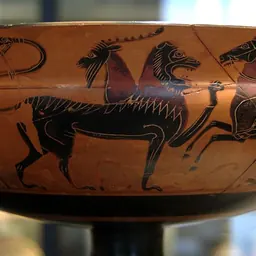
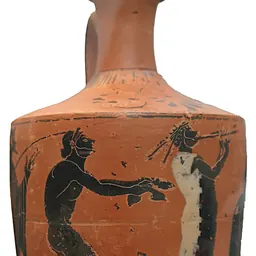
Work by the Lysippides Painter and the Andokides Painter done in black-figure style.
Of the 204 vases attributed to Lysippides P in the Beazley archives, 112 are large amphorae. These contain all variations of Amphorae, Amphora A, Amphora B, Amphora Neck, and 4 Panathenaic Amphorae. There are also 32 cups consisting of Cup A and Little Master Band Variations. The basins of many of these large cups are decorated with the face of a gorgonian. These Gorgonians are typical of the Nikostenes workshop to which, it has been argued, Lysippides was occasionally lent. Some of the other shapes that Lysippides works with are Krater, Columns, Oinchoes, Psykters, and Pyxis. These shapes have very small numbers, but many of them carry the same subjects as those of other Lysippides vases.
Works Most of the Lysippides Painter's vases appear to have been traded to Italy, especially the area around Rome, Etruria. Of the 85 vases that have listed provenances, 74 were shipped to Italy and over of 50 of these to the Etruria region. The other provenances include Sicily, Egypt and Turkey, but they appear in nominal numbers.
bilingual belly amphorae, painted in collaboration with the Andokides Painter Bologna, Museo Civico Archeologico bilingual belly amphora 151 Front: Dionysos between maenad and satyrs, back: Herakles and the Nemean Lion Boston, Museum of Fine Arts bilingual belly amphora 99.538 Front and back: Herakles and the Cretan bull bilingual belly amphora 01.8037 Front and back: Achilles and Ajax playing a board game London, British Museum bilingual belly amphora B 193 Front: Herakles and the Neman Lion between Athena and Iolaos, back: Ajax and Achilles playing a board game Munich, Staatliche Antikensammlungen bilingual belly amphora 2301 Front and back: Herakles at the symposion Paris, Louvre bilingual belly amphora F 204 Front: Herakles and Kerberos, back: Dionysos with kantharos between maenad and satyrs
other works (selection) Bonn, Akademisches Kunstmuseum belly amphora 62b Cambridge, Fitzwilliam Museum eye-cup GR 12.1937 Front: Dionysos with Kantharos between two satyrs, back: Herakles and Kyknos, interior: gorgoneion London, British Museum neck amphora B 211 eye-cup B 426 oinochoe B 492 Malibu, J. Paul Getty Museum psykter 96.AE.94 Moscow, Pushkin Museum belly amphora II 1 B 70 Munich, Staatliche Antikensammlungen neck amphora 1478 neck amphora 1575 eye-cup 2080 Front: Herakles and Apollo fighting over a tripod, back: Herakles and the Nemean lion, Interior: gorgoneion Oxford, Ashmolean Museum neck amphora 208 belly mphora 1965.100 (formerly Northwick, Spencer-Churchill collection) Palermo, Museo Archeologico Regionale bilingual eye-cup V 650 (2051) warriors and archers (signed by the potter Andokides) Paris, Louvre hydria F 294 Athena mounting a chariot in the presence of Herakles, Dionysos, Apollon and Hermes (potter probably Andokides) Pregny, Baron E. de Rothschild belly amphora Rome, Museo Nazionale Etrusco di Villa Giulia belly amphora 24998 Zurich, University neck amphora ETH 7
Don’t just read it —
keep it.
Full-length biographies made to live with: read them, listen on the way to work, watch them tonight.
- E-book
- Audio
- Video
Instant download · yours to keep · every purchase keeps this site free
Important facts
Related people
Same field, nearest in time



Frequently asked questions
Who was Lysippides Painter?
ancient Greek vase painter
When was Lysippides Painter born?
Lysippides Painter was born in 550 BC.
What was Lysippides Painter's occupation?
Lysippides Painter was a black-figure vase painter and attic vase-painter.
What nationality was Lysippides Painter?
Lysippides Painter was Greek.
Sources & further reading
· Wikipedia: Lysippides Painter
Cite this page
APA: Biography.guide. (2026). Lysippides Painter. https://biography.guide/lysippides-painter/
MLA: "Lysippides Painter." Biography.guide, https://biography.guide/lysippides-painter/.
Chicago: "Lysippides Painter." Biography.guide. https://biography.guide/lysippides-painter/.
Data last updated: 2026-09-20 · Spot an error? Report a correction.
Page generated 2026-09-27 05:25 UTC