
Lysimachus
Macedonian officer, one of Alexander's successor kings
About Lysimachus
Lived 361 BC – 281 BC (aged 79–80). Lysimachus was a sovereign, politician and military personnel.
Lysimachus (; Greek: Λυσίμαχος, Lysimachos; c. 360 BC – 281 BC) was a Thessalian He was the second son of Agathocles and his wife; there is some indication in the historical sources that this wife was perhaps named Arsinoe, and that Lysimachus's paternal grandfather may have been called Alcimachus. His father was a nobleman of high rank who was an intimate friend of Philip II of Macedon, who shared in Philip II’s councils and became a favourite in the Argead court. Lysimachus and his brothers grew up with the status of Macedonians; all these brothers enjoyed with Lysimachus prominent positions in Alexander’s circle Lysimachus had an elder brother, Alcimachus of Apollonia, and two younger brothers, Autodicus and Philip. He had two known nephews through his brother Alcimachus, Alcimachus and Philip; his known great-nephew was Lysippus, the grandson of his brother Alcimachus and his known sister-in-law was Adeia, the wife of Autodicus.
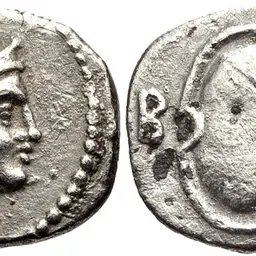
Pausanias and the historian Justin both record a story that Alexander had Lysimachus thrown to a lion as a punishment. According to Justin, this was because Lysimachus had smuggled poison to a person Alexander had condemned to a slow death. Both Pausanias and Justin report that Lysimachus overcame the lion with his bare hands and subsequently became one of Alexander's favorites. Some coins issued during Lysimachus's appointment had his image on one side and a lion on the other.
He was probably appointed Somatophylax during the reign of Philip II. In 324 BC, in Susa, he was awarded a ceremonial crown in recognition of his actions in India. After Alexander's death in 323 BC, he was appointed to the government of Thrace as strategos, although he faced some difficulties from the Thracian king Seuthes III. However, he managed to consolidate his power in the east of his territories, suppressing a revolt of the cities on the Black Sea coast.
In 302 BC, when the second alliance between Cassander, Ptolemy and Seleucus was made, Lysimachus, reinforced by troops from Cassander, entered Asia Minor, where he met with little resistance. On the approach of Antigonus, he retired into winter quarters near Heraclea, marrying its widowed queen Amastris, a Persian princess. Seleucus joined him in 301 BC and, at the Battle of Ipsus, Antigonus was defeated and slain. Antigonus's dominions were divided among the victors. Lysimachus's share was Lydia, Ionia, Phrygia and the north coast of Asia Minor.
Other diadochi
Other
Feeling that Seleucus was becoming dangerously powerful, Lysimachus now allied himself with Ptolemy, marrying his daughter Arsinoe II of Egypt. Amastris, who had divorced herself from him, returned to Heraclea. When Antigonus's son Demetrius I renewed hostilities (297 BC), during his absence in Greece, Lysimachus seized his towns in Asia Minor, but in 294 BC concluded a peace whereby Demetrius was recognized as ruler of Macedonia. He tried to carry his power beyond the Danube, but was defeated and taken prisoner by the Getae king Dromichaetes (or Dromihete), who, however, set him free in 292 BC on amicable terms in return for Lysimachus surrendering the Danubian lands he had captured.
Tetradrachm of Lysimachus. The Greek inscription reads: ΒΑΣΙΛΕΩΣ ΛΥΣΙΜΑΧΟΥ "[coin] of King Lysimachus".
Later years Domestic troubles embittered the last years of Lysimachus’s life. Amastris had been murdered by her two sons; Lysimachus treacherously put them to death. On his return, Arsinoe II asked the gift of Heraclea, and he granted her request, though he had promised to free the city. In 284 BC, Arsinoe, desirous of gaining the succession for her sons in preference to Lysimachus’s first child, Agathocles, intrigued against him with the help of Arsinoe's paternal half-brother Ptolemy Keraunos; they accused him of conspiring with Seleucus to seize the throne, and Agathocles was put to death. Lysimachus's body was given over to another son, Alexander, by whom it was interred at Lysimachia. Daughter, Eurydice Lysimachus
Family tree of Lysimachids
Don’t just read it —
keep it.
Full-length biographies made to live with: read them, listen on the way to work, watch them tonight.
- E-book
- Audio
- Video
Instant download · yours to keep · every purchase keeps this site free
Important facts
People in Lysimachus's life
Named in this biography and alive at the same time

Related people
Same field, nearest in time



Contemporaries
People whose lives overlapped Lysimachus's


Frequently asked questions
Who was Lysimachus?
Macedonian officer, one of Alexander's successor kings
When was Lysimachus born?
Lysimachus was born in 361 BC in Pella.
When did Lysimachus die?
Lysimachus died in 281 BC in Curupedion.
What was Lysimachus's occupation?
Lysimachus was a sovereign, politician and military personnel.
What nationality was Lysimachus?
Lysimachus's recorded nationality: Macedonia, Thrace.
Sources & further reading
Cite this page
APA: Biography.guide. (2026). Lysimachus. https://biography.guide/lysimachus/
MLA: "Lysimachus." Biography.guide, https://biography.guide/lysimachus/.
Chicago: "Lysimachus." Biography.guide. https://biography.guide/lysimachus/.
Data last updated: 2026-09-25 · Spot an error? Report a correction.
Page generated 2026-09-27 05:13 UTC