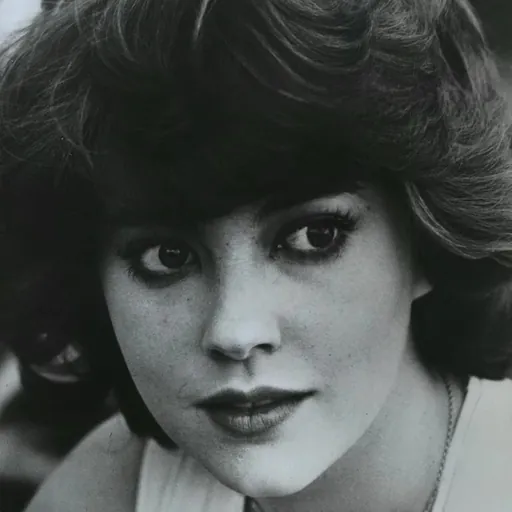
About Lynne Frederick
Lived 1954 – 1994 (aged 39). Lynne Frederick was a British actor and film actor, known for A Long Return, Henry VIII and His Six Wives and Nicholas and Alexandra.
Later life After losing her acting career, Frederick lived a private and reclusive life. When she divorced Frost, she faced public embarrassment when it was reported that she became intoxicated at a formal restaurant. Following this incident, she fled from England to the US, and never returned to her homeland. In later years, she was known for being fiercely private. Subsequently, she refused to give interviews and distanced herself from the celebrity lifestyle.
After her divorce from Barry Unger, Frederick lived in a Los Angeles mansion that had previously been owned by the actor Gary Cooper. She struggled with alcoholism, epileptic seizures and clinical depression. There were also rumours of nervous breakdowns and suicide attempts. Despite participating in numerous recovery treatments at hospitals and clinics, she was unable to rebuild her health. Weary after her years of public scorn and deteriorating conditions, she cloistered herself in her home for days at a time. Her mother Iris moved to California to live with Frederick to help care for her and her daughter.
Frederick was the sole manager of Sellers' estate. She took such pride in being Sellers' wife that she legally changed her last name to Sellers. It has been reported that when she took part in group therapy sessions, she introduced herself as "Lynne Sellers, the wife of Peter Sellers".
Feeling hurt and betrayed by this interview, Lynne did not see or speak to her mother again for the duration of her marriage to Sellers. When asked about cutting ties with her daughter, Iris said: "I have my own life to live. Of course I still love her. I've cried for her and I miss her a great deal. Lynne is right when she says we were terribly close and it hurts when I see her using the press to make me look the guilty party in all this."
Frederick's relationship with her former stepchildren (Michael Sellers, Sarah Sellers, and Victoria Sellers) was, like Peter's relationship with them, distant and often strained. When Lynne began her relationship with Peter, she made efforts to establish a friendly connection with them. Sarah recalled of Lynne: "she seemed quite nice to begin with. I actually told dad that I thought she was a bit stupid. But she came across as very bubbly, friendly, warm and interested. But once they got married things definitely changed". Michael Sellers also bluntly acknowledged his intentional hostility and lack of respect towards Lynne when they first met: "I'm afraid we weren't very kind in our judgement of Lynne. Sarah thought she wasn't too bright. But our views didn't really count for much. Because whatever our opinions, they would be of purely academic interest".
One of Frederick's close friends was Mauritian actress Françoise Pascal. The two first met when they co-starred on a 1972 episode of the television anthology series BBC Play of the Month, and they quickly became "firm friends". Pascal recalled that they remained friends for several years before regretfully losing touch after Frederick married Sellers in 1977. In April 2020, a few weeks before the 26th anniversary of Frederick's death, Pascal tweeted a photo of herself and Frederick, with the caption "I think of her very often! Always had that fresh baby face! RIP Lynne! Xxx".
In 2018, Judy Matheson revealed that she had worked with Frederick in the early 1970s. They were slated to appear in a film together that was to be shot in the Netherlands, with John Hamil, Robert Coleby, and Nina Francis. Because Frederick was young and a relative newcomer to filmmaking at the time, Matheson (who was a few years older and had industry experience) was asked to be Lynne's chaperone for the trip (as Lynne's mother was unavailable). They spent about three weeks lodged together in a hotel room before production on the film was prematurely closed due to financial withdrawals. Matheson stated that she enjoyed Frederick's company, and that they managed to have fun together despite the production difficulties. After returning to Great Britain, they corresponded for a while before gradually losing touch with each other.
During production of Four of the Apocalypse (1975), she was rumoured to have had a brief romance with her co-star Fabio Testi (who was having trouble in his relationship with actress Ursula Andress at the time), which was also during a time when Frederick was having trouble in her own relationship with Julian Posner. Naturally, this helped Testi and Frederick with their chemistry in the movie, and they were paired again for the film Cormack of the Mounties (1975). There has been much speculation about such a romance between Testi and Frederick, but it has not been confirmed.
In her 2014 memoir I Said Yes to Everything, Lee Grant claimed that during production of the film Voyage of the Damned (1976) Frederick, then aged 21, engaged in an affair with Sam Wanamaker, who was 35 years Frederick's senior and married to Charlotte Holland at the time. Grant also stated that she witnessed all the men on set, including the film's director Stuart Rosenberg, make salacious passes at Frederick, all of which she rejected.
Julie Andrews stated in her 2019 autobiography Home Work: A Memoir of My Hollywood Years that she suspected her husband Blake Edwards was having an affair with Lynne (who was married to Sellers at the time) during production of Revenge of the Pink Panther (1978). When Andrews confronted Blake about the "flirtations" between him and Frederick, Julie asked him point-blank which he preferred: staying married or continuing this flirtation. After this confrontation, Blake apparently ceased any kind of flirtation with Frederick. She later had a falling-out with Edwards and Andrews after successfully suing them for their involvement with the film Trail of the Pink Panther (1982), claiming that it insulted Sellers' memory.
Political views and beliefs In a 1975 interview with Men Only, Frederick stated that she "partially agreed" with Women's Lib. Stating "I agree with the fact that women should have equal rights", she added that she also believed in some old-fashioned gender roles. "I agree that there are certain things that men are designed to do; just as there are things women are designed to do. I think women are just as capable of ruling people and looking after our affairs as men are. Sometimes possibly better because women have a level of sensibility and sensitivity as well, which possibly men don't sometimes."
Although not queer herself, Frederick was known for being a blunt and outspoken advocate for same-sex relationships and LGBT rights during a time when it was considered highly taboo. Following her appearance on a controversial episode of the television series Play for Today, where she played a sexually fluid character and shared an onscreen kiss with her female co-star Jane Lapotaire, she said "with homosexuality and lesbianism, I just don't think you can put a ban on it. I don't think you can say it's wrong. I think people should live how they want to live. I don't think it should be illegal." In a 1975 interview, she expressed some agnostic views when she was asked about a progressive Catholic priest's response to the pope's declaring premarital sex a sin. "I really agree with the other priests that it should have never been issued. I think that does put the Church back; I really do. I can say it because I'm not particularly religious. But I think people who are religious, I hope they would feel that it's not a step forward. I think premarital sex is a good idea. I think the worst thing that could possibly happen is to not have sex before you get married, then get married and find out it's dreadful." Frederick later suggested in an interview that she still retained her Methodist faith: "I never touch hard liquor. I suppose wine is okay for a good Methodist like me".
After her own death in 1994, she left individual sums of $250,000 to the British Heart Foundation and the Middlesex Hospital in London as tribute to Sellers. As a sign of gratitude, the Middlesex Hospital hung a plaque thanking both Sellers and Frederick for their generous contributions.
Trail of the Pink Panther (1982) lawsuit Shortly after the release of Trail of the Pink Panther (1982), Frederick filed a suit against MGM, United Artists, and film director Blake Edwards for $3 million in damages and to block the film's distribution. She claimed that the film tarnished Peter Sellers' reputation and that it was made without authorisation from his estate, which she controlled. Her chief objection was that her late husband had specifically prohibited the use of outtakes from earlier Pink Panther films in his lifetime, and that his estate should have had the right to control the use of outtakes after his death. The idea of using outtakes in future Pink Panther films was first presented in Sellers' lifetime when Edwards had shot and edited a three-hour version of The Pink Panther Strikes Again (1976). However, United Artists objected to this long version, and the film was trimmed from three hours to an hour and a half.
In 1985, Judge Charles Hobhouse ruled in favour of Frederick, awarding her $1 million, but dismissed her request to ban the film. Her remains were cremated at Golders Green Crematorium in London, and her ashes were interred with those of Peter Sellers.
In a 1995 interview with Hello!, her mother Iris said Lynne died from natural causes which were brought on by a seizure in her sleep. She denied accusations that her daughter had a problem with drugs including alcohol. There is absolutely no truth in any of the stories I have read about Lynne's death. I never saw Lynne taking cocaine. She liked a glass of wine, but so do most people and she was no more an alcoholic than the next person. The autopsy report was quite clear, her death was by natural causes. Lynne died of a seizure in her sleep. For the record, the coroner found no evidence that Lynne had been taking drugs.
Legacy In the years after her death, Frederick's legacy remained poisoned. In the 1995 revision of his 1994 book The Life and Death of Peter Sellers, Roger Lewis claimed that "there is yet to find a single person to say a good thing about Lynne". Nigel Dempster had a profound dislike for Frederick and referred to her as an "avaricious and cunning man-eater". Roger Moore, and Wendy Richard.
Frederick received minimal attention in the 2004 film adaptation of Lewis's book where she was portrayed by Emilia Fox. All scenes featuring Fox's portrayal of Frederick were deleted from the final cut of the film, but included in the supplemental features of the film's DVD release. On portraying Frederick, Fox stated: "I had thought very carefully about playing Lynne. I wanted to represent her in a way that I thought was fair – which was a very young girl being taken up in this world of laughter and light, and then finding out the reality. Peter Sellers was completely obsessed by work, and it's very difficult to live with someone like that."
Over time, views toward Frederick's image gradually shifted, with some claiming that she has gained a cult following through her films, while another blogger called her one of the most promising, talented, and beautiful young British actresses of the 1970s. Many credit the negative events in her life (the loss of her acting career, blacklisting in Hollywood, and untimely death) to her marriage to Sellers. Even Roger Lewis, who was blunt about his disdain for Frederick, admitted that "of all of Sellers's wives, Lynne Frederick was the most poorly treated". One of the early people to advocate for Frederick was American author Ed Sikov in the 2002 book Mr. Strangelove: A Biography of Peter Sellers: "Lynne Frederick deserves a bit of compassion herself in retrospect. It was the helpless Peter she nursed, the dependent and infantile creature of impulse and consequent contradiction. Patiently she ministered him". Françoise Pascal, Mark Burns, Fabio Testi, Malcolm McDowell (who played her lover in Voyage of the Damned), and Graham Crowden.
In 1982, Frederick's screen appearance as Catherine Howard from the film Henry VIII and His Six Wives (1972) was used on the cover art for the 1982 novel The Dark Rose by Cynthia Harrod-Eagles.
For her work in horror films, Frederick has garnered significant popularity as a scream queen.
Filmography Film
Television Year Title Role Notes 1971 Now, Take My Wife Jenny Love series 1, episode 1: "Just Harry and Me" Comedy Playhouse Jenny Love series 11, episode 1: "Just Harry and Me" Fathers and Sons Dunyasha series 1, episode 1 1972 BBC Play of the Month Nellie Ewell series 7, episode 5: "Summer and Smoke"‡ Softly, Softly: Taskforce Judith "Judy" Oram series 3, episode 17: "Anywhere in the Wide World" Opportunity Knocks Never Again series 12, episode 25: "The Script Writers Chart Show" 1973 No Exit Abigail "Abby" series 1, episode 3: "A Man's Fair Share of Days" Away from It All Vinca series 1, episode 1: "The Ripening Seed" Follyfoot Tina series 3, episode 8: "The Bridge Builder", episode 9: "Uncle Joe" Wessex Tales Rosa Harlborough series 1, episode 1: "A Tragedy of Two Ambitions" 1973 The Generation Game Cinderella series 3, episode 17: "1973 Christmas Special" 1974 Masquerade Natalie Fieldman series 1, episode 3: "Mizzen ab!" The Pallisers Isabel Boncassen series 1, episodes 24, 25, and 26 1976 Play for Today Nicola "Nikki" Cole series 6, episode 11: "The Other Woman" Space: 1999 Shermeen Williams series 2, episode 15: "A Matter of Balance"
‡ denotes lost film
Discography
Live performances Title Year Other artist(s) "If You Were the Only Girl in the World"៛ 1973 Bruce Forsyth ៛ Performed live 25 December 1973 on the BBC show The Generation Game
Awards and nominations Year Association Category Nominated work Result 1973 Evening Standard British Film Awards Best Newcomer – Actress The Amazing Mr. Blunden (1972) and Henry VIII and His Six Wives (1972)
Don’t just read it —
keep it.
Full-length biographies made to live with: read them, listen on the way to work, watch them tonight.
- E-book
- Audio
- Video
Instant download · yours to keep · every purchase keeps this site free
Important facts
more
Voyage of the DamnedPeople in Lynne Frederick's life
Named in this biography and alive at the same time





Related people
Same field, nearest in time


Contemporaries
People whose lives overlapped Lynne Frederick's


Frequently asked questions
Who was Lynne Frederick?
British actress (1954–1994)
When was Lynne Frederick born?
Lynne Frederick was born on 25 July 1954 in London Borough of Hillingdon.
When did Lynne Frederick die?
Lynne Frederick died on 27 April 1994 in Los Angeles.
What was Lynne Frederick's occupation?
Lynne Frederick was an actor and film actor.
What was Lynne Frederick known for?
Lynne Frederick was known for A Long Return, Henry VIII and His Six Wives, Nicholas and Alexandra, Phase IV (1974 film), The Amazing Mr. Blunden and Vampire Circus.
What nationality was Lynne Frederick?
Lynne Frederick was British.
Sources & further reading
Cite this page
APA: Biography.guide. (2026). Lynne Frederick. https://biography.guide/lynne-frederick/
MLA: "Lynne Frederick." Biography.guide, https://biography.guide/lynne-frederick/.
Chicago: "Lynne Frederick." Biography.guide. https://biography.guide/lynne-frederick/.
Data last updated: 2026-09-23 · Spot an error? Report a correction.
Portrait: Wikimedia Commons · author & licence
Page generated 2026-09-27 05:08 UTC