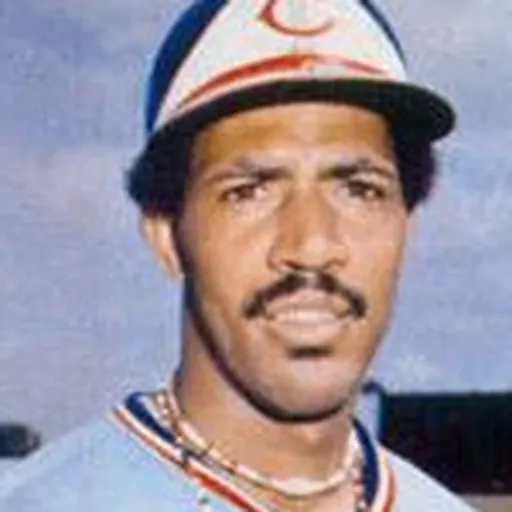
About Lyman Bostock
Lived 1950 – 1978 (aged 27). Lyman Bostock was an American baseball player.
Lyman Wesley Bostock Jr. (November 22, 1950 – September 24, 1978) was an American professional baseball player. He played Major League Baseball for four seasons, as an outfielder for the Minnesota Twins and California Angels, with a lifetime average of .311. He batted left-handed and threw right-handed.
Bostock was shot and mortally wounded while riding as a passenger in a vehicle in his hometown of Gary, Indiana, on September 23, 1978, hours after playing against the Chicago White Sox earlier in the day. He died at 1:30 a.m. the next day.
His shooter was sentenced to a psychiatric hospital and released after seven months. After the shooter's release, Indiana legislators introduced the guilty but mentally ill verdict so that mentally ill people would serve prison time after being released from inpatient mental health treatment.
Early life Born in Birmingham, Alabama, Bostock was the son of Annie Pearl Bostock and Lyman Bostock Sr. (1918–2005), a Negro leagues professional baseball star from 1938 to 1954 as a first baseman. Pearl and Bostock Sr. split when Bostock Jr. was a young child, with Pearl relocating with her son first to Gary, Indiana, in 1954. In 1958, the two again relocated, this time to Los Angeles. The younger Bostock remained estranged from his father for the remainder of his life, feeling that his father had abandoned him.
At one point during his youth, Bostock's baseball glove was stolen. With his mother unable to afford to purchase another, he had to use a glove given to him by a friend of the family. However, the donated glove was for left-handed fielders. Bostock's discomfort in catching fly balls with the hand he was unaccustomed to using led him to begin making basket catches at that time. The habit stayed with him and he frequently made basket catches of fly balls for the remainder of "When I was 8 years old, my mother bought me my first glove," Bostock had recalled. "But someone stole it the next day. My mother wasn't about to buy me another one. But a friend of hers at work gave her a replacement. Unfortunately, it was a left-hander's model and I'm right-handed. Since it was the only glove I had, I had to use it. It was the only way I could catch the ball. It became a habit, and I still have it."
Bostock played baseball at Manual Arts High School in Los Angeles, then attended San Fernando Valley State College (now California State University, Northridge (CSUN)). It was there that he met Yuovene Brooks, who would become his wife. Bostock did not play baseball during his first two years of college, choosing instead to become involved in student activism. Nonetheless, he was selected in the 1970 amateur draft by the St. Louis Cardinals.
"What you saw is what you got from Lyman," said Bob Hiegert, Bostock's college coach at Cal State Northridge. "There was nothing hidden about Lyman. He wore his heart on his sleeve."
Bostock chose not to sign, stayed in college, and began playing baseball for Hiegert and the Matadors. He was an all-conference player in the California Collegiate Athletic Association in both of his seasons at San Fernando Valley, hitting .344 as a junior and .296 as a senior, leading the Matadors to a second-place finish at the Division II College World Series in 1972. He was selected by the Twins in the 26th round (596th overall) of the 1972 amateur draft and decided to turn professional, just 15 credits short of finishing his bachelor's degree.
Baseball career
Minor leagues (1972-1974) Bostock's minor league stops were with the Class A Charlotte Twins in 1972; the Class AA Orlando Twins in 1973, and the Class AAA Tacoma Twins in 1974. His batting averages for those years were .294.313, and .333, respectively. In 1975, he was hitting .391 after 22 games and 92 at bats with Tacoma when the Minnesota Twins called him up.
Minnesota Twins (1975-1977) Bostock was promoted to the major leagues in April 1975, making his major league debut on April 8, when he was 1-for-4 with two walks and three runs scored in an 11–4 Twins win over the For the season, he batted .282 in 98 games for Minnesota (and .391 in 22 games for the Tacoma Twins in the Pacific Coast League).
A fine defensive center fielder, Bostock finished fourth in the tight American League batting race in 1976, his first full season in the majors. He hit .323, finishing behind the Kansas City Royals' George Brett (.333) and Hal McRae (.332), and teammate Rod Carew (.331). Bostock hit for the cycle on July 24, in a 17–2 Twins victory over the Chicago White Sox.
In 1977, Bostock's .336 batting average was second only to the .388 of Carew. On May 25, Bostock collected 12 putouts in the second game of a doubleheader against the Boston Red Sox, tying the major league mark for putouts by an outfielder, which had been set by Earl Clark of the Boston Braves and was equalled by Jacoby Ellsbury Bostock had a total of 17 putouts in the doubleheader, which set an American League record Bostock had made $20,000 with the Twins in 1977 and signed a $2.3 million, six-year contract with the Angels. The Twins, Padres, and Yankees had all tried to sign Bostock. The team refused, so Bostock announced he would donate his April salary to charity.
In his four-season career, Bostock was a .311 career hitter, with a .365 on-base percentage, 23 home runs, 102 doubles, 30 triples, 45 stolen bases and 250 runs batted in during 526 games. A contact hitter, he had 171 career walks against 174 career strikeouts and a .988 fielding percentage playing all three outfield positions, with the majority in centerfield. as he regularly did when in Chicago, Bostock visited his uncle Thomas Turner in nearby nowrap|Gary, Indiana. Leonard Smith leaned out of his vehicle and fired one round from a .410 caliber shotgun into the back seat of Turner's car, where Bostock and Barbara Smith were seated.
Bostock is interred in the Inglewood Park Cemetery in Inglewood, California. "There were never enough hours in the day for Lyman," said Angels teammate Bobby Grich. "We called him 'Jibber-Jabber' because he was always talking. Everyone was crazy about him because he was so outgoing and friendly, always up, always looking on the bright side."
In his eulogy at the funeral of Bostock, Angels teammate Ken Brett said, "We called him Jibber Jabber because he enlivened every clubhouse scene, chasing tension, drawing laughter in the darkest hour of defeat. When winning wasn’t in the plan, Lyman knew the sun would come up the next morning…. There’s only one consolation: We’re all better persons for having him touch our lives." A memorial scholarship fund was commissioned in his name, and is annually awarded to a needy CSUN student athlete. In 1981, Bostock became the first inductee into the CSU Northridge Matadors Hall of Fame.
Don’t just read it —
keep it.
Full-length biographies made to live with: read them, listen on the way to work, watch them tonight.
- E-book
- Audio
- Video
Instant download · yours to keep · every purchase keeps this site free
Important facts
People in Lyman Bostock's life
Named in this biography and alive at the same time






Related people
Same field, nearest in time

Contemporaries
People whose lives overlapped Lyman Bostock's




Frequently asked questions
Who was Lyman Bostock?
American baseball player (1950-1978)
When was Lyman Bostock born?
Lyman Bostock was born on 22 November 1950 in Birmingham.
When did Lyman Bostock die?
Lyman Bostock died on 23 September 1978 in Gary.
What was Lyman Bostock's occupation?
Lyman Bostock was a baseball player.
What nationality was Lyman Bostock?
Lyman Bostock was American.
Sources & further reading
Cite this page
APA: Biography.guide. (2026). Lyman Bostock. https://biography.guide/lyman-bostock/
MLA: "Lyman Bostock." Biography.guide, https://biography.guide/lyman-bostock/.
Chicago: "Lyman Bostock." Biography.guide. https://biography.guide/lyman-bostock/.
Data last updated: 2026-09-20 · Spot an error? Report a correction.
Portrait: Wikimedia Commons · author & licence
Page generated 2026-09-27 04:58 UTC