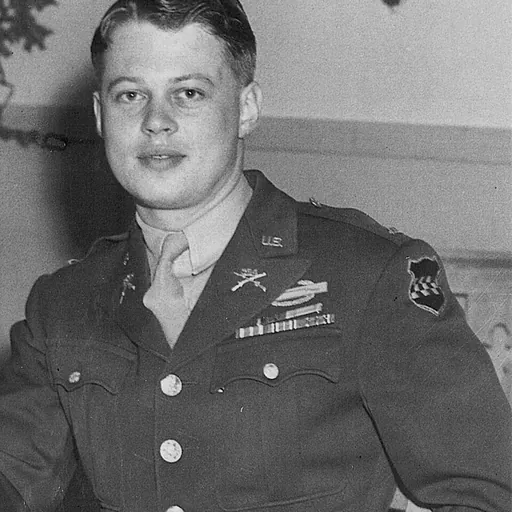
About Lyle Bouck
Lived 1923 – 2016 (aged 92). Lyle Bouck was an American military personnel.
Lyle Joseph Bouck Jr. (December 17, 1923 – December 2, 2016) enlisted in the Missouri National Guard at age 14. During World War II, he was a 20-year-old lieutenant in charge of the Intelligence and Reconnaissance Platoon, 394th Infantry Regiment, 99th Infantry Division. On the first morning of the Germans' advance during the Battle of the Bulge, his 18-man unit along with four forward artillery observers held off an entire German battalion of more than 500 men for nearly an entire day, killing or wounding 92, and significantly delayed the German advance in a vital sector of the northern front. Every single member of the platoon was later decorated, making it one of the most decorated platoons in all of World War II. Bouck was one of the youngest commissioned officers in the U.S. Army.
Early life and enlistment
Bouck was born in St. Louis, Missouri, the second child of Lyle Joseph and Magdalen M. Bouck. His father, a private first class in the U.S. Army during World War I, was a carpenter and Bouck grew up during the Depression, moving frequently with his family. Bouck and his four siblings, Robert, Bernice, Eugene and John, often lived in homes with only one bedroom and no indoor plumbing or electricity. Bouck enlisted in the Headquarters Company, 138th Infantry Regiment of the Missouri National Guard at age 14 so he could earn one dollar per drill day to help his family. He was never asked his age. He was rapidly promoted to supply sergeant at age 16, making more than most of his civilian friends.
Active duty
On December 23, 1940, the 35th Infantry Division was activated for one year of federal duty. His unit participated in the Texas-Louisiana maneuvers of 1941. Bouck was assigned responsibility as transportation sergeant for the regimental Headquarters Company and performed very well. While attending a transportation course, and just before their federal duty was completed, the Japanese attacked Pearl Harbor. Their active duty status was indefinitely extended and Bouck's unit was sent to protect California against a possible enemy invasion.
When his unit was subsequently moved to advance duty on the Aleutian Islands in May 1942, he decided to volunteer to attend Officer Candidate School, the newly created Parachute School, or the Army Air Corps. the unit of 18 men along with four U.S. Forward Artillery Observers from Battery C, 371st Field Artillery, held off an entire German battalion of over 500 men during a 23-hour-long fight, inflicting 92 casualties on the Germans. The platoon seriously disrupted the entire Sixth Panzer Army's schedule of attack along the northern edge of the offensive. At dusk on 16 December, the remaining German paratroopers finally able to make ground against the American's due to the platoon's Browning M2 .50 caliber machine gun melting from overheat and being low on ammo advanced on the platoon and captured the remaining 24 soldiers and a member of the forward artillery observation platoon assisting the platoon who was killed.
Due to the capture of the platoon's soldiers and the blur of events during the first week of this massive campaign, the U.S. Army did not recognize the platoon for its courageous deeds for 37 years. On October 25, 1981, the entire platoon was recognized with a Presidential Unit Citation, and every member of the platoon was decorated, including four Distinguished Service Crosses, five Silver Stars, and ten Bronze Stars with V for Valor.
Prisoners of war
The I&R platoon members who were able to walk were sent east into Germany. After two days of walking through the cold, Bouck and the remainder of his platoon were loaded into a boxcar in the village of Junkerath. Bouck was jammed into a single railroad cattle car with 71 other POWs and traveled for days without food or water. By Christmas Day, seven men in Bouck's car had died and the rest were barely hanging on. The prisoners were transported to hospitals in Frankfurt and Hanover.
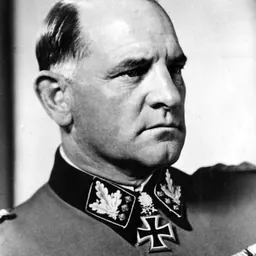
Sepp Dietrich commanded the Sixth Panzer Army. He charged his best colonel Obersturmbannführer Joachim Peiper commander of a Kampfgruppe from the 1st SS Panzer Division Leibstandarte SS Adolf Hitler, with leading the push to Antwerp. The Kampfgruppe included units of the 1st SS Panzer Regiment, reconnaissance, infantry, and associated elements of the division, and the 501st Heavy Panzer Battalion, which was equipped with a mix of Tiger and King Tiger tanks. The German plan called for units to reach the Meuse River on the first day, but Peiper's units did not reach Lanzerath until just after midnight. It had been delayed twelve hours by horrendously snarled road traffic, blown bridges, and ultimately, the tenacious defense of Bouck and his soldiers.
Unit recognition
On October 26, 1981, after considerable lobbying and letter-writing by Bouck, members of the unit were finally decorated. Fourteen of the 18 members were present at a special World War II Valor Awards ceremony at Ft. Myer, Virginia. Secretary of the Army John O. Marsh hosted the ceremony. Every member of the platoon was awarded the Presidential Unit Citation. Four members—Bouck, Slape, Milosevich, and Tsakanikas—were given the Distinguished Service Cross; five were given Silver Stars, and ten the Bronze Star with V devices, all for their 10-hour struggle with an entire 500-man-strong German battalion.
Don’t just read it —
keep it.
Full-length biographies made to live with: read them, listen on the way to work, watch them tonight.
- E-book
- Audio
- Video
Instant download · yours to keep · every purchase keeps this site free
Important facts
People in Lyle Bouck's life
Named in this biography and alive at the same time


Related people
Same field, nearest in time



Contemporaries
People whose lives overlapped Lyle Bouck's
Frequently asked questions
Who was Lyle Bouck?
US Army officer
When was Lyle Bouck born?
Lyle Bouck was born on 17 December 1923 in Fenton.
When did Lyle Bouck die?
Lyle Bouck died on 2 December 2016 in Sunset Hills.
What was Lyle Bouck's occupation?
Lyle Bouck was a military personnel.
What nationality was Lyle Bouck?
Lyle Bouck was American.
Sources & further reading
Cite this page
APA: Biography.guide. (2026). Lyle Bouck. https://biography.guide/lyle-bouck/
MLA: "Lyle Bouck." Biography.guide, https://biography.guide/lyle-bouck/.
Chicago: "Lyle Bouck." Biography.guide. https://biography.guide/lyle-bouck/.
Data last updated: 2026-09-23 · Spot an error? Report a correction.
Portrait: Wikimedia Commons · author & licence
Page generated 2026-09-27 05:05 UTC