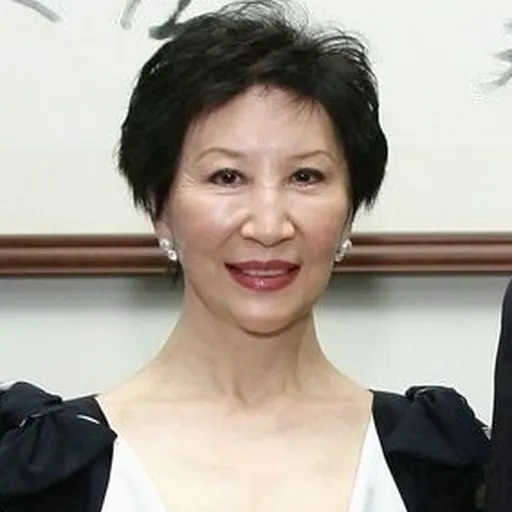
Lydia Dunn, Baroness Dunn
Hong Kong politician (born 1940)
About Lydia Dunn, Baroness Dunn
Born 1940. Lydia Dunn, Baroness Dunn is a British politician, justice of the peace and business executive.
Lydia Selina Dunn, Baroness Dunn, (; born 29 February 1940) is a Hong Kong-born retired British businesswoman and politician. She became the second person of Hong Kong origin (the first was Lawrence Kadoorie, Baron Kadoorie) and the first female ethnic Chinese Hongkonger to be elevated to the peerage as a life peeress with the title and style of Baroness in 1990.
Launching her career in British firms Swire Group and HSBC Group, she was an Unofficial Member and then the Senior Member of the Executive Council and Legislative Council of Hong Kong in the 1980s and 1990s, witnessing the major events of Hong Kong including the Sino-British Joint Declaration and the Tiananmen Square protests of 1989. She is best known in Hong Kong for her part in (unsuccessfully) lobbying for the people of Hong Kong to have the right of abode in the United Kingdom after the Handover of Hong Kong on 1 July 1997, and she remained influential until her retirement from Hong Kong politics in 1995.
From 1990 to 2010, she also served as a member of the House of Lords, the first ethnic Chinese person to assume such position. She resigned from the House of Lords in 2010 following the Constitutional Reform and Governance Act 2010 which effectively disallows "Non-Doms" from sitting in either House of the British Parliament.
Early life, business and public career Dunn was born in Hong Kong to refugee parents from China. She was educated at the St. Paul's Convent School in Hong Kong, and at the College of the Holy Names and at the University of California, Berkeley. Upon her return to Hong Kong, she was hired by the Swire Group where she kept rising to the directorships of the John Swire and Sons (HK) Ltd., Swire Pacific Ltd., and Cathay Pacific Airways. In 1981, she became the first woman to sit on the director board of the Hong Kong and Shanghai Bank. Britain refused to change its restrictive nationality policy, but eventually allowed about 50,000 Hong Kong families to become British citizens through the British Nationality Selection Scheme in 1990 in the aftermath of the Tiananmen massacre. That year, Dunn was appointed to the House of Lords in 1989.
In May 1989, Dunn and several other Unofficial Members of the Executive and Legislative Councils presented the Basic Law Drafting Committee with a proposal for an "OMELCO Consensus" model for the post-1997 process of electing the Chief Executive, providing a moderate alternative to those put forth by the pro-democracy camp and the conservative hardliners from the business and professional community. However, following Beijing's disapproval of the "OMELCO Consensus", Dunn softened her tone. In a House of Lords debate in 1992, Dunn described having more directly elected seats as "unwise" and talked of it as "reviving uncertainty, tension and discord in our community." She also said that "for the British Government to put a request to the Chinese Government, asking for democracy -- that, too, will be improper."
Following Chris Patten's arrival in Hong Kong as the colony's last governor in 1992, Dunn supported his proposal of separating the Executive Council from the Legislative Council so as to allow for more checks and balances. After a reshuffling of the Executive Council, Dunn became its sole remaining member. Subsequently, she became more outwardly discreet during the Patten governorship. It was widely speculated that she had lost her political influence due to her disagreement with the governor over his more confrontational approach in dealing with the Chinese as compared to her consensual approach. In 1995, Dunn announced that she was retiring from Hong Kong politics, fueling speculation in the media over whether she still believed in the territory's future after 1997.
While former British-appointed politicians found new favour with Beijing authorities in the run-up to 1997, Dunn bucked the trend by reinforcing her ties to Britain, retaining her seat in the House of Lords and maintaining high-profile positions in British companies, including HSBC Holdings. In 1996, she relocated to Britain with her British husband Michael Thomas, the former Attorney General of Hong Kong.
Dunn rarely sat or spoke in the House of Lords during her years as a peer. After the passage of the Constitutional Reform and Governance Act 2010, she resigned from the British upper house in 2010 to preserve her "Non-Dom" status.
Personal life Dunn is married to Michael David Thomas, former Attorney General of Hong Kong in 1988. She has four stepchildren from Thomas's previous marriage. She has reportedly been living in London since 1996. In 2010, Dunn auctioned 160 items from her private art collection at Christie's, with lots reportedly valued at up to GBP30,000 (HK$354,000) each. Dunn was also awarded the Prime Minister of Japan's Trade Award in 1987 and the United States' Secretary of Commerce award in 1988. In 1991, she was conferred an honorary degree of Doctor of Laws by the University of Hong Kong. She also received Doctor of Science honoris causa by the University of Buckingham in 1995.
Publication In the Kingdom of the Blind (1983)
Don’t just read it —
keep it.
Full-length biographies made to live with: read them, listen on the way to work, watch them tonight.
- E-book
- Audio
- Video
Instant download · yours to keep · every purchase keeps this site free
Important facts
People in Lydia Dunn, Baroness Dunn's life
Named in this biography and alive at the same time





Related people
Same field, nearest in time






Contemporaries
People whose lives overlapped Lydia Dunn, Baroness Dunn's


Frequently asked questions
Who is Lydia Dunn, Baroness Dunn?
Hong Kong politician (born 1940)
When was Lydia Dunn, Baroness Dunn born?
Lydia Dunn, Baroness Dunn was born on 29 February 1940 in British Hong Kong.
What is Lydia Dunn, Baroness Dunn's occupation?
Lydia Dunn, Baroness Dunn is a politician, justice of the peace and business executive.
What nationality is Lydia Dunn, Baroness Dunn?
Lydia Dunn, Baroness Dunn is British.
Sources & further reading
· Wikipedia: Lydia Dunn, Baroness Dunn
Cite this page
APA: Biography.guide. (2026). Lydia Dunn, Baroness Dunn. https://biography.guide/lydia-dunn-baroness-dunn/
MLA: "Lydia Dunn, Baroness Dunn." Biography.guide, https://biography.guide/lydia-dunn-baroness-dunn/.
Chicago: "Lydia Dunn, Baroness Dunn." Biography.guide. https://biography.guide/lydia-dunn-baroness-dunn/.
Data last updated: 2026-09-22 · Spot an error? Report a correction.
Portrait: Wikimedia Commons · author & licence
Page generated 2026-09-27 05:04 UTC