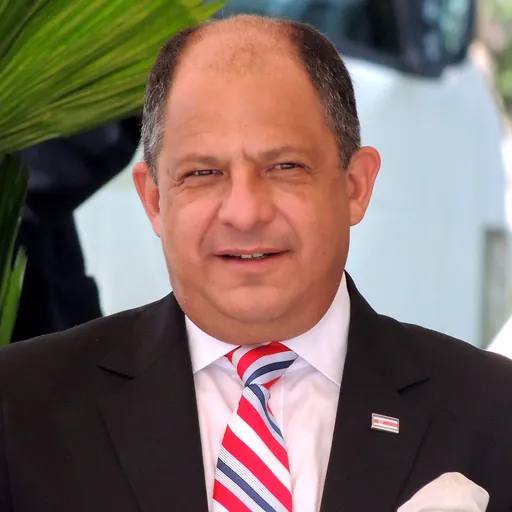
About Luis Guillermo Solís
Born 1958. Luis Guillermo Solís is a Costa Rican politician, historian, diplomat, university teacher, political scientist and researcher.
Early life, education, and academic career Solís was born in San José, Costa Rica, to Vivienne Rivera Allen, an educator, and Freddy Solís Avendaño, an uneducated shoemaker. Both his parents lived in Turrialba, and as such many residents consider him Turrialban. His maternal grandmother's family has Afro-Caribbean and Chinese roots, coming from Jamaica to Costa Rica in the early 1900s. Solís grew up in San Pedro de Montes de Oca and Curridabat, neighborhoods of San José. He attended Methodist High School in San José, where he was president of the student body, before studying history at the University of Costa Rica, where he earned a degree with academic honors in 1979. He earned a master's degree in Latin American Studies at Tulane University in New Orleans.
Solís has held various academic and consulting positions. Between 1981 and 1987, he was an associate professor at the University of Costa Rica. In addition, he was a Fulbright Scholar at the University of Michigan from 1983 to 1985. During this time, Solís worked with the Arias administration and eventually became director of the Center for Peace and Reconciliation (CPR for its Spanish initials). Solís went as far as to call the PLN leadership "Napoleonic" and "anti-democratic". Ottón Solís, one of PAC's founders and three-time presidential candidate, suggested that Luis Guillermo Solís run as a vice presidential candidate in 2010. Luis Guillermo Solis rejected the offer because he was working for the General Secretariat of Ibero-America (SEGIB for its Spanish initials), and employees of SEGIB were not allowed to participate in elections. Among his aims, Solís claimed he would clean up corruption, create major investments in infrastructure, and shore up Costa Rica's universal health care and social security system. He said that he would "put the brakes" on new free trade agreements and would begin correctly administrating current free trade agreements. As such, Solís received a tremendous amount of political support from the country's trade unions.
On 2 February 2014, Solís won the most votes in the election with 30.95 percent. PLN candidate Johnny Araya came second with 29.95 percent of the vote. Most of Solís' support came from the Central Valley provinces of San José, Alajuela, Heredia and Cartago.
Because no candidate exceeded 40 percent of the vote, a runoff was scheduled for 6 April, as required by the constitution. However, on 5 March, Araya announced that he would abandon his campaign after polls showed him far behind Solís; one poll showed him losing by over 43 percent. However, under Costa Rican law the runoff still had to take place, and Solís won with over 77 percent of the vote, the largest margin ever recorded for a free election in Costa Rica. Unlike the first round, Solís earned a majority in every province, including Puntarenas, Limón, and Guanacaste. When he took office on 8 May, he was the first president in 66 years not to come from the PLN or what is now the PUSC. For his part, Araya congratulated Solís on his victory, calling for national unity.
Presidency (2014–2018)
A little over a week before taking office, in April 2014, Solís announced the creation of his cabinet. His cabinet consists of mostly PAC members or non-aligned citizens. However, two PUSC members were also added: María del Rocío Sáenz, Abel Pacheco's former health minister, heads the Costa Rican Social Security System (Caja Costarricense del Seguro Social). Delia Villalobos, another former health minister, heads the Social Protection Council (Consejo de Seguridad).
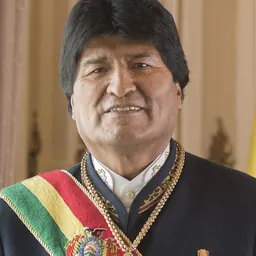
Solís took office on 8 May 2014, amid festive fanfare. Delegations from more than 80 countries attended his inauguration at La Sabana Metropolitan Park, including Prince Felipe de Borbón of Spain, Evo Morales of Bolivia, Rafael Correa of Ecuador, and the Secretary General of the Organization of American States, José Miguel Insulza. Solís said, in Costa Rican vernacular, that he is taking over a "weed farm" (finca encharralada),
Economic issues In 2014, President Solís presented a budget with an increase in spending of 19% for 2015, an increase of 0.5% for 2016 and an increase of 12% for 2017. When the 2017 budget was finally proposed, it totaled US$15.9 billion. Debt payments account for one-third of that amount. Of greater concern is the fact that a full 46% of the budget will require financing, a step that will increase the debt owed to foreign entities.
The country's credit rating was reduced by Moody's Investors Service in early 2017 to Ba2 from Ba1, with a negative outlook on the rating. The agency particularly cited the "rising government debt burden and persistently high fiscal deficit, which was 5.2% of GDP in 2016". Moody's was also concerned about the "lack of political consensus to implement measures to reduce the fiscal deficit [which] will result in further pressure on the government's debt ratios". In late July 2017, the Costa Rica Central Bank estimated the budget deficit at 6.1 percent of the country's GDP.
A 2017 study by the Organisation for Economic Co-operation and Development warned that reducing the foreign debt must be a very high priority for the government. Other fiscal reforms were also recommended to moderate the budget deficit.
Liquidity problems
In early August 2017, the President admitted that the country was facing a "liquidity crisis" and promised that a higher VAT tax and higher income tax rates were being considered by his government. Such steps are essential, Solís told the nation, because it was facing difficulties in paying its obligations and guaranteeing the provision of services."
He explained that the Treasury will prioritize payments on the public debt first, then salaries, pensions, and, finally, on infrastructure. The subsequent priorities include transfers to institutions "according to their social urgency." All other payments will be made only if funds are available.
Solís claims that economic neoliberalism has created too much income inequality for Costa Rica.
Solís supports environmental protections, which he believes Costa Rica has forgotten.
Solís is a Catholic. With regard to ethical issues, he also supports civil unions, and in-vitro fertilization.
Solís is not married to Mercedes Peñas Domingo, but during his administration, she was altogether considered the First Lady of Costa Rica. He and Peñas, who began dating in 2006, have one daughter, Inés.
Don’t just read it —
keep it.
Full-length biographies made to live with: read them, listen on the way to work, watch them tonight.
- E-book
- Audio
- Video
Instant download · yours to keep · every purchase keeps this site free
Important facts
Family & relationships
People in Luis Guillermo Solís's life
Named in this biography and alive at the same time





Related people
Same field, nearest in time



Contemporaries
People whose lives overlapped Luis Guillermo Solís's


Frequently asked questions
Who is Luis Guillermo Solís?
Costa Rican 47th president
When was Luis Guillermo Solís born?
Luis Guillermo Solís was born on 25 April 1958 in San José.
What is Luis Guillermo Solís's occupation?
Luis Guillermo Solís is a politician, historian, diplomat, university teacher, political scientist and researcher.
What nationality is Luis Guillermo Solís?
Luis Guillermo Solís is Costa Rican.
Sources & further reading
· Wikipedia: Luis Guillermo Solís
· DBpedia: Luis Guillermo Solís
Cite this page
APA: Biography.guide. (2026). Luis Guillermo Solís. https://biography.guide/luis-guillermo-solis/
MLA: "Luis Guillermo Solís." Biography.guide, https://biography.guide/luis-guillermo-solis/.
Chicago: "Luis Guillermo Solís." Biography.guide. https://biography.guide/luis-guillermo-solis/.
Data last updated: 2026-09-23 · Spot an error? Report a correction.
Portrait: Wikimedia Commons · author & licence
Page generated 2026-09-27 05:07 UTC